
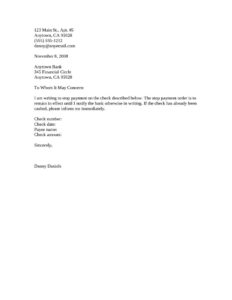
Stop Payment On Check
Use this free Stop Payment on Check letter template to formally request your bank halt a check before it clears — free download in PDF and DOCX.
DOCX
0
likes
Download Files
- DOCX
A Stop Payment on Check letter is a written request that instructs your bank to refuse payment on a specific check you’ve already written but no longer want honored. People most often use it after a check is lost, stolen, sent in error, or written to a payee they’re now in a dispute with. You can download this template free in PDF and DOCX, with no signup required.
What Is a Stop Payment on Check Letter?
A Stop Payment on Check letter is a formal notice from an account holder to their bank asking the bank not to pay a particular check when it is presented for payment. It identifies the exact check by number, date, payee, and amount so the bank can flag it in their system. Although many banks accept stop payment requests by phone or online, a written letter creates a clear, dated record of your instruction and is often required to keep the order in effect for an extended period. The letter in this template is issued by the customer and addressed to the bank’s branch, and it asks to be notified if the check has already cleared.
When Do You Need a Stop Payment on Check Letter?
This letter is useful any time you need to prevent a check from being cashed and want a documented record of the request. Common situations include:
- A lost or stolen check — you mailed or wrote a check that never reached the payee, or a blank check went missing.
- A payment error — you wrote the check for the wrong amount, the wrong date, or to the wrong payee.
- A duplicate payment — you accidentally paid the same bill or invoice twice and need to cancel one check.
- A service or goods dispute — you paid by check for work that was never completed or merchandise that wasn’t delivered.
- A canceled transaction — a sale, contract, or order fell through after the check was issued.
- Suspected fraud — you believe the check could be altered, forged, or cashed by someone other than the intended payee.
What a Stop Payment Letter Should Have
For the bank to act on your request, the letter must contain enough detail to identify one specific check without confusion. A complete stop payment letter includes your full name and contact information, your address, the date, and the bank’s name and branch address. The body should clearly state that you are requesting a stop payment, name the exact check, and indicate how long the order should remain in effect. It should also ask the bank to inform you immediately if the check has already been cashed, since a stop payment cannot reverse a check that has already cleared. Finally, it should be signed by the account holder.
How to Fill Out a Stop Payment on Check Letter
- Add your contact details. At the top, enter your name, street address (for example, 123 Main St., Apt. #5, Anytown, CA 95928), phone number, and email address so the bank can reach you with confirmation or questions.
- Date the letter. Write the current date, such as November 8, 2008 in the template, so there is a record of when the request was made.
- Address the bank. Enter the bank’s name and the branch address — for example, Anytown Bank, 345 Financial Circle, Anytown, CA 95928.
- Open with the request. The letter states you are writing to stop payment on the check described below and that the order remains in effect until you notify the bank otherwise in writing.
- Enter the check number. Copy the number printed in the upper or lower corner of the check.
- Enter the check date. Record the date written on the check itself.
- Enter the payee name. Write exactly who the check was made out to.
- Enter the check amount. State the dollar figure precisely.
- Sign the letter. Sign as the account holder (for example, Danny Daniels) and keep a copy for your records.
Fees, Timing, and How Long the Order Lasts
Most banks charge a fee to place a stop payment order, and the amount varies by institution and account type — check your bank’s fee schedule before you submit the request. Timing matters: a stop payment only works if the check has not already been presented and paid. That’s why this letter asks the bank to notify you immediately if the check has already been cashed. Stop payment orders are usually effective for a limited period — often six months — after which they may expire unless you renew them in writing. Because this template states the order remains in effect until you notify the bank otherwise in writing, confirm with your bank how their renewal process works so the check doesn’t slip through after the initial term.
Stop Payment vs. Canceling a Check
People sometimes confuse stopping payment with simply tearing up a check. If a check is in your possession, you can destroy it and no stop payment is needed. A stop payment is for checks that are out of your hands — mailed, lost, stolen, or held by a payee — where you cannot physically retrieve them. It’s also different from closing an account or reporting fraud; a stop payment targets one specific check rather than your entire account. If multiple checks are affected or your account information is compromised, talk to your bank about broader protective steps.
Common Mistakes to Avoid
- Acting too late. A check that has already cleared cannot be stopped — submit the request as soon as you decide to halt the payment.
- Wrong check details. A single incorrect digit in the check number or amount can cause the bank to miss the check and pay it anyway.
- Forgetting the payee name. Always include who the check was written to so the bank can match it accurately.
- Not keeping a copy. Save a signed copy and any confirmation the bank provides in case of a dispute.
- Assuming it’s permanent. Stop payment orders often expire; track the expiration date and renew if needed.
- Skipping the bank’s process. Some banks require their own form or a phone call in addition to a letter — confirm what your bank needs.
Frequently Asked Questions
What is a Stop Payment on Check letter? It is a written request telling your bank not to pay a specific check that you’ve already written. It identifies the check by number, date, payee, and amount so the bank can flag and refuse it when it is presented for payment.
How do I fill out the form? Add your name and contact details, the date, and the bank’s name and address, then enter the check number, check date, payee name, and amount. Sign the letter as the account holder and keep a copy for your records.
Does a stop payment letter need to be notarized? No, a stop payment request typically does not require notarization. It does need your signature as the account holder, and your bank may also ask you to confirm the request through their own form or by phone.
Can I stop a check that has already been cashed? No. Once a check has cleared, a stop payment cannot reverse it. That’s why this letter asks the bank to notify you immediately if the check has already been cashed so you can explore other options.
How long does a stop payment stay in effect? It varies by bank, but stop payment orders are often valid for around six months. Because this template states the order continues until you notify the bank in writing, confirm your bank’s renewal requirements to avoid the check being paid later.
How much does this template cost? The template is completely free to download here in both PDF and DOCX formats with no signup. Note that your bank may charge its own fee to place the actual stop payment order.
This template is a general example provided for informational purposes only and is not legal, financial, or banking advice. Stop payment fees, time limits, and procedures vary by bank and jurisdiction — consult your financial institution or a qualified professional for guidance specific to your situation.
Official resource: for the rules that apply to your situation, see the Consumer Financial Protection Bureau.
Related Forms
- Christmas Cash Envelope
- Hair Cash Envelope
- Debt Payment Organizer
- Consumer Equity Form
- Blank Cash Envelope
- Large-Print Bill Tracker
Browse more in Money.