
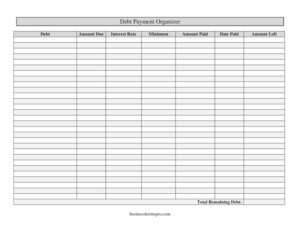
Debt Payment Organizer
Track every loan and credit card balance with this free Debt Payment Organizer template, monitor payments and payoff progress, in PDF and DOCX free download.
PDF
DOC
1 downloads
0
likes
Download Files
- DOC
A Debt Payment Organizer is a simple worksheet that lists every debt you owe, what you pay toward it, and how much is left, so you can manage payoff in one place. People most often use it to stop juggling scattered statements and finally see all their balances side by side. It’s free to download in PDF and DOCX, with no signup required.
What Is a Debt Payment Organizer?
A Debt Payment Organizer is a personal money tracking document used to record and monitor outstanding debts and the payments made against them. Anyone managing credit card balances, personal loans, student loans, medical bills, auto financing, or money owed to family can use it. Rather than being an official creditor document, it is a self-managed tool that captures each debt’s name, balance, interest rate, minimum payment, and the running total still owed. By updating it after each payment, you create a clear picture of your overall debt load and your progress over time. It turns vague worry into concrete numbers you can act on.
When Do You Need a Debt Payment Organizer?
- You have multiple debts across several lenders and keep losing track of due dates and balances.
- You want to start a payoff plan such as the debt snowball or debt avalanche and need to compare interest rates and balances.
- You’re consolidating bills and want a baseline of everything owed before you begin.
- You and a partner share finances and need one shared view of household debt.
- You’re rebuilding credit and want to document steady progress each month.
- You’re meeting with a credit counselor or financial coach and need an organized summary to bring along.
What a Debt Payment Organizer Should Have
A complete organizer captures both the standing details of each debt and the activity against it. The essential elements are the debt name (so each line is identifiable), the amount due or current balance, the interest rate, and the minimum payment required. It should also record the amount paid, the date paid, and the amount left after that payment. Finally, a total remaining debt figure ties everything together into one number you can watch shrink. Together these fields let you prioritize high-interest debts, confirm you’re meeting minimums, and measure momentum from one update to the next.
How to Fill Out a Debt Payment Organizer
- Debt: Write the name of each debt on its own row — for example “Visa card,” “Auto loan,” or “Medical bill, City Clinic.” Be specific enough to tell similar accounts apart.
- Amount Due: Enter the current outstanding balance for that debt from your latest statement.
- Interest Rate: Record the annual percentage rate (APR). This helps you decide which debts cost the most and should be targeted first.
- Minimum: Note the minimum monthly payment required so you never accidentally miss it.
- Amount Paid: When you make a payment, log how much you sent toward that debt.
- Date Paid: Enter the date the payment was made or cleared, creating a timeline of your activity.
- Amount Left: Subtract the amount paid from the prior balance and write the new remaining balance.
- Total Remaining Debt: Add up the “amount left” column across all rows to see your combined debt at a glance.
Choosing a Payoff Strategy With Your Organizer
Once every debt is listed, the organizer becomes a planning tool. Two popular approaches use the same data in different ways. The debt avalanche method sorts debts by interest rate and attacks the highest-rate balance first while paying minimums on the rest — this usually saves the most money over time. The debt snowball method instead targets the smallest balance first to build quick wins and motivation. Because your organizer already shows both interest rate and amount due for each line, you can sort by either column and decide which strategy fits your personality and budget. Whichever you choose, keep paying every minimum to avoid late fees, and direct any extra cash to your chosen priority debt.
Keeping the Organizer Accurate Over Time
The value of a Debt Payment Organizer comes from consistent updates. Set a recurring reminder — payday or the first of the month works well — to log payments and refresh balances. Interest accrues between statements, so your “amount left” is an estimate until the next statement confirms it; reconcile your numbers whenever a new statement arrives. If you open a new account or pay one off entirely, add or strike the row so the total stays honest. Many people keep both a printed copy on the fridge for visibility and a DOCX version on their computer for easy editing. Watching the total remaining debt drop month after month is often the strongest motivator to stay on plan.
Common Mistakes to Avoid
- Leaving out a debt because it feels small — every balance affects your total and your plan.
- Recording the statement balance but forgetting to subtract new payments, so the “amount left” stays stale.
- Ignoring the interest rate column, which is the key to deciding payoff order.
- Only paying the minimum on everything and never directing extra money toward a target debt.
- Forgetting to log the date paid, which makes it hard to confirm on-time payments later.
- Updating sporadically, so the total remaining debt no longer reflects reality.
Frequently Asked Questions
What is a Debt Payment Organizer used for? It is a worksheet for listing all your debts and tracking the payments you make against each one. It helps you see your total balance, compare interest rates, meet minimum payments, and measure payoff progress in a single document.
How do I fill out a Debt Payment Organizer? List each debt with its current balance, interest rate, and minimum payment, then log the amount and date of each payment along with the remaining balance. Finally, total the remaining balances to find your overall debt. Update it every time you pay.
Is this organizer a legal or official document? No. It is a personal money management tool for your own use, not a contract or a statement from a creditor. Your lenders’ statements remain the official record of what you owe.
Should I use the snowball or avalanche method? The avalanche method (highest interest first) generally saves the most in interest, while the snowball method (smallest balance first) offers quicker motivational wins. The organizer supports both because it tracks interest rate and balance for every debt.
How often should I update it? Update it each time you make a payment and reconcile balances whenever a new statement arrives, since interest changes the amount owed. A monthly review keeps your total remaining debt accurate and useful.
How much does this template cost? Nothing — it’s a free download in both PDF and DOCX with no signup required. You can print the PDF or edit the DOCX to add rows and customize it for your own debts.
This Debt Payment Organizer template is a general example provided for informational purposes only and is not financial, tax, or legal advice. Debt terms, interest calculations, and your best repayment strategy vary by lender and individual circumstances — consult a qualified financial professional for guidance specific to your situation.
Official resource: for the rules that apply to your situation, see the Consumer Financial Protection Bureau.
Related Forms
- Account Statement
- List of Accounts
- Accounts Receivable Ledger
- Hair Cash Envelope
- Credit Freeze Temporary Lift
- Roommate Expense Tracker
Browse more in Money.