
List of Accounts
Organize every bank, brokerage, and retirement account in one place with this free List of Accounts template — free download in PDF and DOCX.
PDF
DOCX
18 downloads
0
likes
Download Files
- DOCX
A List of Accounts is a master inventory that records every financial account you hold — banking, brokerage, retirement, and investment club accounts — along with the institutions, account numbers, holders, and login details tied to each. People most often use it to keep their finances organized in one secure document and to make sure a spouse, executor, or trusted person can locate accounts when needed. You can download this template free in PDF and DOCX, with no signup required.
What Is a List of Accounts?
A List of Accounts is a personal financial summary document that catalogs all the accounts a person or household owns. It captures the institution holding each account (bank, broker, or investment group), the account type and number, who the account holder and any joint holders are, and the credentials used to access the account online. It is not a legal instrument and it does not transfer money or ownership — instead it functions as a reference record. Individuals create it for their own planning, families build one for shared visibility, and estate planners often recommend keeping one alongside a will so that heirs are not left guessing about where assets are held.
When Do You Need a List of Accounts?
- Estate and emergency planning — so a spouse, executor, or power of attorney can find and access your accounts if you become incapacitated or pass away.
- Consolidating scattered finances — when you have bank, brokerage, and retirement accounts across multiple institutions and want one consolidated view.
- Year-end or tax preparation — to quickly reference every account number and institution your accountant may need.
- Tracking joint and shared accounts — documenting joint holders, contributors, and investment club members and their relationships to you.
- Reviewing investments — listing brokerage stocks, mutual funds, and margin versus cash accounts in one place for an annual portfolio review.
- Switching banks or advisors — having every account, credit card, and number ready when you move institutions or update beneficiaries.
What a List of Accounts Should Have
A complete List of Accounts groups information by account category and records enough detail to identify and access each one. For every entry you want the institution name and branch, the company address and website, the account holder and any joint holders or contributors, the account type and number, and login credentials such as username and password. For banking sections, include associated credit cards and their numbers. For brokerage and retirement sections, note whether the account is margin or cash, plus the underlying stocks, mutual funds, or retirement holdings. Because the document concentrates sensitive data in one place, it should also note where the original is stored and who is authorized to access it.
How to Fill Out a List of Accounts
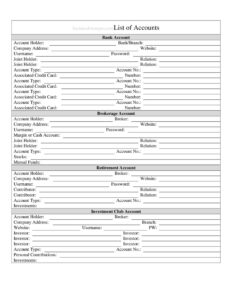
- Bank Account section: Enter the bank account name, the Account Holder, and the Bank/Branch. Add the Company Address and Website, then the online Username and Password.
- Joint holders: List each Joint Holder and their Relation to the primary holder (spouse, child, business partner).
- Account details: For each row, record the Account Type (checking, savings, money market), the Account No., and any Associated Credit Card with its Number. Repeat for additional bank accounts.
- Brokerage Account section: Enter the Account Holder, Broker, Company Address, Website, and login credentials. Mark whether it is a Margin or Cash Account, list joint holders and relations, then the Account Type, Account No., and the Stocks and Mutual Funds held.
- Retirement Account section: Record the holder, broker, address, website, and credentials, then each Contributor and Relation, plus the account type, number, and Investments.
- Investment Club Account section: Enter the broker, branch, website, login, every Investor, the account type and number, Personal Contributions, and Investments.
- Review and store: Double-check numbers, date the document, and place it somewhere secure.
Keeping the Document Secure
Because a List of Accounts gathers usernames, passwords, and account numbers in a single file, security matters as much as completeness. If you store it digitally, keep it in an encrypted file or a reputable password manager rather than an unprotected document on your desktop. If you keep a printed copy, place it in a locked safe, fireproof box, or safe deposit box, and tell only the people who genuinely need access where it lives. Avoid emailing the completed form or saving it to shared cloud folders. Review and update it at least once a year and whenever you open or close an account, change a password, or add a joint holder — outdated credentials defeat the document’s purpose.
How It Fits Into Estate Planning
A List of Accounts is not a will, trust, or beneficiary designation, and it does not by itself transfer assets to anyone. Instead it works alongside those documents as a practical roadmap. A will names who inherits, but an executor still has to locate the accounts — this list tells them exactly where to look. Keep it consistent with your actual beneficiary designations on retirement and brokerage accounts, since those designations, not this list, control who receives the funds. Many people store the list with their estate documents and reference it in conversations with their executor or financial power of attorney.
Common Mistakes to Avoid
- Letting it go stale — failing to update passwords, balances, or closed accounts so the information is unreliable when it matters.
- Storing it insecurely — leaving login credentials in plain text on a phone, email, or shared drive.
- Skipping account numbers — recording only the institution but not the actual account number, which limits how useful the list is.
- Omitting joint holders and contributors — not noting who else has rights to or contributes to an account.
- Forgetting associated credit cards — leaving off cards linked to bank accounts, which can cause confusion later.
- Telling no one it exists — building a thorough list but never informing the person who would actually need it.
Frequently Asked Questions
What is a List of Accounts used for? It is a personal reference that records all your financial accounts — banking, brokerage, retirement, and investment club — in one organized place. People use it for financial organization, tax prep, and estate planning so that they or a trusted person can quickly find and access accounts.
Is a List of Accounts a legal document? No. It is an informational record, not a contract or estate instrument. It does not transfer ownership or override beneficiary designations, but it is extremely useful alongside your will, trust, and power of attorney as a practical guide to where your assets are held.
Should I really write down my passwords? Only if you store the document securely. Recording credentials makes the list more useful in an emergency, but the completed file should be encrypted or kept in a locked location, and you should update passwords on the list whenever you change them.
Does this form need to be notarized? No, a List of Accounts does not require notarization or witnesses because it is a personal reference rather than a legal instrument. You may still date and sign it for your own records and consistency.
How often should I update it? Review it at least once a year and any time you open or close an account, change a password, add a joint holder or contributor, or switch institutions. An out-of-date list can be more misleading than helpful.
How much does this template cost? It is completely free to download here in both PDF and DOCX formats, with no signup required. You can fill out the PDF by hand or edit the DOCX version on your computer.
This List of Accounts template is a general example provided for informational purposes only and is not legal, financial, or tax advice. Requirements and best practices for recording and protecting financial information vary by situation and jurisdiction — consult a qualified attorney, financial advisor, or estate planning professional for guidance specific to your circumstances.
Official resource: for the rules that apply to your situation, see the Consumer Financial Protection Bureau.
Related Forms
- Side Hustle Income Tracker
- Zero-Based Budget
- Lump Sum Payment Planning Form
- Home Business Worksheet
- Employee Sales Commission Tracker
- Kids Cash Envelope
Browse more in Money.