
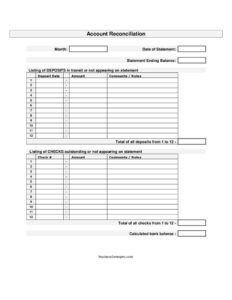
Account Reconciliation Form
Download a free Account Reconciliation Form template in PDF and DOCX to match your records to bank statements and catch errors fast — free download.
PDF
DOCX
4 downloads
0
likes
Download Files
- DOCX
An Account Reconciliation Form is a worksheet used to compare your internal financial records against a bank or account statement so that every deposit, check, and balance matches. People most often reach for it at the end of the month to confirm their books are accurate and to catch missing or duplicate transactions. You can download this template free in both PDF and DOCX formats, with no signup required.
What Is an Account Reconciliation Form?
An Account Reconciliation Form is a structured document that helps you verify that the balance in your records agrees with the balance shown on an official statement, such as a bank, credit card, or ledger account statement. It is used by bookkeepers, small business owners, treasurers, accountants, and individuals managing personal finances. The form documents each statement period, lists deposits and checks with their dates and amounts, and provides space for notes explaining any differences. By laying transactions side by side, it makes discrepancies easy to spot. The goal is a clean, reconciled balance — where your figures and the statement figures match exactly, leaving a clear paper trail of how you got there.
When Do You Need an Account Reconciliation Form?
Reconciliation is a routine control that keeps financial records trustworthy. You may need this form in situations such as:
- Completing your monthly bank reconciliation when a new statement arrives and you need to match it to your ledger.
- Closing the books at the end of a month, quarter, or year before preparing financial reports.
- Investigating a balance that does not match expectations, where a missing deposit or uncashed check may be the cause.
- Tracking outstanding checks that have been written but have not yet cleared the account.
- Confirming that all deposits recorded internally actually posted to the account on the expected dates.
- Preparing supporting documentation for an audit, a tax filing, or a review by a partner, lender, or accountant.
Whether you are reconciling a business operating account or a household budget, the form gives you a repeatable process you can follow every period.
What an Account Reconciliation Form Should Have
A complete reconciliation form ties your records to the statement clearly and leaves room to explain differences. Key elements include the reconciliation month so each form covers a defined period; the date of statement being reconciled; the starting and ending balance figures; an itemized list of deposits with their dates and amounts; a list of checks or withdrawals; and a comments/notes area for explaining variances, outstanding items, or follow-up actions. A good form also makes the math visible, so anyone reviewing it can trace how the beginning balance becomes the reconciled ending balance.
How to Fill Out an Account Reconciliation Form
- Enter the month you are reconciling at the top so the form is clearly labeled for that period.
- Record the date of statement printed on the bank or account statement you are working from.
- Write down the balance shown on the statement — this is the figure you are reconciling your records against.
- List each deposit by its deposit date, then enter the corresponding amount in the amount column.
- List each check or withdrawal, recording its number and amount so you can tell which items have cleared and which remain outstanding.
- Compare each transaction to your own ledger or accounting software, checking off matches as you go.
- Use the comments/notes column to flag anything unusual — an outstanding check, a deposit in transit, a bank fee, or an error to correct.
- Total the deposits and checks, apply them to the balance, and confirm your adjusted figure matches your records. Sign or initial and date the form when it balances.
Understanding Outstanding Items and Timing Differences
Most reconciliation differences come down to timing, not mistakes. A deposit in transit is money you recorded but the bank has not yet posted; an outstanding check is one you wrote that the recipient has not cashed. Both appear on your books but not yet on the statement, so they create a temporary gap. The comments column is the right place to note these items, because next month they should clear and the difference should disappear. Bank fees, interest, and automatic payments work the opposite way — they appear on the statement before you record them. Tracking each type separately helps you understand why the two balances differ and confirms the difference is expected rather than an error.
Tips for Faster, Cleaner Reconciliations
Reconcile on the same day each month so the task never piles up. Work from a printed or downloaded statement rather than memory, and check off each item as you match it to avoid double-counting. Keep prior months’ completed forms on file so you can carry forward outstanding checks and spot recurring issues. If a difference will not resolve, recheck for transposed digits — swapping two numbers produces an error divisible by nine, a quick clue. Finally, never force a balance: if it does not match, find the reason and note it rather than plugging a number to make it appear correct.
Common Mistakes to Avoid
- Skipping the statement date — without it you cannot tell which period the form covers or compare consecutive months.
- Omitting outstanding checks and deposits in transit, which makes the balances appear to disagree when the difference is simply timing.
- Recording amounts in the wrong column, mixing deposits with checks and throwing off the totals.
- Leaving the comments field blank when a discrepancy exists, so future reviewers cannot understand the variance.
- Forgetting bank fees, interest, or automatic charges that appear only on the statement.
- Forcing the numbers to match instead of investigating the underlying cause of a difference.
Frequently Asked Questions
What is an Account Reconciliation Form used for? It is used to compare your own financial records to an official account statement and confirm they agree. The form lists deposits, checks, balances, and notes so you can identify any differences and document how they were resolved. It creates a clear record that the period has been reviewed and balanced.
How do I fill out the Account Reconciliation Form? Start by entering the month and the statement date, then record the statement balance. List each deposit and check with its date and amount, match them against your ledger, and use the comments column to explain any unmatched items. When your adjusted figure equals your records, the account is reconciled.
How often should I reconcile an account? Most people reconcile monthly, as soon as a new statement is available, because shorter intervals make errors easier to find. Businesses with high transaction volume may reconcile weekly or even daily. Consistency matters more than frequency — pick a schedule and stick to it.
What if my balance does not match the statement? Differences are usually caused by outstanding checks, deposits in transit, bank fees, or recording errors. Review each transaction line by line and note unmatched items in the comments column. If a number is off by an amount divisible by nine, you may have transposed two digits somewhere.
Is this Account Reconciliation Form a legal or official document? It is an internal accounting worksheet, not a regulated legal filing. While it is not legally binding on its own, completed reconciliation forms are valuable supporting records for audits, tax preparation, and financial reviews. Keep them on file with your statements.
Is the template free to download? Yes. This Account Reconciliation Form is completely free to download in both PDF and DOCX formats, with no signup required. You can edit the DOCX version to add your own columns or print the PDF and fill it in by hand.
This template is a general example provided for informational purposes only and does not constitute accounting, financial, tax, or legal advice. Reconciliation practices and recordkeeping requirements vary by organization and jurisdiction — consult a qualified accountant or financial professional for guidance specific to your situation.
Official resource: for the rules that apply to your situation, see the Consumer Financial Protection Bureau.
Related Forms
- Tip Jar Labels
- Credit Change Notice
- Payment Calculator per $1000
- Loan Deferral Request
- Clothing Cash Envelope
- Accounts Receivable Ledger
Browse more in Money.