
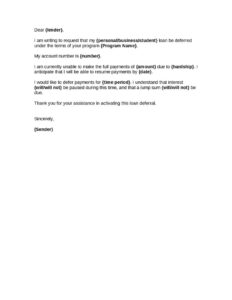
Loan Deferral Request
Download a free Loan Deferral Request template to formally ask your lender to pause or postpone payments — available as a free PDF and DOCX download.
DOCX
0
likes
Download Files
- DOCX
A Loan Deferral Request is a written request asking a lender to temporarily pause or postpone your loan payments, usually because of a short-term financial hardship. Most people use it when an unexpected event — job loss, illness, or reduced income — makes the regular payment schedule unmanageable for a few months. You can download this Loan Deferral Request template free in PDF and DOCX, with no signup required.
What Is a Loan Deferral Request?
A Loan Deferral Request is a formal letter or form submitted by a borrower to a lender, loan servicer, or financial institution asking to delay one or more scheduled payments. It documents the borrower’s circumstances, the specific relief being requested, and the proposed period of deferral. Unlike a casual phone call, a written request creates a paper trail showing exactly what was asked and when. The lender reviews the request and decides whether to grant the deferral, often adjusting the loan term, interest accrual, or repayment plan in response. It is commonly used for mortgages, auto loans, personal loans, and student loans whenever a borrower needs temporary breathing room without defaulting.
When Do You Need a Loan Deferral Request?
A deferral request is the right tool when you expect to resume payments but need a short pause. Common situations include:
- Job loss or reduced hours — when income drops suddenly and you need a month or two to recover before regular payments restart.
- Medical emergency — when illness or injury leads to large bills and lost wages at the same time.
- Natural disaster or property damage — when a storm, fire, or flood disrupts your finances and forces unexpected spending.
- Temporary business slowdown — for self-employed borrowers experiencing a seasonal or one-time dip in revenue.
- Unexpected major expense — such as a car repair, family emergency, or relocation cost that strains your budget.
- Transition between income sources — for example, waiting on a new job’s first paycheck or a delayed benefits payment.
What a Loan Deferral Request Should Have
A complete and persuasive deferral request includes a clear identification of you and the loan, a concise explanation of the hardship, and a specific request. Lenders move faster when the document leaves no ambiguity. At minimum, include your full name and contact details, the loan or account number, the lender’s name, the type of loan, the current payment amount and due date, the reason for the request, the number of payments or months you want deferred, and your proposed plan for resuming payments. Attaching brief supporting documentation — such as a termination letter, medical statement, or insurance claim — strengthens your case. A polite, professional tone and your dated signature complete the request.
How to Fill Out a Loan Deferral Request
- Add your information. Enter your full legal name, mailing address, phone number, and email so the lender can confirm your identity and reach you with a decision.
- Identify the lender. Write the lender or servicer’s name and address as they appear on your statement.
- Reference the loan. Include the loan or account number, the loan type (mortgage, auto, personal, student), and the original loan date if known.
- State the current terms. List your regular payment amount, the due date, and any payments already missed.
- Explain the hardship. In two or three sentences, describe what changed and why you cannot pay right now. Be honest and specific.
- Specify the request. State exactly how many payments or months you want deferred and the date you expect to resume.
- Propose a repayment plan. Note whether you can pay the deferred amount as a lump sum, add it to the end of the loan, or spread it across future payments.
- Attach evidence and sign. List any documents you are including, then date and sign the request.
Deferral vs. Forbearance vs. Modification
These terms are often confused, but they describe different forms of relief. A deferral generally postpones payments and moves them to a later point in the loan, often the end of the term, sometimes without additional interest. A forbearance temporarily reduces or pauses payments, but the skipped amount usually becomes due in a lump sum or spread over a short window once it ends, and interest typically continues to accrue. A loan modification permanently changes the loan’s terms — such as the interest rate, length, or monthly payment — and is meant for long-term affordability problems rather than a brief gap. Choosing the right request matters: ask for a deferral when you only need a short pause, and ask about modification when your hardship looks permanent.
After You Submit the Request
Submit the request through the channel your lender prefers — many accept email, an online portal, or mailed letters. Keep a copy of everything you send, along with the date. Follow up if you do not hear back within a week or two, since deferrals are time-sensitive when a payment is approaching. If the lender approves, ask for the new terms in writing, including how interest will be handled and exactly when payments resume. Continue making any payments you can until you receive written confirmation, because an unapproved request does not stop late fees or credit reporting.
Common Mistakes to Avoid
- Waiting until you are already past due — submit before you miss a payment, when lenders are more flexible.
- Being vague about the hardship — a clear, honest explanation is far more convincing than a generic excuse.
- Not stating a specific timeframe — always name how many months you need and when you’ll resume.
- Ignoring how interest accrues — confirm whether deferred interest is added to your balance.
- Forgetting to keep copies — without a record, you can’t prove what you requested or when.
- Assuming approval — keep paying what you can until the deferral is confirmed in writing.
Frequently Asked Questions
What is a Loan Deferral Request? It is a written request asking your lender to temporarily postpone one or more loan payments due to a short-term financial hardship. It documents your situation, the relief you want, and your plan to resume payments. Lenders use it to evaluate whether to grant the deferral.
How do I fill out a Loan Deferral Request? Enter your contact details, the lender’s name, and your loan or account number, then briefly explain your hardship. State how many payments or months you want deferred and when you’ll resume. Attach any supporting documents, then date and sign it before sending.
Will a deferral hurt my credit score? An approved deferral arranged with your lender generally should not be reported as a missed payment, but practices vary by lender and loan type. Always ask how the deferral will be reported and get the answer in writing. Skipping payments without approval, by contrast, can damage your credit.
Does interest keep building during a deferral? Often yes — many loans continue to accrue interest even while payments are paused, and that interest may be added to your balance. The exact treatment depends on your loan agreement and the lender’s terms. Confirm the details before agreeing so there are no surprises.
Is a Loan Deferral Request legally binding? The request itself is only a proposal; it is not binding until the lender approves it. Any deferral becomes effective when the lender confirms the new terms, ideally in writing. Until then, your original payment obligations remain in force.
How much does this template cost? Nothing — this Loan Deferral Request template is completely free to download in both PDF and DOCX formats with no signup required. You can edit the DOCX to match your loan and hardship details. Customize it as needed before submitting it to your lender.
This template is a general example provided for informational purposes only and is not legal, financial, or tax advice. Loan terms, deferral options, and credit reporting rules vary by lender and by jurisdiction. Consult your lender and a qualified financial or legal professional before relying on this document.
Official resource: for the rules that apply to your situation, see the Consumer Financial Protection Bureau.
Related Forms
- Debit Register Wallet
- Insurance Worksheet
- Full Page Check Register
- Why Denied Credit letter
- Home Budget Cuts Worksheet
- Debt Payment Organizer
Browse more in Money.