
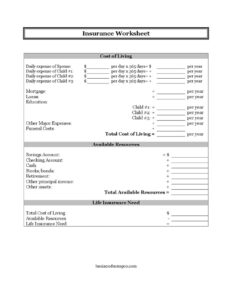
Insurance Worksheet
Use this free Insurance Worksheet template to estimate your family's cost of living, total resources, and life insurance need — free PDF and DOCX download.
PDF
DOCX
1 downloads
0
likes
Download Files
- DOCX
An Insurance Worksheet is a simple planning tool that helps you estimate how much life insurance coverage your family would need to maintain its standard of living if you were no longer there to provide for them. The most common reason people use it is to translate vague worry about “having enough coverage” into a concrete dollar figure based on real expenses and assets. This template is free to download in both PDF and DOCX formats with no signup required.
What Is an Insurance Worksheet?
An Insurance Worksheet is a self-completed financial planning document that compares your household’s ongoing costs against the resources your family already has, then calculates the gap that life insurance would need to fill. It is typically used by individuals, couples, and parents — often with help from a financial planner or insurance agent — to size a policy before shopping for quotes. The worksheet documents three things: your family’s annual cost of living, the assets available to cover those costs, and the resulting life insurance need. It is not a binding contract or an application; it is a working estimate that guides smarter decisions about coverage amounts and policy types.
When Do You Need an Insurance Worksheet?
This worksheet is useful any time your financial responsibilities change or you want to verify that existing coverage is adequate. Common situations include:
- Getting married or moving in together and wanting to protect a spouse who depends on your income.
- Having a baby or adopting, when new daily expenses and future education costs enter the picture.
- Buying a home with a mortgage you would not want your family to carry alone.
- Reviewing coverage at renewal to make sure an old policy still matches your current obligations.
- Meeting with a financial advisor or insurance agent and wanting to arrive prepared with your own numbers.
- Estate and family planning, where you want to leave enough behind to cover funeral costs and outstanding loans.
What an Insurance Worksheet Should Have
A complete Insurance Worksheet is built around three clearly separated sections. The first is Cost of Living, which captures recurring family expenses, debts, future education costs, and one-time funeral costs. The second is Available Resources, which lists liquid and invested assets your family could draw on. The third is the Life Insurance Need calculation, which subtracts resources from costs to reveal the coverage gap. A useful worksheet also annualizes daily expenses (multiplying by 365) so every line shares the same time frame, and it provides separate lines for each child so growing families can keep figures accurate.
How to Fill Out an Insurance Worksheet
- Spouse daily expense: Enter your spouse’s estimated daily living cost, multiply by 365, and write the yearly figure.
- Children’s daily expenses: Repeat the same daily-times-365 calculation for Child #1, Child #2, and Child #3, adding each yearly amount.
- Mortgage and loans: Add the annual cost of your mortgage and any other loans you want covered.
- Education: Enter projected yearly education costs for each child you wish to fund.
- Other major expenses: Include any large recurring costs not yet listed.
- Funeral costs: Add a one-time estimate for final expenses.
- Total Cost of Living: Sum all the lines above for your annual cost figure.
- Available Resources: List savings, checking, cash, stocks and bonds, retirement, other principal income, and other assets, then total them.
- Life Insurance Need: Subtract Total Available Resources from Total Cost of Living to find your estimated coverage gap.
Understanding the Cost-of-Living Side
The cost-of-living section is where most people either over- or underestimate their needs, so it deserves careful thought. Daily expenses should reflect real spending — food, utilities, transportation, childcare, and routine bills — rather than an optimistic budget. Multiplying by 365 gives an annual snapshot, but remember that some costs, like a mortgage or education, may run for many years. If you want coverage that replaces income for a decade or more, consider multiplying the annual total by the number of years you want it to last, then subtracting resources. Funeral costs are entered as a single lump sum because they are a one-time event, not a recurring expense.
Reading the Final Number
The bottom of the worksheet produces your Life Insurance Need: the difference between what your family would need and what it already has. A positive number means there is a gap a policy could fill, while a number at or below zero suggests your existing assets may already cover the projected costs. Treat this figure as a starting point for conversations with an agent, not a final verdict — factors like inflation, future income growth, and changing family circumstances all influence how much coverage actually makes sense. Revisiting the worksheet every couple of years keeps your estimate aligned with reality.
Common Mistakes to Avoid
- Mixing time frames — entering some expenses as daily and others as yearly without converting them consistently.
- Forgetting future costs like a child’s college education that hasn’t started yet.
- Double-counting assets by listing the same account under multiple resource lines.
- Overstating liquid resources, such as counting retirement funds that carry penalties or restrictions.
- Ignoring inflation, which can erode the value of a fixed coverage amount over many years.
- Treating the result as final rather than as an estimate to refine with a professional.
Frequently Asked Questions
What is an Insurance Worksheet used for? It is used to estimate how much life insurance coverage a person should carry by comparing their family’s projected cost of living against the assets already available. The worksheet turns scattered financial details into a single coverage-need figure that guides policy shopping.
How do I calculate my life insurance need with this worksheet? Total your annual cost of living, including daily expenses, mortgage, loans, education, and funeral costs. Then total your available resources such as savings, investments, and retirement. Subtract the resources from the costs, and the remainder is your estimated life insurance need.
Does this worksheet replace advice from an insurance agent? No. The worksheet is a self-assessment tool that helps you understand your situation, but it does not account for every variable an agent or financial planner would consider, such as inflation, tax treatment, and policy structure. Use it as preparation for that conversation, not a substitute.
Is the Insurance Worksheet legally binding? No. It is a personal planning document, not a contract, application, or policy. Filling it out creates no obligation and does not affect any existing or future insurance coverage.
How often should I update my Insurance Worksheet? Review it whenever a major life event occurs — marriage, a new child, a home purchase, or a significant change in income or debt. Even without big changes, revisiting it every two to three years helps keep your coverage estimate accurate.
How much does this Insurance Worksheet cost? Nothing. It is completely free to download here in both PDF and DOCX formats, with no signup or payment required, so you can print it or fill it out digitally.
This template is a general example provided for informational purposes only and is not insurance, financial, or tax advice. Coverage needs and product options vary by individual circumstance and jurisdiction, so consult a licensed insurance professional or qualified financial advisor before making decisions.
Official resource: for the rules that apply to your situation, see the Consumer Financial Protection Bureau.
Related Forms
- Customer Credit Analysis
- Credit Memo
- Accounts Receivable Form
- Appointment Of Collection Agent
- Quarterly Tax Payment Worksheet
- Dependent Care Claim Form
Browse more in Money.