
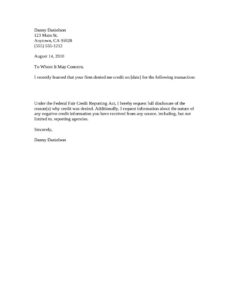
Why Denied Credit letter
Use this free Why Denied Credit letter template to request the reasons a lender refused you credit under the Fair Credit Reporting Act — free download.
DOCX
2 downloads
0
likes
Download Files
- DOCX
A Why Denied Credit letter is a written request you send to a lender or creditor asking them to explain, in detail, why your credit application was rejected. People most often use it after receiving a denial and wanting the specific reasons — and the negative information behind them — so they can correct errors or improve their standing. You can download this template free in PDF and DOCX, with no signup required.
What Is a Why Denied Credit Letter?
A Why Denied Credit letter is a formal consumer letter addressed to a creditor, bank, card issuer, or finance company that turned down a credit request. It documents the date of the denied transaction and invokes the consumer’s right under the federal Fair Credit Reporting Act (FCRA) to learn why credit was refused. The letter asks the creditor to disclose the reasons for denial and the nature of any negative information they relied on — including data received from credit reporting agencies. Individuals issue it on their own behalf, often after a loan, credit card, or financing application is declined. It creates a paper trail and prompts a written response you can use to dispute inaccuracies or address legitimate concerns.
When Do You Need a Why Denied Credit Letter?
This letter is useful any time a credit decision goes against you and the explanation you received feels vague or incomplete. Common situations include:
- A credit card application was declined and the form letter you received only said “based on information in your credit report.”
- An auto loan or financing offer at a dealership fell through and you want the precise reasons.
- A mortgage pre-approval or personal loan was denied and you suspect a reporting error caused it.
- You were approved but at far worse terms (higher rate, lower limit) and want to understand the negative factors.
- You believe identity theft or a mixed credit file may have damaged your application.
- You are rebuilding credit and need a clear list of what creditors are flagging so you can fix it.
What a Why Denied Credit Letter Should Have
To get a useful response, your letter should clearly identify you, the transaction, and your legal request. A complete letter includes:
- Your full name and current mailing address so the creditor can respond.
- A phone number where they can reach you with questions.
- The date you send the letter.
- A clear statement of the date credit was denied and a description of the transaction.
- A direct request for full disclosure of the reasons for denial under the Fair Credit Reporting Act.
- A request for the nature of any negative information used, including data from reporting agencies.
- Your signature and printed name to authenticate the request.
How to Fill Out a Why Denied Credit Letter
- At the top, replace the sample sender block (“Danny Danielson, 123 Main St., Anytown, CA 95928, (555) 555-1212”) with your own full name, street address, city, state, ZIP, and phone number.
- Update the date line to the day you actually mail or send the letter.
- Keep or adjust the salutation. “To Whom It May Concern” works, but if you know a specific department or contact, address them directly.
- In the body, fill in the bracketed [date] with the exact date you were denied credit, as shown on your denial notice.
- Complete the transaction description — for example, “a $10,000 auto loan application” or “a new credit card account” — so the creditor can locate your file.
- Leave the FCRA request language intact, since it states your right to disclosure of the reasons and any negative information.
- Sign above your printed name (“Sincerely, [Your Name]”) and keep a copy for your records.
Your Rights Under the Fair Credit Reporting Act
The FCRA gives consumers important protections when credit is denied. If a creditor relied on a credit report, they must provide an adverse action notice telling you which credit reporting agency supplied the information and how to reach it. You are also entitled to a free copy of the report that was used, generally if you request it within 60 days of the denial. This letter complements those rights by asking the creditor directly to spell out the reasons and the negative information involved. Knowing the specific factors — late payments, high balances, short credit history, or a reporting error — lets you take targeted action rather than guessing.
What to Do After You Get a Response
Once the creditor replies, review the stated reasons carefully against your own records and a current copy of your credit report. If you find inaccurate or outdated information, file a dispute with the relevant credit reporting agency to have it investigated and corrected. If the reasons are legitimate, use them as a roadmap: pay down balances, bring accounts current, or wait until negative marks age off. Keep every letter and response together so you can show a consistent history if you reapply or escalate a complaint. Sending requests by mail with delivery confirmation helps prove the creditor received your inquiry.
Common Mistakes to Avoid
- Leaving the bracketed [date] blank or vague — without the denial date, the creditor may not match your request to a file.
- Forgetting to describe the transaction, which makes it harder for the creditor to locate the application.
- Sending the letter to the wrong address rather than the creditor’s customer service or compliance department.
- Waiting too long, since some rights to a free report are time-limited after a denial.
- Failing to keep a copy of the letter and proof of mailing for your records.
- Removing the FCRA language, which is what frames your request as a legal right rather than a casual question.
Frequently Asked Questions
What is a Why Denied Credit letter? It is a formal letter you send to a creditor that rejected your credit application, asking them to explain the specific reasons and to disclose any negative information they used. It relies on your rights under the federal Fair Credit Reporting Act. The goal is to get a clear, written explanation you can act on.
How do I fill out this letter? Add your name, address, phone number, and the date at the top, then enter the date credit was denied and a short description of the transaction in the body. Keep the FCRA request language, sign at the bottom, and keep a copy. The template guides you to each spot.
Does this letter need to be notarized or witnessed? No. A Why Denied Credit letter is a consumer request and does not require notarization or witnesses to be valid. Your signature and accurate contact details are enough.
Is the creditor legally required to respond? Under the FCRA, a creditor who takes adverse action based on a credit report generally must provide an adverse action notice with the source of the information and your rights. This letter formally requests the reasons and negative details. Specific obligations and timeframes vary, so check current federal rules.
How much does this template cost? It is completely free to download here in PDF and DOCX formats, with no signup or account required. You can edit it in a word processor or print it and fill it in by hand.
When should I send it? Send it as soon as possible after receiving a credit denial, since some rights to a free credit report are time-limited — often within 60 days of the adverse action notice. Acting quickly also helps you correct errors before reapplying.
This template is a general example provided for informational purposes only and is not legal, financial, or tax advice. Consumer credit rules and Fair Credit Reporting Act requirements vary by jurisdiction and change over time. Consult a qualified attorney or credit professional for guidance on your specific situation.
Official resource: for the rules that apply to your situation, see the Consumer Financial Protection Bureau.
Related Forms
- Blank Cash Envelope
- Roommate Utilities Tracker
- Zero-Based Budget
- Theme Park Cash Envelope
- Profit And Loss Worksheet
- Payment Calculator per $10000
Browse more in Money.