
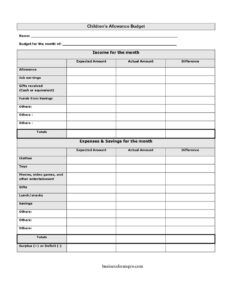
Childrens Allowance Budget
Use our free Children's Allowance Budget template to help kids track income, expenses, and savings each month — free download in PDF and DOCX.
PDF
DOCX
2 downloads
0
likes
Download Files
- DOCX
A Children’s Allowance Budget is a simple, kid-friendly worksheet that helps a child plan and track the money they earn or receive each month against what they spend and save. Parents most often use it to teach money skills — turning a weekly allowance into a hands-on lesson about choices, saving, and living within a limit. It’s free to download here in both PDF and DOCX formats, with no signup required.
What Is a Children’s Allowance Budget?
A Children’s Allowance Budget is a one-page money plan designed for young people, usually filled in with a parent or guardian. It lists where the child’s money comes from — allowance, small job earnings, gifts, and savings — and where it goes, such as toys, movies, snacks, and saving for the future. By comparing an expected amount to the actual amount and showing the difference, it teaches the same planning skills adults use, scaled down to a child’s world. It isn’t a legal or banking document; it’s an educational tool that builds the habit of thinking before spending and watching whether the month ends in a surplus or a deficit.
When Do You Need a Children’s Allowance Budget?
This worksheet is useful any time you want to give money lessons a structure children can actually see and follow. Common situations include:
- You’ve just started giving a regular weekly or monthly allowance and want your child to plan how to use it.
- Your child is saving toward a specific goal — a video game, a toy, or a gift for someone — and needs to see how long it will take.
- A birthday or holiday brought in gift money, and you want to help decide how much to spend versus save.
- Your child earns small amounts from chores, a lemonade stand, or odd jobs and you want a place to record it.
- You’re homeschooling or teaching a financial-literacy lesson and need a printable, age-appropriate budget.
- You want to compare month to month so your child can see whether their spending habits are improving.
What a Children’s Allowance Budget Should Have
A complete worksheet covers four basics so the math always balances. First, the child’s name and the month being budgeted, so old sheets don’t get mixed up. Second, an income section that captures every dollar coming in — allowance, job earnings, gifts, and money pulled from savings. Third, an expenses-and-savings section broken into categories a child recognizes, like clothes, toys, entertainment, lunch and snacks, gifts, and a dedicated savings line. Fourth, a comparison of expected versus actual amounts with a running difference, plus a final total that reveals a surplus (money left over) or a deficit (overspending).
How to Fill Out a Children’s Allowance Budget
- Write the child’s name and the budget for the month of at the top.
- In the income section, enter the income for the month and break it down: list the allowance, any job earnings, gifts received (cash or equivalent), funds from savings, and anything else under others.
- For each income line, fill in the expected amount you planned at the start, then the actual amount once the month ends, and note the difference.
- Move to expenses & savings for the month and estimate each category: clothes, toys, movies, video games, and other entertainment, gifts, lunch/snacks, savings, and others.
- Record actual spending in each category as it happens, then compare against the expected figures.
- Add everything into the total rows for income and for expenses.
- Subtract total expenses from total income to find the surplus or deficit — money left over, or an overspend to fix next month.
Making It a Teaching Tool
The real value of this worksheet isn’t the numbers — it’s the conversation around them. Before the month starts, sit down together and let your child decide how to split their money among the categories. Encourage them to give the savings line a real number rather than leaving it for whatever’s left, since paying yourself first is a habit worth learning early. When a category like movies, video games, and other entertainment runs over, resist the urge to rescue it; instead, point to the difference column and talk about what they’d trade off next time. Over a few months, the columns tell a story your child can read on their own.
Expected vs. Actual: Why the Difference Matters
Many kids’ budgets only track what was spent. This one deliberately separates the expected amount from the actual amount because the gap between a plan and reality is where learning happens. A child who expected to spend $5 on snacks but actually spent $12 sees, in plain numbers, why their savings goal slipped. Reviewing the surplus or deficit line at the end of each month — and celebrating a surplus rather than only flagging a deficit — keeps the exercise positive and motivating.
Common Mistakes to Avoid
- Filling in only the expected amounts and never going back to record the actual numbers, which defeats the purpose.
- Forgetting to count gift money or job earnings as income, so the totals don’t match real life.
- Leaving the savings line blank or treating it as an afterthought instead of a planned amount.
- Letting the parent do all the work — the child should hold the pencil and own the choices.
- Mixing two different months on the same sheet instead of starting a fresh one for each month.
- Punishing a deficit harshly; it’s better used as a calm lesson about adjusting next month’s plan.
Frequently Asked Questions
What is a Children’s Allowance Budget used for? It’s an educational worksheet that helps a child plan how to use their allowance, earnings, and gift money each month. It tracks income against spending and savings so kids can see the results of their choices. The goal is to build money habits early in a low-stakes, visual way.
What age is this budget appropriate for? It works well for elementary and middle-school children who are starting to handle their own money, typically around ages 6 to 14. Younger kids may need a parent to read the categories and help with the math, while older kids can fill it in mostly on their own. Adjust the categories and amounts to fit your child’s situation.
How do I calculate the surplus or deficit? Add up all the income lines for your total income, then add up all the expense and savings lines for total expenses. Subtract total expenses from total income: a positive result is a surplus and a negative result is a deficit. The worksheet has a dedicated line so the answer is easy to find each month.
Should savings be listed as an expense? On this worksheet, savings sits in the expenses-and-savings section so it gets a planned amount rather than only leftover money. Treating saving as a deliberate “spending” decision teaches children to set money aside first. You can keep a separate running total elsewhere to watch the savings goal grow over time.
Is this a legal or financial document? No. It is a personal teaching and planning tool, not a contract, bank statement, or anything legally binding. Nothing entered on it creates an obligation — it simply records a child’s money for educational purposes.
How much does the template cost? It’s completely free to download from Business Forms Pro in both PDF and DOCX formats, with no signup required. The PDF is ready to print and fill in by hand, while the editable DOCX lets you rename categories or adjust the layout for your family. You can reuse it every month at no cost.
This Children’s Allowance Budget template is a general example provided for informational and educational purposes only. It is not financial advice, and family money practices vary widely. For guidance tailored to your situation, consult a qualified professional.
Official resource: for the rules that apply to your situation, see the Consumer Financial Protection Bureau.
Related Forms
- Savings Passbook
- Christmas Cash Envelope
- Cash Receipts
- Payroll Budget Estimate
- Petty Cash Voucher
- Petty Cash
Browse more in Money.