
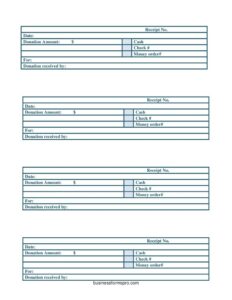
Cash Receipts
Free cash receipt template in PDF & DOCX. Learn what cash receipts are, how to fill one out, and how to use them for payments and donations — download today.
PDF
DOCX
2 downloads
0
likes
Download Files
- DOCX
A cash receipt is a written record that money was received — for a sale, a payment, or a donation — given to the payer and kept by the recipient. This template records every detail and works well for donations and contributions. Download it free in PDF or DOCX. No signup or email required.
What Are Cash Receipts?
A cash receipt is proof that money changed hands. When a business or organization receives a payment — whether in cash, by check, or by money order — it issues a receipt that records how much was received, when, from whom, and what for. The payer keeps it as proof they paid, and the recipient keeps a copy as part of their financial records. The term “cash receipts” also describes the broader category of all money a business takes in, which is tracked together in a cash receipts journal. Either way, the humble receipt is the building block: it’s the original evidence behind every dollar recorded as income.
Cash Receipt vs. Cash Receipts Journal
It helps to separate the two. A cash receipt is the individual document handed over each time money is received. A cash receipts journal is the running ledger where all of those receipts are recorded together, so a business can total its incoming cash for a day, week, or month. The receipt comes first — it captures one transaction — and the journal aggregates many receipts into the accounting records. Keeping accurate individual receipts is what makes the journal, and ultimately the books, trustworthy.
When Do You Use a Cash Receipt?
- Recording a cash, check, or money-order payment from a customer
- Issuing proof of a donation or contribution to a nonprofit or charity
- Giving a tenant or client a receipt for a payment made
- Keeping a record of money received for your own bookkeeping
- Providing documentation a donor or payer may need for tax purposes
What a Cash Receipt Includes
A complete receipt leaves no doubt about the transaction. The template above captures a receipt number (for tracking and sequencing), the date, and the amount received. It records the payment method — cash, check number, or money order number — what the payment was for, and who it was received by. For organizations that take donations, the same fields work perfectly: the amount becomes the donation amount, and the “received by” line shows who accepted it on the organization’s behalf.
How to Fill Out a Cash Receipt
- Enter a unique receipt number so the receipt can be tracked and filed in order.
- Write the date the money was received.
- Record the amount received.
- Mark the payment method — cash, the check number, or the money-order number.
- Note what the payment or donation was for.
- Add who it was received by, and give the original to the payer while keeping a copy.
Using Cash Receipts for Donations
For charities, churches, and nonprofits, cash receipts do double duty as donation records. A donor who gives cash or a check often needs written acknowledgment, both for their own records and potentially for claiming a tax deduction. Issuing a clear receipt — with the amount, date, and your organization’s details — gives donors that proof and shows your group keeps proper records. Keep your copies organized, because they’re also what you’ll use to reconcile total donations and report them accurately at year-end.
Why Cash Receipts Matter
Cash is the hardest money to track, because unlike a card payment there’s no automatic electronic trail. A receipt creates that trail by hand. Issuing one for every payment protects both sides: the payer has proof they paid, and you have evidence of what you took in. Sequentially numbered receipts also make it obvious if one is missing, which is a simple but powerful control against errors and theft. At reconciliation time, your receipts should match the cash actually in hand and the totals in your books — and when they don’t, the receipts are how you find the gap.
Common Mistakes to Avoid
- Skipping the receipt for “small” cash payments, leaving no record
- Reusing or duplicating receipt numbers, which breaks tracking
- Forgetting to note the payment method or what it was for
- Not keeping a copy for your own records
- Letting receipts pile up instead of recording them in your books promptly
Cash Receipt vs. Sales Receipt
The two overlap but aren’t identical. A sales receipt is given specifically when a product or service is sold, and it usually itemizes exactly what was bought. A cash receipt is broader — it acknowledges that money was received by any method recorded as cash (including checks and money orders) for any reason, whether a sale, a loan repayment, a deposit, or a donation. In everyday use the terms are often interchangeable, and a single receipt can serve both purposes. What matters most is that every payment you take in is acknowledged in writing and recorded, so your income is fully and accurately documented and nothing slips through untracked.
Frequently Asked Questions
What are cash receipts? They’re written records that money was received — for a sale, payment, or donation — showing the amount, date, payer, and purpose. The payer keeps one copy and the recipient keeps another.
What’s the difference between a cash receipt and a cash receipts journal? A cash receipt is the individual document for one payment; the cash receipts journal is the ledger where all receipts are recorded together to total incoming cash.
Can I use this as a donation receipt? Yes. The fields work perfectly for donations — record the donation amount, date, what it was for, and who received it, then give the donor a copy as their proof.
How do you reconcile cash receipts? Compare your receipts and recorded totals against the actual cash and deposits for the period. They should match; any difference points to a missing receipt or an unrecorded transaction.
Why are cash receipts important? Cash leaves no automatic trail, so a receipt is the only proof a payment happened. Numbered receipts also help catch errors or missing funds.
How much does this template cost? It’s free to download in PDF and DOCX.
Related Forms
Petty Cash · Check Register · Donation Record · Account Reconciliation Form · Daily Cash Sheet
This template is provided for general informational purposes only and is not financial, accounting, or tax advice. For donation tax-deductibility rules, consult a qualified professional.
Official resource: for the rules that apply to your situation, see the Consumer Financial Protection Bureau.
Related Forms
- Stop Payment On Check
- Daily Sales Commission Tracker
- Roommate Utilities Tracker
- Payment Calculator per $100
- Credit Change Notice
- Theme Park Cash Envelope
Browse more in Money.