
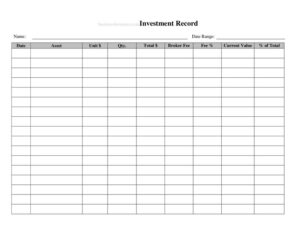
Investment Record
Track stocks, funds, and other holdings with our free Investment Record template—organize your portfolio in PDF or DOCX with free download.
PDF
DOCX
7 downloads
0
likes
Download Files
- DOCX
An Investment Record is a simple document for logging the details of every investment you own, from stocks and mutual funds to bonds, CDs, and retirement accounts. People most often use it to keep one organized, up-to-date summary of their portfolio for tax preparation, estate planning, or routine financial review. You can download this Investment Record template free in PDF or DOCX, with no signup required.
What Is an Investment Record?
An Investment Record is a personal financial worksheet that captures the key facts about each holding in your portfolio: what you bought, when you bought it, how much you paid, where it is held, and how it has performed. It is not a brokerage statement or an official tax form—it is a centralized log you maintain yourself so that all your scattered account information lives in one place. Individuals, families, small-business owners, and executors use it to monitor performance, calculate cost basis, and make sure nothing is overlooked. Because it consolidates account numbers, custodians, and purchase histories, it doubles as a reference for heirs and financial advisors who may need a complete picture of your assets.
When Do You Need an Investment Record?
Keeping a written Investment Record becomes valuable in many everyday situations. Common reasons to start one include:
- Tax season: You need cost basis, purchase dates, and dividend totals to report capital gains, losses, and income accurately.
- Portfolio review: You want a single snapshot of every holding to check your asset allocation and rebalance.
- Estate and legacy planning: You are documenting assets so an executor, trustee, or family member can locate and value your investments.
- Switching advisors or brokerages: You are transferring accounts and need a clean record of what you hold and its original cost.
- Tracking multiple accounts: You have holdings spread across several brokers, retirement plans, and apps, and statements never line up.
- Loan or net-worth applications: A lender or financial planner asks for a summary of your investable assets.
Types of Investments to Log
One Investment Record can hold many asset categories. Typical entries include individual stocks, exchange-traded funds (ETFs), mutual funds, bonds and treasury notes, certificates of deposit, money-market accounts, retirement accounts such as IRAs and 401(k)s, real estate investment trusts (REITs), and alternative holdings like precious metals or private equity. Grouping similar assets together makes it easier to see how much of your portfolio sits in each category.
What an Investment Record Should Have
A complete Investment Record gives you enough detail to value and report each holding without digging through old statements. The core elements are:
- Investment name and type (e.g., “Apple Inc. – stock” or “Vanguard 500 Index – mutual fund”).
- Ticker symbol or identifier where applicable.
- Account and custodian holding the asset, plus the account number.
- Purchase date and purchase price per share or unit.
- Quantity of shares or units owned.
- Total cost (cost basis) including commissions or fees.
- Current value and the date you recorded it.
- Income received, such as dividends or interest.
- Notes for maturity dates, beneficiaries, or reinvestment settings.
How to Fill Out an Investment Record
Work through the template one holding at a time, using your latest brokerage or account statement as a reference:
- Enter the investment name and type. Write the full name and classify it (stock, bond, fund, CD, etc.) so categories are easy to total later.
- Add the ticker or identifier. Record the ticker symbol, CUSIP, or fund number to avoid confusing similarly named holdings.
- List the account and custodian. Note which brokerage, bank, or plan holds it and the corresponding account number.
- Record the purchase date. Use the original acquisition date—important for short- versus long-term tax treatment.
- Enter purchase price and quantity. Log the price per share and the number of shares or units bought.
- Calculate total cost basis. Multiply price by quantity and add any commissions or transaction fees.
- Fill in current value and date. Look up today’s price, multiply by your holdings, and note the date you checked.
- Track income. Add dividends, interest, or distributions received during the period.
- Use the notes field for beneficiaries, maturity dates, automatic reinvestment, or reminders.
Keeping Your Record Accurate and Secure
An Investment Record is only useful if it stays current and protected. Set a regular cadence—monthly or quarterly—to update current values and log any new purchases, sales, or dividends. After you sell a position, keep the original entry but mark it as closed and note the sale date and proceeds; this preserves the history you will need for tax reporting. Because the document contains account numbers and balances, store it securely: keep printed copies in a locked location and protect digital files with a password or encrypted folder. Let a trusted family member or executor know where to find it without leaving sensitive details exposed.
Common Mistakes to Avoid
- Forgetting to record cost basis: Without the original purchase price and fees, calculating capital gains at tax time becomes guesswork.
- Mixing up purchase dates: Inaccurate dates can lead to misclassifying long-term and short-term gains.
- Letting values go stale: An outdated record gives a misleading view of your net worth and allocation.
- Omitting reinvested dividends: These increase your cost basis; leaving them out can overstate taxable gains.
- Not noting account custodians: Heirs or advisors may struggle to locate assets without the institution and account number.
- Storing it carelessly: Account numbers in an unsecured file are an identity-theft risk.
Frequently Asked Questions
What is an Investment Record used for? It is a personal log that consolidates the details of all your investments in one place. People use it for tax preparation, portfolio reviews, estate planning, and to keep track of holdings spread across multiple accounts and custodians.
How do I fill out an Investment Record? Work through each holding using your latest statement, entering the investment name, type, ticker, account, purchase date, price, quantity, cost basis, current value, and any income. Update the current values periodically so the record stays accurate.
Is an Investment Record a legal or official document? No. It is a private worksheet you maintain for your own reference; it is not an official tax form or brokerage statement. However, it can be a helpful supporting record when preparing taxes or sharing information with an advisor.
Does an Investment Record need to be notarized? No. Because it is an informal personal log rather than a contract or legal instrument, no signature, witness, or notarization is required. You simply keep it updated and stored securely.
How often should I update my Investment Record? A good habit is to update current values monthly or quarterly and to log every new purchase, sale, or dividend as it happens. At minimum, refresh it before tax season and any major portfolio review.
How much does this Investment Record template cost? Nothing—you can download it free from Business Forms Pro in PDF or DOCX format with no signup. Use the DOCX version if you want to add columns or customize categories to match your portfolio.
This Investment Record template is a general example provided for informational purposes only and is not legal, financial, or tax advice. Investment and tax requirements vary by jurisdiction and individual circumstances—consult a qualified financial professional or tax advisor before making decisions based on this document.
Official resource: for the rules that apply to your situation, see the Consumer Financial Protection Bureau.
Related Forms
- Release Of Security Agreement
- Utilities Annual Use Tracker With Budget
- Cash Receipts
- Bad Check Notice
- Credit Freeze Temporary Lift
- Christmas Cash Envelope
Browse more in Money.