
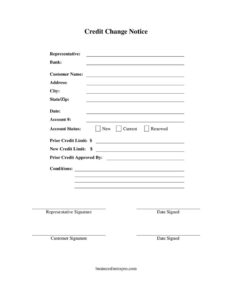
Credit Change Notice
Use this free Credit Change Notice template to formally inform a customer of a new credit limit or account status — free download in PDF and DOCX.
PDF
DOCX
3 downloads
0
likes
Download Files
- DOCX
A Credit Change Notice is a written document a business sends to a customer to communicate a change in their credit terms, such as a new credit limit or a change in account status. The most common reason people use one is to formally and clearly notify a customer that their credit line has been increased, reduced, renewed, or placed under new conditions. This template is free to download in both PDF and DOCX formats, with no signup required.
What Is a Credit Change Notice?
A Credit Change Notice is a formal communication issued by a seller, lender, or credit department to a customer who holds a credit account. It documents an adjustment to the terms under which credit is extended — typically a revised credit limit, a new account status, or updated conditions. The notice creates a clear paper trail showing what changed, when it took effect, and who authorized it. It is commonly used by wholesalers, suppliers, service providers, and finance teams that manage net-terms accounts. By putting the change in writing and capturing signatures from both the representative and the customer, the notice reduces disputes and keeps everyone aligned on the current credit arrangement.
When Do You Need a Credit Change Notice?
This form is useful any time the credit relationship with a customer shifts. Common situations include:
- Increasing a credit limit after a customer demonstrates a strong, consistent payment history.
- Reducing a credit limit in response to late payments, declining orders, or higher perceived risk.
- Renewing an existing credit line at the end of a review period or contract term.
- Changing account status — for example, moving an account from active to on-hold, or reinstating a previously suspended account.
- Adding new conditions, such as shortened payment terms, a required deposit, or personal guarantee requirements.
- Onboarding a new credit customer and confirming their initial approved limit in writing.
What a Credit Change Notice Should Have
A complete Credit Change Notice clearly identifies the customer, the account, and the exact nature of the change. It should include the customer’s name and full mailing address, the account number, and the bank associated with the account where relevant. It must show both the prior credit limit and the new credit limit so the change is unambiguous, along with the account status and any conditions attached. It should record who approved the prior credit and who is issuing the current notice. Finally, signature and date lines for both the representative and the customer turn the notice from a one-way memo into an acknowledged, mutually documented record.
How to Fill Out a Credit Change Notice
- Enter the Date the notice is being issued at the top of the form.
- Fill in the Customer Name, Address, City, and State/Zip so the notice is addressed to the correct party.
- Record the Account # and the Bank tied to the account for accurate identification.
- Indicate the Account Status — for example, active, on hold, suspended, or closed.
- Use the change indicators to mark whether the credit is Current, New, or Renewed, so the type of change is clear at a glance.
- Enter the Prior Credit Limit and note who set it under Prior Credit Approved By.
- Write the New Credit Limit that will now apply going forward.
- Spell out any Conditions attached to the new limit, such as payment terms, deposits, or guarantees.
- Add the issuing Representative name, then have the representative sign under Representative Signature.
- Have the customer sign under Customer Signature and complete the Date Signed field to acknowledge the change.
Types of Credit Changes to Document
Not every change is an increase. Distinguishing the type of change on the notice helps both sides understand the intent. A new approval establishes credit for a customer for the first time and sets the baseline limit. A renewed line confirms that an existing arrangement continues, often after a periodic credit review. A change to the current limit — up or down — adjusts an already-active account. Reductions deserve special care: explain the reason in the conditions area and, where appropriate, give the customer reasonable notice before the change takes effect so they can adjust ordering or payment plans accordingly.
Keeping Records and Following Up
After both parties sign, give the customer a copy and retain the original in your credit file. Update your accounting or ERP system so the new limit and status are enforced on future orders. If the change includes conditions with a deadline — such as a required deposit or a switch to shorter terms — note those dates in your follow-up calendar. Keeping signed notices on file builds a chronological history of the account that is invaluable during annual reviews, collections, or any dispute over what terms were in effect at a given time.
Common Mistakes to Avoid
- Omitting the prior limit: showing only the new figure makes the change hard to interpret and easy to dispute.
- Leaving conditions vague: if terms, deposits, or guarantees apply, state them precisely rather than implying them.
- Forgetting the effective date: without a clear date, it is unclear when the new limit applies to orders.
- Skipping signatures: an unsigned notice is easy for either party to dispute later.
- Mismatched account details: a wrong account number or address can send the notice to the wrong record.
- No retained copy: failing to file the signed notice leaves you without proof of the agreed change.
Frequently Asked Questions
What is a Credit Change Notice used for? It is used to formally tell a customer that their credit terms have changed — typically a new credit limit, a renewed line, an updated account status, or added conditions. It documents exactly what changed and when, creating a clear record for both the business and the customer.
Does a Credit Change Notice need to be signed by the customer? The template includes a customer signature and date line because acknowledgment strengthens the record and reduces disputes. While a business can issue a notice as a one-way communication, having the customer sign confirms they received and understood the change, which is especially helpful when conditions or reductions are involved.
Is a Credit Change Notice legally binding? Its enforceability depends on the underlying credit agreement and applicable laws in your area. The notice itself documents an agreed adjustment, and a signature by both parties supports that understanding, but the binding terms generally flow from the original credit application or contract. Requirements vary by jurisdiction.
Can I use this notice to reduce or revoke a customer’s credit? Yes. The form accommodates increases, reductions, renewals, and status changes. When reducing or revoking credit, clearly state the reason and any conditions, and consider giving reasonable advance notice so the customer can adjust their purchasing and payment plans.
What is the difference between this and a collections or demand letter? A Credit Change Notice communicates a change to the credit terms going forward, while a collections or demand letter requests payment of an amount already overdue. The two serve different purposes, though a serious delinquency might prompt both a credit reduction notice and separate collection efforts.
How much does this Credit Change Notice template cost? It is completely free to download from Business Forms Pro in both PDF and DOCX formats, with no signup required. You can customize the editable version with your company details, logo, and any account-specific language before sending it to a customer.
This Credit Change Notice template is provided as a general example for informational purposes only and does not constitute legal, financial, or tax advice. Credit and lending requirements vary by jurisdiction and by the terms of your underlying agreements. Consult a qualified attorney or financial professional before relying on this document for your specific situation.
Official resource: for the rules that apply to your situation, see the Consumer Financial Protection Bureau.
Related Forms
- Pocket Discount Calculator
- Release Of Security Agreement
- Income Sources
- Account Balance
- Report Lost Or Stolen Credit Card
- Entertainment Cash Envelope
Browse more in Money.