
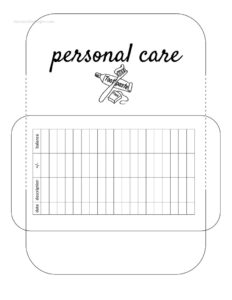
Personal Care Envelope
Use a free Personal Care Envelope template to budget grooming, hygiene, and self-care spending with the cash envelope method — free PDF and DOCX download.
PDF
DOCX
0
likes
Download Files
- DOCX
A Personal Care Envelope is a labeled budgeting envelope used to set aside cash for grooming, hygiene, and self-care expenses so you spend only what you have allotted each month. People most often use it as part of the cash envelope budgeting system to keep haircuts, toiletries, and salon visits from quietly draining their bank account. You can download this Personal Care Envelope template for free in both PDF and DOCX formats — no signup required.
What Is a Personal Care Envelope?
A Personal Care Envelope is a simple, physical (or printable) envelope that holds the cash you have budgeted for personal grooming and hygiene during a set period, usually one month. It is part of the envelope budgeting method, in which you divide your spending money into category-specific envelopes and stop spending in a category once its envelope is empty. The Personal Care category typically covers haircuts, skincare, cosmetics, shaving supplies, soap, shampoo, deodorant, nail care, and similar everyday self-care purchases. By giving these recurring but easy-to-forget costs their own dedicated envelope, you make a frequently overlooked spending area visible, intentional, and capped.
When Do You Need a Personal Care Envelope?
This envelope is useful any time personal-care spending tends to creep up without you noticing. Common situations include:
- You are starting a cash-based budget and want a clear category for toiletries and grooming instead of lumping them into “miscellaneous.”
- You regularly overspend on cosmetics, skincare, or salon visits and want a hard monthly limit.
- You share finances with a partner and want each person to have a fixed personal-care allowance.
- You are paying down debt and need to trim discretionary spending without eliminating basic hygiene needs.
- You are teaching a teenager or young adult to manage their own grooming budget.
- You want to save for a larger personal-care purchase — like a professional haircut or a year of contact lenses — by rolling over leftover cash.
What a Personal Care Envelope Should Have
A well-designed Personal Care Envelope makes tracking effortless. The key elements are a clear category label so the envelope is never confused with another, the budgeted amount for the period, the date or month it covers, and space to log deposits and withdrawals. Many versions also include a running balance line and a short notes area where you can jot down what each withdrawal paid for. Together, these elements turn a plain envelope into a self-contained mini-ledger you can review at a glance to see how much personal-care money remains before the period ends.
How to Fill Out a Personal Care Envelope
Because the layout is intentionally simple, filling it out takes only a minute:
- Label the category. Write “Personal Care” on the front so the envelope is unmistakable and won’t be raided for groceries or gas.
- Enter the budget period. Add the month or the start and end dates the envelope covers, such as a single pay period or a calendar month.
- Write the budgeted amount. Record the total cash you are allotting — for example, the amount you decided to spend on haircuts, toiletries, and grooming this month.
- Insert the cash. Place that exact amount inside the envelope when you set up your budget.
- Log each transaction. Every time you remove cash, note the date, what it was for (shampoo, haircut, razors), and the amount spent.
- Update the running balance. Subtract each withdrawal so the remaining figure always reflects what is left.
- Reconcile at period end. Compare the cash inside to your logged balance, then decide whether to roll the leftover forward or reset.
Tips for Getting the Most From Your Envelope System
The Personal Care Envelope works best when it is part of a complete set of category envelopes — groceries, transportation, entertainment, and so on. Fund all of them on the same day you get paid so the system stays in sync with your income. Keep receipts inside the envelope until you have logged them, which makes month-end reconciliation simple and helps you spot patterns, like spending most of the category on cosmetics. If your envelope consistently runs out before the period ends, that is real data: either raise the budgeted amount and cut elsewhere, or look for cheaper alternatives. If it consistently has cash left over, you can lower the allotment and redirect the difference toward savings or debt.
Rollover vs. Reset: Choosing a Strategy
Personal-care costs are uneven — some months you only buy a tube of toothpaste, others you pay for a haircut, new razors, and skincare all at once. For this reason, many people let the Personal Care Envelope roll over: leftover cash stays in the envelope and accumulates for bigger or less frequent purchases. Others prefer a clean reset each period, sweeping any surplus into savings and starting fresh. Neither is wrong. If your grooming costs spike occasionally, rollover smooths them out. If you want maximum savings discipline, reset and bank the difference. Pick the approach that matches how predictable your personal-care spending really is.
Common Mistakes to Avoid
- Borrowing from the envelope. Pulling cash for unrelated expenses defeats the purpose and leaves you short for actual grooming needs.
- Not logging small purchases. A few dollars on travel-size toiletries add up fast; record everything so the balance stays accurate.
- Setting an unrealistic budget. Guessing too low guarantees the envelope empties early — base the amount on a month or two of real spending.
- Mixing categories. Keep household cleaning supplies or medical items in their own envelopes so the personal-care figure stays meaningful.
- Forgetting to reconcile. If you never compare cash to your log, errors and “mystery” shortfalls go unnoticed.
- Skipping the refill. The system only works if you fund the envelope every period on a consistent schedule.
Frequently Asked Questions
What is a Personal Care Envelope used for? It is a budgeting envelope that holds the cash you have set aside for grooming and hygiene expenses such as haircuts, toiletries, skincare, and cosmetics. By keeping this money separate and capped, you avoid overspending on self-care items that are easy to lose track of in a general budget.
How do I decide how much to put in it? Review your last one or two months of personal-care spending and use that as a starting point. If you are unsure, begin with a modest amount and adjust after the first period based on whether the envelope ran out too soon or had cash left over.
Can I roll leftover cash into the next month? Yes. Many people let the Personal Care Envelope accumulate so they can cover occasional larger costs like a haircut or new skincare products. Alternatively, you can sweep the surplus into savings each period — both approaches are valid.
Do I have to use physical cash? The traditional method uses real cash because handing over physical money makes spending feel more deliberate. However, you can run a “digital envelope” by tracking the same figures in an app or on the printed sheet while keeping the funds in a bank account.
Is this template legally binding? No. A Personal Care Envelope is a personal budgeting tool, not a contract or financial agreement. It has no legal status — it simply helps you organize and limit your own spending.
How much does this template cost? Nothing. You can download the Personal Care Envelope template for free in PDF and DOCX formats, with no account or signup required, and print as many copies as you need.
This template is a general example provided for informational purposes only and does not constitute financial, tax, or budgeting advice. Individual financial situations vary, so consider consulting a qualified financial professional before making decisions about your personal budget.
Official resource: for the rules that apply to your situation, see the Consumer Financial Protection Bureau.
Related Forms
- Large Check Register
- Utilities Annual Use Tracker
- Pets Cash Envelope
- Petty Cash
- Date Night Cash Envelope
- Request Credit Card Chargeback
Browse more in Money.