
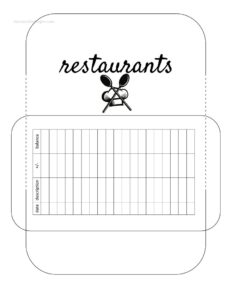
Restaurants Cash Envelope
Track dining-out spending with a free Restaurants cash envelope template that keeps your food budget on target — free download in PDF and DOCX.
PDF
DOCX
2 downloads
0
likes
Download Files
- DOCX
A Restaurants cash envelope is a labeled budgeting envelope you use to hold and track the cash set aside for dining out, takeout, and coffee runs each month. People reach for it most often when they want to stop overspending on restaurants and bring a real, physical limit to a category that’s easy to blow through. You can download this template free in PDF and DOCX, with no signup required.
What Is a Restaurants Cash Envelope?
A Restaurants cash envelope is part of the cash-envelope (or “envelope system”) method of budgeting, where you divide your spending money into category envelopes and only spend what’s physically inside each one. This particular envelope is dedicated to restaurant and eating-out costs — sit-down meals, fast food, delivery apps, lunch with coworkers, and the occasional latte. The front of the envelope typically includes space to write the category name, the budgeted amount, the time period, and a simple ledger to log each transaction. When the cash runs out, dining out stops until the next cycle. It’s a hands-on, no-app way to make a flexible category feel concrete and accountable.
When Do You Need a Restaurants Cash Envelope?
This envelope is most useful when restaurant spending is your problem category — the one that quietly drains your budget. Common situations include:
- You overspend on takeout and delivery. Apps make ordering frictionless, and a cash envelope reintroduces the friction that keeps spending in check.
- You’re starting a zero-based budget. You’ve assigned every dollar a job, and dining out needs its own dedicated container so it doesn’t borrow from groceries or rent.
- You share finances with a partner. A shared restaurant envelope makes it obvious how much is left for the two of you to eat out this month.
- You’re paying down debt or saving aggressively. Capping restaurants frees up cash for higher-priority goals without cutting out dining entirely.
- You want to break the “I’ll just tap my card” habit. Handing over physical cash makes the cost feel real in a way swiping a card never does.
- You’re teaching a teen or new budgeter. The envelope gives a clear, visual lesson in spending limits and trade-offs.
What a Restaurants Cash Envelope Should Have
A useful restaurant envelope keeps the essentials visible right on the front so you never have to guess your balance. A complete version should include the category label (“Restaurants” or “Eating Out”), the budgeted amount for the period, the budgeting cycle (weekly, biweekly, or monthly), a running ledger with columns for the date, description, amount spent, and remaining balance, and a clear spot to record the starting and ending totals. Some people also add a notes line to flag recurring habits — like a Friday pizza order — that they want to watch. The goal is a self-contained tracker: open the envelope, read the front, and know exactly where you stand.
How to Fill Out a Restaurants Cash Envelope
- Label the category. Write “Restaurants” (or “Dining Out”) clearly at the top so it doesn’t get confused with groceries or entertainment.
- Set the budget period. Note whether this envelope covers a week, two weeks, or a month, and write the start and end dates.
- Enter the budgeted amount. Record the total cash you’re allocating, then count that exact amount in and place it inside.
- Write the starting balance. List the opening amount at the top of the ledger so every entry can be subtracted from it.
- Log each purchase. After every restaurant, drive-thru, or delivery, write the date, where you spent (e.g., “Taco shop”), and the amount.
- Update the running balance. Subtract each purchase to show how much cash remains for the rest of the period.
- Reconcile at the end. Compare the cash left in the envelope to your ledger’s ending balance to confirm they match.
Tips for Making the Envelope System Work
The cash envelope only works if you actually carry it — or at least the cash from it — when you go out. Pull the amount you expect to spend before leaving home rather than walking around with the whole month’s budget. If a restaurant requires a card (some delivery services do), treat your card spending as a withdrawal: physically remove that amount of cash from the envelope and set it aside so the balance still reflects reality. Keep your receipts until you’ve logged them. And resist the urge to “borrow” from another envelope; the discipline of running out is the entire point.
What to Do With Leftover Cash
If you reach the end of the period with cash still in the Restaurants envelope, you have choices. You can roll it forward to next period for a bigger dining-out budget, or sweep it into savings, debt payoff, or a different goal. Many budgeters use a small leftover balance as a built-in reward — a sign they ate at home more often. Decide your rule in advance so the surplus has a plan rather than disappearing into impulse spending.
Common Mistakes to Avoid
- Forgetting to log small purchases. A $4 coffee logged inconsistently throws off your whole balance — record everything.
- Lumping groceries in with restaurants. Keep them in separate envelopes; they’re different habits with different limits.
- Not accounting for card-only spending. If you tap a card, remove the matching cash so the envelope stays accurate.
- Setting an unrealistic budget. Too tight and you’ll abandon the system in a week; review past spending to pick a workable number.
- Carrying the full balance everywhere. It invites impulse spending — only take what you plan to use.
- Skipping the end-of-period reconciliation. Without it, you never learn whether your budget is on target.
Frequently Asked Questions
What is a Restaurants cash envelope used for? It’s used to hold the cash you’ve budgeted specifically for eating out — restaurants, fast food, delivery, and coffee. By spending only the cash inside, you keep this easily-overspent category within a set limit each budgeting period.
How do I fill out the envelope? Label it “Restaurants,” write the budget period and the budgeted amount, then place that cash inside. Each time you spend, log the date, place, and amount on the front and subtract it from your running balance so you always know what’s left.
How much should I budget for restaurants? There’s no universal number — it depends on your income, goals, and how often you eat out. A good starting point is to review your last month or two of dining spending, then set a target slightly below it so the envelope gently curbs the habit.
What if I have to pay with a card? Treat the card charge as a withdrawal from the envelope. Remove the equivalent cash and set it aside (or move it to savings) so your envelope balance still reflects what’s truly available to spend.
Is this an official or legal document? No. A cash envelope is a personal budgeting tool, not a legal or financial contract. It’s simply a way to organize and track your own spending, and you can adapt it however suits your household.
Is the template really free to download? Yes. You can download this Restaurants cash envelope template free in both PDF and DOCX formats with no signup required, print as many copies as you need, and customize the labels and amounts to fit your budget.
This template is a general example provided for informational purposes only and does not constitute financial, tax, or budgeting advice. Personal financial situations vary, so consider consulting a qualified financial professional before making decisions about your budget.
Official resource: for the rules that apply to your situation, see the Consumer Financial Protection Bureau.
Related Forms
- Financial Worksheet
- Customer Order Tracker
- Gas Cash Envelope
- School Cash Envelope
- Credit Freeze Temporary Lift
- Tax Refund Status Tracker
Browse more in Money.