
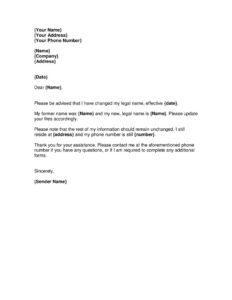
Name Change Notification Letter
Download a free Name Change Notification Letter template to inform banks, employers, and agencies of your legal name change — free PDF and DOCX download.
PDF
DOCX
4 downloads
0
likes
Download Files
- DOCX
A Name Change Notification Letter is a short written notice that informs a company, institution, or individual that you have legally changed your name and asks them to update their records accordingly. People most commonly use it after marriage, divorce, or a court-ordered name change to update accounts with banks, employers, insurers, and service providers. You can download this template free in PDF and DOCX formats — no signup required.
What Is a Name Change Notification Letter?
A Name Change Notification Letter is a formal communication you send to organizations that hold records under your name. It states your former legal name, your new legal name, and the effective date of the change, then requests that the recipient update their files. It is typically sent by an individual to a specific contact at a company — for example, a bank, payroll department, utility provider, or membership organization. The letter does not itself change your name (that happens through marriage, divorce, or court order); instead, it puts third parties on notice so their records, billing, and correspondence reflect your correct identity going forward.
When Do You Need a Name Change Notification Letter?
Once your name change is legally official, you usually need to notify many separate organizations one at a time. This letter is useful in situations such as:
- After marriage or civil partnership — adopting a spouse’s surname or a combined name and updating accounts.
- After divorce — reverting to a former or maiden name following a court decree.
- After a court-ordered name change — when you have legally changed your name through a petition.
- Updating financial accounts — notifying banks, credit unions, lenders, or investment firms so statements and cards match your new name.
- Updating service providers — informing utilities, insurers, subscription services, doctors’ offices, or your landlord.
- Notifying your employer — alerting HR or payroll so pay records, benefits, and tax documents are accurate.
What a Name Change Notification Letter Should Have
A complete and effective letter is brief but precise. It should clearly include the following elements:
- Your current contact details — name, address, and phone number.
- The recipient’s name, company, and address.
- The date the letter is written.
- A clear statement of your former legal name and your new legal name.
- The effective date of the name change.
- Confirmation that other details, such as your address and phone number, remain unchanged.
- An invitation for the recipient to contact you with questions or to send any additional forms.
- A polite closing and your signature using your new name.
How to Fill Out a Name Change Notification Letter
This template uses simple placeholder fields. Work through them in order:
- Enter {Your Name} at the top using your current legal name, followed by {Your Address} and {Your Phone Number} so the recipient can reach you.
- Add the recipient’s details: the contact {Name}, their {Company}, and the {Address} where the letter is being sent.
- Insert the {Date} you are writing the letter.
- In the greeting, replace Dear {Name} with the recipient’s name or department title.
- State the {date} your name change became effective.
- Fill in your former {Name} exactly as it appeared in their existing records.
- Enter your new, legal {Name} precisely as it now appears on your official documents.
- Confirm that your {address} and phone {number} remain unchanged, or correct them if they have also changed.
- Sign off as {Sender Name} using your new legal name, and sign by hand if sending a printed copy.
Supporting Documents and Follow-Up
Most organizations will not update your records on the strength of a letter alone. Many require a copy of the legal document that authorized the change — typically a marriage certificate, a divorce decree, or a court order. It is good practice to mention in your cover note that you can supply this documentation on request, and to keep certified copies on hand. Some institutions also have their own internal change-of-name form, which is why this letter invites the recipient to send any additional paperwork. After mailing or emailing the letter, follow up within a couple of weeks to confirm the change was processed, and check that your next statement, card, or correspondence reflects the correct name.
Tips for Notifying Multiple Organizations
Because a name change touches dozens of accounts, organization saves time. Make a checklist of everyone who holds records under your name — government agencies, banks, employers, insurers, schools, healthcare providers, utilities, and subscriptions. Prioritize the most important first: your government identification and Social Security records (where applicable), then your bank and employer, since these often feed information to others. Keep a master copy of the letter and customize only the recipient details for each one. Save a dated copy of every letter you send so you have a record of when each organization was notified.
Common Mistakes to Avoid
- Using a nickname or informal name instead of your exact new legal name as it appears on official documents.
- Omitting the former name — recipients need it to locate your existing records.
- Forgetting the effective date, which can create confusion about which records apply when.
- Failing to enclose supporting documents when the organization requires proof of the change.
- Sending to a generic address rather than the correct department, which can delay processing.
- Not keeping copies of the letters you send or following up to confirm the update was made.
Frequently Asked Questions
What is a Name Change Notification Letter used for? It is used to formally tell a company or institution that you have legally changed your name and to request that they update their records. It documents your former name, new name, and the effective date so the recipient can correct billing, statements, and correspondence.
Does a Name Change Notification Letter actually change my name? No. Your name is changed legally through marriage, divorce, or a court order, not by this letter. The letter simply notifies third parties of a change that has already taken effect so their files match your official documents.
Do I need to include supporting documents? Many organizations require proof such as a marriage certificate, divorce decree, or court order before they will update your records. It is wise to mention that you can provide a copy and to keep certified copies ready in case they are requested.
Does this letter need to be notarized or witnessed? Generally no. A name change notification is an informational letter, not a sworn legal document, so notarization is usually unnecessary. However, the underlying legal documents that authorized the change may have their own certification requirements.
How much does this template cost? Nothing. You can download the Name Change Notification Letter template for free in both PDF and DOCX formats, with no signup required, and reuse it for as many organizations as you need.
Should I send a separate letter to each organization? Yes. Each bank, employer, agency, and provider keeps its own records, so each needs its own notification. You can reuse the same template and simply change the recipient details for every account you need to update.
This template is provided as a general example for informational purposes only and does not constitute legal, financial, or tax advice. Name change procedures and documentation requirements vary by jurisdiction and by organization. Consult a qualified professional or the relevant institution to confirm what is required in your situation.
Related Forms
- Stop Payment Check Recipient
- General Notice Of Death
- Stolen Identity Report To FBI
- Child Visitation Letter
- Demand Alimony Payment Letter
- Notice To Heirs And Legatees
Browse more in Notifications.