
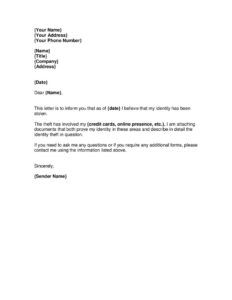
Stolen Identity Report To FBI
Use this free Stolen Identity Report to FBI template to formally notify authorities of identity theft and document your case — free download in PDF and DOCX.
PDF
DOCX
2 downloads
0
likes
Download Files
- DOCX
A Stolen Identity Report to FBI is a formal letter you send to report that your personal identity has been stolen and to request that the matter be documented and investigated. People most often use it after discovering fraudulent accounts, unauthorized transactions, or misuse of their personal information online. This template is free to download in PDF and DOCX formats — no signup required.
What Is a Stolen Identity Report to FBI?
A Stolen Identity Report to FBI is a written notification that alerts a federal contact or agency that you believe your identity has been compromised. It is issued by the victim — the individual whose name, financial accounts, or online presence has been misused — and addressed to a named recipient at a relevant office or agency. The letter documents when you discovered the theft, what was affected, and confirms that supporting evidence is attached. While many identity theft complaints are filed online through official channels, a formal written letter creates a dated paper trail, identifies you clearly, and signals that you are cooperating fully and ready to provide additional information on request.
When Do You Need a Stolen Identity Report to FBI?
Identity theft can surface in many ways, and a written report is useful whenever you need an official record of your notification. Common situations include:
- You find credit cards or loans opened in your name that you never authorized.
- Someone has taken over your online accounts, email, or social media presence and is impersonating you.
- You receive bills, collection notices, or tax documents for activity you did not initiate.
- A data breach has exposed your personal information and you suspect it is being used fraudulently.
- A financial institution, employer, or government office asks you to provide a formal report of the theft.
- You need a dated, written record to support disputes with creditors, banks, or credit bureaus.
In each of these cases, a clear written letter helps establish the timeline and shows you acted promptly once the theft was discovered.
What a Stolen Identity Report Should Have
To be useful and credible, your report should contain a few essential elements. It must clearly identify you with your full name, address, and phone number so the recipient can confirm your identity and reach you. It should name the recipient and their title and office. The body must state the date you believe the theft occurred or was discovered, describe what was affected (credit cards, online presence, financial accounts, and so on), and reference the supporting documents you are attaching. Finally, it should invite the recipient to contact you for questions or additional forms and close with your signature.
How to Fill Out a Stolen Identity Report to FBI
- Enter {Your Name}, {Your Address}, and {Your Phone Number} at the top so the recipient can verify and contact you.
- Address the letter to the recipient: fill in their {Name}, {Title}, {Company} or office, and {Address}.
- Add the {Date} you are sending the letter.
- Open with the salutation, inserting the recipient’s {Name}.
- In the first sentence, enter the {date} on which you believe your identity was stolen or first noticed the theft.
- Describe what the theft involved by completing the {credit cards, online presence, etc.} field — be specific about each account or area affected.
- Confirm that you are attaching documents that prove your identity and describe the theft in detail.
- Restate that the recipient may contact you using the information listed above if they need questions answered or additional forms.
- Close with Sincerely and sign with your {Sender Name}.
What to Attach to Strengthen Your Report
The letter itself is a cover notification — the strength of your case comes from the evidence behind it. Attach copies (never originals) of documents that prove who you are, such as a government-issued ID, and documents that show the fraud, such as statements with unauthorized charges, screenshots of compromised accounts, collection letters, or correspondence from creditors. Keep a clearly labeled list of every attachment and number the pages so nothing goes missing. Many victims also keep a written log of phone calls, dates, and the names of people they spoke with. The more organized your supporting material, the easier it is for the recipient to understand exactly what happened and act on it.
Keeping Records and Following Up
Always keep a complete copy of the signed letter and every attachment for your own files. If you send the report by mail, consider using a method that provides delivery confirmation so you can prove it was received. Note the date you sent it and set a reminder to follow up if you do not hear back within a reasonable time. A reported case of identity theft often needs to be referenced repeatedly — when disputing charges, placing fraud alerts or credit freezes, or working with banks — so a tidy, dated record of your notification is genuinely valuable in the weeks and months that follow.
Common Mistakes to Avoid
- Being vague about what was affected — list specific accounts, cards, or platforms rather than writing “everything.”
- Omitting the date of discovery, which establishes your timeline and shows you acted quickly.
- Sending original documents instead of copies, which can be lost.
- Forgetting your contact details, leaving the recipient unable to follow up.
- Not keeping a copy of the signed letter and attachments for your records.
- Relying only on the letter and skipping official reporting channels that may also be required.
Frequently Asked Questions
What is a Stolen Identity Report to FBI? It is a formal letter in which a victim notifies a named recipient that they believe their identity has been stolen, describes what was affected, and confirms that supporting evidence is attached. It creates a dated written record of your notification and your willingness to cooperate. It is typically used alongside official reporting channels.
How do I fill out this report? Start with your name, address, and phone number, then address the recipient by name and title. State the date you discovered the theft, describe what was affected such as credit cards or your online presence, and confirm you are attaching proof. Sign and date the letter and keep a copy.
Does this letter need to be notarized? Notarization is generally not required for a notification letter like this. The important thing is that it is accurate, dated, and signed by you. If a specific agency or institution requests a notarized statement, follow their instructions.
Is this report legally binding? The letter is a notification, not a contract, so it is not “binding” in the contractual sense. However, knowingly providing false information in a report to authorities can carry serious consequences, so only state what you genuinely believe to be true.
How much does this template cost? It is completely free to download from Business Forms Pro in both PDF and DOCX formats, with no signup required. You can edit the DOCX version to fit your situation before sending it.
Should I also report identity theft through official channels? Yes. A written letter is helpful, but you should also use the official reporting tools and processes provided by the relevant authorities and your financial institutions. Doing both ensures your case is documented thoroughly and routed to the right place.
This template is a general example provided for informational purposes only and is not legal, financial, or law enforcement advice. Reporting procedures and requirements vary by jurisdiction and agency — consult the appropriate official channels and a qualified professional for guidance specific to your situation.
Related Forms
- Name Change Notification Letter
- Notice To Heirs And Legatees
- Demand Alimony Payment Letter
- Letter To Notify Creditors Of Death
- Child Visitation Letter
- General Notice Of Death
Browse more in Notifications.