
Letter To Notify Creditors Of Death
Use this free Letter to Notify Creditors of Death template to formally inform a creditor of a passing and request a death notice — free PDF & DOCX download.
PDF
DOCX
18 downloads
0
likes
Download Files
- DOCX
A Letter to Notify Creditors of Death is a written notice that informs a bank, lender, or other creditor that an account holder has passed away and requests that a formal death notice be added to their file. People most often use it during estate administration to stop further billing, prevent identity theft, and begin settling the deceased person’s accounts. You can download this template free in both PDF and DOCX formats — no signup required.
What Is a Letter to Notify Creditors of Death?
A Letter to Notify Creditors of Death is a formal communication sent by a surviving spouse, adult child, executor, or estate representative to a company that the deceased had an account with. It identifies the decedent, provides key dates and identifying details, and asks the creditor to flag the account accordingly. The letter typically accompanies supporting documents — such as a death certificate or proof of authority — that establish the sender’s right to make the request. Its purpose is to create a clear paper trail so the creditor can pause activity on the account, halt new charges or interest, and route future correspondence to the right person while the estate is being administered.
When Do You Need a Letter to Notify Creditors of Death?
This letter is useful in many situations that arise after a loved one passes away. Common scenarios include:
- Notifying a credit card company so charges, fees, and interest stop accruing.
- Informing a mortgage lender or auto loan servicer of the borrower’s death.
- Telling a utility, phone, or subscription provider to close or transfer an account.
- Alerting a bank or financial institution to freeze or review an account.
- Protecting the decedent’s identity by adding a death notice to credit files and accounts.
- Providing executors and administrators with a consistent, professional document to send to multiple creditors during probate.
What a Death Notification Letter Should Have
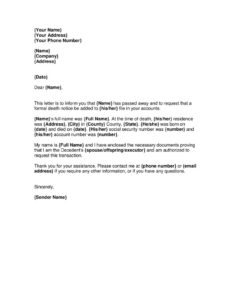
To be effective, the letter should clearly identify everyone involved and include enough detail for the creditor to locate the correct account. The essential elements are: your contact information as the sender; the creditor’s name, company, and address; the decedent’s full legal name and last residence; their date of birth and date of death; identifying numbers such as a Social Security number and account number; a statement of your relationship and authority; and a reference to the enclosed supporting documents. A polite closing with your phone and email invites the creditor to follow up if anything is missing.
How to Fill Out a Letter to Notify Creditors of Death
- Enter your name, address, and phone number at the top so the creditor knows who is writing.
- Add the creditor’s contact block: the recipient name, company, and address, followed by the date you are sending the letter.
- Open with the salutation “Dear {Name}” using the contact person or department.
- State that the account holder has passed away and that you are requesting a formal death notice be added to their file.
- Provide the decedent’s full legal name, their last residence address, city, county, and state.
- List the decedent’s date of birth and date of death.
- Supply identifying numbers — the Social Security number and the account number — so the creditor can match the record.
- Identify yourself by full name and state your relationship: spouse, offspring, or executor, noting that you have enclosed documents proving your authority.
- Close by inviting questions, listing your phone number and email address, then sign with your name.
Supporting Documents to Enclose
Creditors will almost always require proof before acting on a death notification. The most common document is a certified copy of the death certificate, which establishes the date and fact of death. If you are the executor or administrator, include a copy of the letters testamentary or letters of administration issued by the probate court showing you are authorized to act for the estate. A surviving spouse or child may be asked for additional identification or a copy of a will. Sending copies rather than originals is generally safer, and keeping a record of what you mailed protects you if a creditor later claims it never received the notice.
How to Send the Letter and Keep Records
Because this letter has legal and financial significance, it is wise to send it in a way that proves delivery. Many people use certified mail with a return receipt so they have dated confirmation that the creditor received it. Keep a copy of every letter you send, note the date, and log any phone calls or follow-up correspondence. If you are notifying several creditors, create a simple checklist with each company, the date you wrote, and the status of the account. This organized approach is especially helpful for executors managing multiple accounts during probate, and it reduces the chance that a missed creditor surfaces later.
Common Mistakes to Avoid
- Leaving out the account number or Social Security number, which forces the creditor to request more information and delays processing.
- Sending the letter without the supporting documents that prove your relationship or authority.
- Mailing original death certificates instead of copies, risking loss of an irreplaceable document.
- Forgetting to keep a copy of the letter and proof of mailing for your records.
- Using an outdated address for the creditor rather than the correct billing or estate-services department.
- Assuming a phone call alone is enough — most creditors require the request in writing.
Frequently Asked Questions
What is a Letter to Notify Creditors of Death used for? It is used to formally inform a creditor that an account holder has died and to request that a death notice be added to the account file. This helps stop new charges and interest, begins the process of settling the account, and creates a written record during estate administration.
Who should send this letter? It is typically sent by the surviving spouse, an adult child, or the executor or administrator of the estate. The template asks you to state your relationship and confirm that you have enclosed documents proving you are authorized to make the request.
Does this letter need to be notarized? The letter itself usually does not need to be notarized, but creditors will generally require supporting proof such as a certified death certificate or court-issued letters of authority. Requirements vary by company and jurisdiction, so check what each creditor asks for.
What documents should I include with the letter? Commonly a certified copy of the death certificate and, if you are the executor, the letters testamentary or letters of administration from the probate court. Sending copies rather than originals and noting them as enclosures helps the creditor verify your request.
Is this letter legally binding? The letter is a notification rather than a contract, so it does not by itself create legal obligations. However, it serves as important documented notice, and how it interacts with the estate’s debts and probate is governed by local law.
How much does this template cost? This Letter to Notify Creditors of Death template is completely free to download from Business Forms Pro in both PDF and DOCX formats, with no signup required. You can edit it to fit your situation and send a separate copy to each creditor.
This template is a general example provided for informational purposes only and is not legal, financial, or tax advice. Estate procedures, creditor notification rules, and required documents vary by jurisdiction. Consult a qualified attorney or estate professional for guidance specific to your circumstances.
Related Forms
- Name Change Notification Letter
- Stop Payment Check Recipient
- Child Visitation Letter
- General Notice Of Death
- Stolen Identity Report To FBI
- Demand Alimony Payment Letter
Browse more in Notifications.