
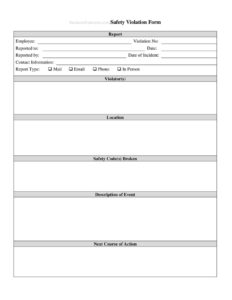
Safety Violation Form
Document workplace safety breaches clearly with our Safety Violation Form template, with field-by-field guidance and a free download in PDF and DOCX.
PDF
DOCX
1 downloads
0
likes
Download Files
- DOCX
A Safety Violation Form is a workplace document used to formally record and report a breach of safety rules, codes, or procedures. The most common reason people reach for one is to create a written, dated record of an unsafe act or hazardous condition so it can be reviewed, corrected, and tracked. You can download this template free in PDF and DOCX, with no signup required.
What Is a Safety Violation Form?
A Safety Violation Form is an internal report created by an employee, supervisor, or safety officer to document when someone has broken a safety code or standard. It captures who violated the rule, what code was broken, where and when it happened, and what is being done about it. Organizations use these forms to maintain an accountable paper trail, identify recurring hazards, and demonstrate that they responded to risks promptly. Because the form includes a unique violation number and a designated recipient, it integrates neatly into a broader safety management system. Whether the issue is a missing guard on a machine or a blocked fire exit, this form turns an observation into a structured, actionable record.
When Do You Need a Safety Violation Form?
This form is useful any time a workplace safety standard is not being followed and the incident needs to be documented and addressed. Common situations include:
- An employee is observed not wearing required personal protective equipment in a designated area.
- A machine is operated with a safety guard removed, bypassed, or disabled.
- Hazardous materials are stored, labeled, or disposed of improperly.
- Emergency exits, fire extinguishers, or electrical panels are blocked or obstructed.
- Established lockout/tagout, ladder, or scaffolding procedures are skipped or shortcut.
- A near-miss occurs because a safety rule was ignored, even if no one was injured.
Filing a form for each of these creates a consistent history that helps supervisors spot patterns and decide whether retraining, equipment changes, or disciplinary action is needed.
What a Safety Violation Form Should Have
A complete Safety Violation Form needs enough detail that someone uninvolved could understand exactly what happened and why it mattered. At minimum it should identify the person making the report and the person it is directed to, a unique violation number for tracking, the date the report was filed and the date the incident occurred, and the violator or violators involved. It should also pinpoint the location, name the specific safety code or codes broken, and provide a clear factual description of the event. Finally, it should state the next course of action so the report drives a real response rather than sitting in a file. Contact information and a chosen report type round out the record.
How to Fill Out a Safety Violation Form
- Report and Violation No: Label the report and assign a sequential violation number so it can be tracked in your log.
- Employee: Enter the name of the employee involved or the person submitting the report, depending on your internal convention.
- Reported by / Reported to: List who is filing the report and the supervisor or safety officer receiving it.
- Date / Date of Incident: Record the date you completed the form and the separate date the violation actually occurred.
- Contact Information: Add a phone number or email for the reporter in case follow-up is needed.
- Report Type: Indicate how the report was submitted — Mail, Email, Phone, or In Person.
- Violator(s): Name the individual or individuals responsible for the violation.
- Location: Specify exactly where it happened — building, floor, work area, or machine.
- Safety Code(s) Broken: Cite the specific rule, policy, or standard that was violated.
- Description of Event: Write a factual, objective account of what occurred.
- Next Course of Action: State the corrective step, such as retraining, repair, or follow-up review.
Writing an Effective Description of Event
The Description of Event field is where most of the report’s value lives, so treat it carefully. Stick to observable facts: what you saw, who was present, what was said, and what condition the equipment or area was in. Avoid opinions, assumptions about intent, or emotionally charged language — write “the machine was running with the guard removed” rather than “the operator was being reckless.” Include time of day and any contributing conditions such as lighting, weather, or staffing. If photos exist, note that they are attached and reference them by number. A clear, neutral description protects everyone involved, supports a fair review, and makes the Next Course of Action far easier to determine.
Tracking and Following Up
A Safety Violation Form is only as useful as the follow-through behind it. Use the violation number to log each report in a central spreadsheet or safety system, and revisit open items until the Next Course of Action is fully completed. Aggregating these records over time reveals trends — a particular machine, shift, or task that generates repeated reports often points to a deeper problem worth fixing at the source. Keep completed forms secure, since they may contain sensitive personnel information, and retain them according to your organization’s record-keeping policy.
Common Mistakes to Avoid
- Leaving the Date of Incident blank or confusing it with the report date, which distorts your timeline.
- Skipping the violation number, making the report impossible to track or reference later.
- Writing vague descriptions like “unsafe behavior” instead of concrete, observable facts.
- Failing to cite the specific Safety Code(s) Broken, which weakens the basis for any corrective action.
- Leaving the Next Course of Action empty so the report leads nowhere.
- Including speculation or accusatory language rather than a neutral account of events.
Frequently Asked Questions
What is a Safety Violation Form used for? It is used to document and report a workplace breach of safety rules or codes. The form captures who was involved, what happened, where and when, and the corrective action planned. It creates an accountable record that helps organizations correct hazards and track repeat issues.
Who should fill out a Safety Violation Form? Any employee, supervisor, or safety officer who observes a violation can complete it. The Reported by field identifies the person filing, while Reported to names the recipient responsible for review. In many workplaces, supervisors or a dedicated safety team handle the follow-up.
Does a Safety Violation Form need to be signed or witnessed? Signatures and witness statements are not legally required by the form itself, but many organizations ask the reporter and reviewer to sign for accountability. If there were witnesses to the incident, noting them in the description strengthens the record. Follow your own company’s policy on signatures.
How detailed should the Description of Event be? Detailed enough that someone uninvolved could understand exactly what happened. Include objective facts, the location, time, conditions, and the specific code that was broken. Avoid opinions, assumptions, or emotional language so the report stays fair and credible.
Is filing a Safety Violation Form a disciplinary action? Not by itself — the form is primarily a documentation and reporting tool. Whether discipline follows depends on the severity of the violation, company policy, and the Next Course of Action decided after review. Many reports lead to retraining or equipment fixes rather than discipline.
How much does this Safety Violation Form template cost? Nothing — it is completely free to download from Business Forms Pro in both PDF and DOCX formats, with no signup required. You can use it as-is or edit the DOCX version to match your organization’s safety codes and reporting workflow.
This Safety Violation Form template is a general example provided for informational purposes only and does not constitute legal, regulatory, or safety-compliance advice. Workplace safety requirements vary by jurisdiction, industry, and applicable regulations — consult a qualified safety or legal professional to ensure your reporting practices meet all relevant standards.
Official resource: for the rules that apply to your situation, see the U.S. Small Business Administration.
Related Forms
- Recurring Appointment Reminder Card
- 2025 Postal Holidays
- Meeting Agenda Portrait
- Green Appointment Reminder Card
- Venue Reservation Request
- Room Reservation Form
Browse more in Office.