
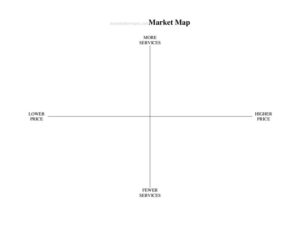
Market Map Services
Download a free Market Map Services template to organize providers, segments, and competitors at a glance—free download in PDF and DOCX, no signup required.
PDF
DOCX
0
likes
Download Files
- DOCX
A Market Map Services form is a structured worksheet for laying out the companies, providers, and offerings within a market so you can see segments, gaps, and competitors at a glance. People most often use it when they need to brief a team, pitch investors, or plan a go-to-market strategy. It’s free to download here in both PDF and DOCX formats, with no signup required.
What Is a Market Map Services Form?
A Market Map Services form is a research and planning document that organizes a market’s service providers into a clear, visual structure. It is typically created by founders, product managers, strategy analysts, consultants, or marketing teams who need to understand the competitive landscape. The form documents who offers what, how providers are grouped into categories or segments, and where opportunities or overlaps exist. Rather than a loose list, it forces a disciplined view: each provider is tied to a category, a description, and supporting notes. The end result is a snapshot of an industry that can be shared, updated, and used to support decisions about positioning, partnerships, pricing, and investment.
When Do You Need a Market Map Services Form?
This form is useful any time you need to make sense of a crowded or unfamiliar service market. Common scenarios include:
- Launching a new product or service and needing to understand who already serves your target customers.
- Preparing an investor pitch deck where a clean market map shows where your company sits among competitors.
- Competitive analysis for a quarterly strategy review or board meeting.
- Vendor or partner selection, when you want to compare service providers side by side before signing a contract.
- Market-entry research for a new region, vertical, or customer segment.
- Onboarding a new strategy or marketing hire who needs a fast, structured overview of the landscape.
Types of Market Maps
Market maps come in a few flavors, and this services-focused template can be adapted to most of them. A category map groups providers by the type of service they offer. A segment map arranges them by the customer they serve, such as enterprise versus small business. A value-chain map places providers along the steps of delivering a service, from sourcing to support. A competitive quadrant plots providers on two axes, such as price and breadth of offering. Choose the framing that answers the question you actually need to answer, then use the form’s fields to capture the supporting detail behind each entry.
What a Market Map Services Form Should Have
A complete market map is more than a list of logos. To be genuinely useful, it should include a clearly defined market or scope, named categories or segments, each provider mapped to a category, a short description of what each provider does, and notes on strengths, weaknesses, or positioning. It should also record the date and the source of the information so readers know how current and reliable it is. Finally, it should leave room for identified gaps and opportunities—the whole point of mapping a market is to spot where unmet needs or whitespace exist.
How to Fill Out a Market Map Services Form
Because this is a flexible template, work through it section by section and adapt the fields to your market:
- Define the market. At the top, write the market or industry you are mapping and a one-line scope statement so readers know what’s in and out.
- List your categories or segments. Create the column or row headings that group providers—by service type, customer segment, or value-chain stage.
- Add each provider. Enter the company or service name under the category it belongs to. Keep names consistent and accurate.
- Describe the offering. In the description field, summarize in one or two lines what each provider actually does.
- Capture positioning notes. Record strengths, weaknesses, pricing tier, or differentiators that matter to your analysis.
- Mark gaps and opportunities. Note categories that are thin, underserved, or ripe for entry.
- Record date and sources. Date the map and cite where the data came from so it can be verified and refreshed later.
Tips for a Useful Market Map
Keep the map focused: a tight, well-defined scope is far more useful than an exhaustive list that tries to cover everything. Use consistent criteria for placing providers in categories so the map stays logical and defensible. Cite your sources—analyst reports, company websites, and customer interviews each carry different weight. Update the map on a schedule, because service markets shift quickly as companies launch, pivot, and consolidate. Finally, end with a clear takeaway: a market map exists to support a decision, so make sure the gaps and opportunities you identify point to a concrete next step.
Common Mistakes to Avoid
- Mapping too broad a market so the result is cluttered and hard to read or act on.
- Inconsistent categories where providers could fit in several boxes, blurring the analysis.
- Listing competitors without descriptions, leaving readers unable to tell providers apart.
- Forgetting to date the map, which makes it impossible to know how stale the information is.
- Skipping the gaps section and treating the map as an inventory rather than a strategy tool.
- Relying on a single source instead of cross-checking, which can bake in errors or bias.
Frequently Asked Questions
What is a Market Map Services form used for? It is used to organize and visualize the providers within a service market so you can compare offerings, group them by category, and identify gaps. Teams use it for competitive analysis, investor pitches, go-to-market planning, and vendor selection. The structured format makes a complex market easy to understand at a glance.
How do I fill out a market map? Start by defining the market and scope, then set up your categories or segments. Add each provider under the right category with a short description and positioning notes, mark any gaps or opportunities, and record the date and sources. Work from the broad structure down to the detail so the map stays organized.
Is this template free to download? Yes. The Market Map Services template is completely free to download in both PDF and DOCX formats, with no signup or account required. You can edit the DOCX version to match your own categories and market.
What’s the difference between a market map and a competitor list? A competitor list is simply names, while a market map adds structure by grouping providers into categories or segments and showing how they relate. A market map is built to reveal patterns, overlaps, and whitespace, not just to enumerate companies. That structure is what makes it useful for strategy decisions.
How often should I update a market map? Service markets change quickly, so review and refresh your map at least quarterly, or sooner if you are using it for an active decision like a fundraise or product launch. Always date each version so readers know how current it is. Keeping sources noted makes updates much faster.
Can I customize the categories and layout? Absolutely. The template is intentionally flexible so you can rename categories, add segments, or reframe it as a value-chain or quadrant view. Edit the DOCX version to fit your specific market and the question you are trying to answer.
This Market Map Services template is provided as a general example for informational purposes only and does not constitute legal, financial, or business advice. Market conditions and competitive information vary and change over time—verify your data and consult a qualified professional before making strategic or financial decisions based on your map.
Official resource: for the rules that apply to your situation, see the U.S. Small Business Administration.
Related Forms
- Meeting Agenda
- Blue Appointment Reminder Card
- Meeting Agenda List
- Insertion Order
- Employee Attendance Record
- Return To Work Form
Browse more in Office.