
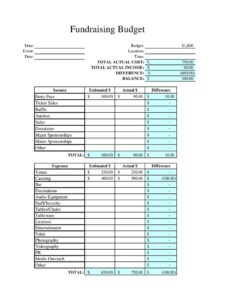
Fundraising Budget Spreadsheet
Plan and track campaign costs with a free Fundraising Budget Spreadsheet template — organize income, expenses, and net proceeds. Free download in PDF and DOCX.
PDF
XLSX
8 downloads
0
likes
Download Files
- XLSX
A Fundraising Budget Spreadsheet is a planning and tracking tool that helps campaign committees, candidates, and political organizations project the income and expenses tied to a fundraising effort. People most often use it to know whether an event or appeal will actually net money after costs, and to keep a clean record for compliance and reporting. It is free to download here in both PDF and DOCX formats, with no signup required.
What Is a Fundraising Budget Spreadsheet?
A Fundraising Budget Spreadsheet is a financial worksheet that lays out every expected dollar coming into a fundraising activity alongside every dollar going out. It is typically prepared by a campaign treasurer, finance director, or volunteer coordinator before an event and updated as real numbers come in. The document records anticipated contributions, ticket sales, sponsorships, and in-kind donations against costs such as venue, catering, printing, and staff. By comparing projected revenue with projected expense, the spreadsheet reveals the net proceeds a fundraiser can realistically deliver. It serves both as a pre-event planning blueprint and as an after-the-fact accounting of how money was actually raised and spent during a political campaign.
When Do You Need a Fundraising Budget Spreadsheet?
Almost any organized money-raising activity benefits from a written budget. Common situations include:
- Planning a campaign fundraising dinner or gala where ticket prices must cover catering, venue rental, and still leave a healthy surplus.
- Launching a small-dollar donor drive and needing to weigh mail and digital advertising costs against expected response rates.
- Hosting a house party or meet-and-greet with modest expenses where the committee still wants a clear net figure.
- Setting quarterly finance goals so the treasurer can report projected versus actual results to the campaign manager.
- Coordinating multiple events across a season and comparing which formats deliver the best return on every dollar invested.
- Preparing for compliance filings where a clean internal record of receipts and disbursements supports official campaign finance reports.
What a Fundraising Budget Spreadsheet Should Have
A complete budget separates the two sides of the ledger clearly and rolls them up into a bottom-line result. At minimum it should include an event or campaign name and date, an income section listing each revenue source with a projected and actual amount, an expense section itemizing every cost with projected and actual amounts, subtotals for both sides, and a net proceeds line that subtracts total expenses from total income. Many budgets also track the number of attendees or donors, the average gift, and a per-head cost. Adding a notes column for assumptions — such as the expected ticket conversion rate — makes the spreadsheet easier to defend and update later.
How to Fill Out a Fundraising Budget Spreadsheet
Because this is an open worksheet template, build it out in the order below:
- Label the activity. Enter the event or campaign name, the date, the responsible person, and the fundraising goal at the top.
- List income sources. In the revenue section, add rows for ticket sales, individual contributions, sponsorships, auction proceeds, and in-kind donations.
- Project each income line. Enter the number of units (tickets, donors) and a price or average gift, then calculate the projected amount.
- List expense categories. Add rows for venue, food and beverage, printing, postage, advertising, supplies, and any staffing or vendor fees.
- Project each expense. Record the estimated cost per line and total the expense column.
- Calculate net proceeds. Subtract total projected expenses from total projected income to see the bottom line.
- Add actual columns. As receipts and invoices arrive, fill in the actual figures beside each projection.
- Review and adjust. Compare projected and actual results, note variances, and refine assumptions for the next event.
Connecting the Budget to Compliance Records
Political fundraising is closely regulated, and a budget spreadsheet supports — but does not replace — official campaign finance reporting. Federal, state, and local rules govern contribution limits, donor disclosure, in-kind valuation, and reporting deadlines, and they vary widely by jurisdiction. Your budget should mirror the same categories your treasurer uses for receipts and disbursements so figures reconcile cleanly when it is time to file. Keep supporting documents — invoices, contracts, contribution records, and bank deposits — alongside the spreadsheet. When the budget’s income and expense lines match the committee’s accounting software or ledger, preparing the required disclosure reports becomes far less stressful and audits go more smoothly.
Tips for a More Accurate Budget
Build your projections conservatively: estimate income on the low side and expenses on the high side so a surprise rarely works against you. Use historical data from past events to set realistic attendance and average-gift numbers. Always include a small contingency line for last-minute costs such as additional printing or rush shipping. Track in-kind donations even though no cash changes hands, because they may carry reporting obligations and they show the true cost of running an event. Finally, update the actual columns promptly after the event while invoices and receipts are fresh, rather than weeks later from memory.
Common Mistakes to Avoid
- Forgetting hidden costs such as credit card processing fees, gratuities, taxes, or permit charges that quietly erode net proceeds.
- Overestimating attendance and building income projections on optimistic ticket sales that never materialize.
- Ignoring in-kind contributions that still need to be valued and may trigger reporting requirements.
- Failing to update actuals so the spreadsheet only ever shows projections and never the real result.
- Mixing multiple events into one tab instead of giving each fundraiser its own clearly labeled budget.
- Not reconciling the budget with the committee’s official financial records before filing reports.
Frequently Asked Questions
What is a Fundraising Budget Spreadsheet used for? It is used to project and track the income and expenses of a fundraising effort so you can see expected net proceeds before committing money. Campaigns rely on it to plan events, set realistic goals, and keep accounting records that support compliance reporting.
How do I fill out a Fundraising Budget Spreadsheet? Start by labeling the event and goal, then list every income source with projected amounts and every expense category with estimated costs. Total each side, subtract expenses from income to find net proceeds, and update the actual figures as receipts and invoices arrive.
Does a fundraising budget replace official campaign finance reports? No. The budget is an internal planning and tracking tool, while disclosure reports are filed with the relevant election authority according to its rules. A well-organized budget makes those filings easier, but you still must complete the official forms required in your jurisdiction.
What should I include on the expense side? Include venue rental, food and beverage, printing, postage, advertising, supplies, vendor or staffing fees, and processing fees. Add a contingency line for unexpected costs so a small surprise does not turn a profitable event into a loss.
How do I handle in-kind donations in the budget? Record the fair value of donated goods and services on the income side and offset them on the expense side so the spreadsheet reflects the true cost of the event. In-kind contributions often carry reporting obligations, so track them carefully and confirm the rules that apply to you.
Is this Fundraising Budget Spreadsheet free to download? Yes. You can download this template free in PDF and DOCX formats with no signup required, then customize the income and expense lines to fit your event. Use the editable DOCX version if you want to add your own categories and formulas.
This Fundraising Budget Spreadsheet template is a general example provided for informational purposes only and is not legal, financial, tax, or campaign-compliance advice. Campaign finance and reporting requirements vary by jurisdiction and change over time, so consult a qualified attorney, accountant, or your election authority before relying on this document.
Related Forms
- Voting Demographics By Income
- Media Contacts
- Electorate Information
- Sponsorships Tracker
- Opponent Information Form
- Talking Points
Browse more in Political.