
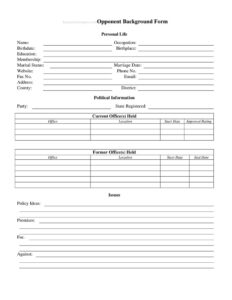
Opponent Information Form
Download a free Opponent Information Form template to organize opposition research on a rival candidate, in PDF and DOCX with no signup required.
PDF
DOCX
6 downloads
0
likes
Download Files
- DOCX
An Opponent Information Form is a structured document campaign teams use to compile and organize verified facts about a rival candidate in one place. People most often use it to keep opposition research, voting records, public statements, and contact details accurate and accessible during a campaign. You can download it free in PDF and DOCX, with no signup required.
What Is an Opponent Information Form?
An Opponent Information Form is a research and tracking sheet used by political campaigns, party committees, advocacy groups, and debate-prep teams to document publicly available information about a competing candidate. It typically records the opponent’s name, the office sought, party affiliation, background, public positions, and notable statements, along with the source for each item. The form exists to centralize what a team knows so messaging, fact-checking, and debate preparation stay consistent and grounded in verifiable evidence. Rather than scattering notes across emails and spreadsheets, the form creates a single, dated record that staff and volunteers can update over the course of a campaign.
When Do You Need an Opponent Information Form?
This form is useful any time a campaign needs to understand and respond to a competitor. Common situations include:
- Launching a campaign and building a baseline profile of each declared opponent before voters tune in.
- Preparing for a debate or candidate forum, where staff need quick access to the opponent’s prior statements and positions.
- Drafting comparative messaging for mailers, ads, or social media that contrast the candidates’ records.
- Responding to attacks, when a team must verify whether a claim made by or about the opponent is accurate.
- Onboarding new staff or volunteers who need a concise, sourced summary of the competitive landscape.
- Tracking a race over time, logging new endorsements, fundraising disclosures, and public appearances as they happen.
What an Opponent Information Form Should Have
A complete and useful form captures both identity details and substantive research, with sourcing built in. Key elements include the opponent’s full name and any commonly used variations, the office or position they are seeking, and their party affiliation. It should record professional and political background, current and past public positions on major issues, and notable public statements with dates. Critically, every claim should have a source citation and a date the information was gathered. Adding fields for endorsements, campaign finance highlights, public contact or campaign information, and a researcher’s name keeps the record organized and accountable. The goal is verifiable, attributable information — not rumor.
How to Fill Out an Opponent Information Form
Work through the form section by section, citing a source for every entry:
- Opponent name: Enter the candidate’s full legal name and note any nicknames or alternate spellings used publicly.
- Office sought: Record the specific office, district, and election date so the profile is unambiguous.
- Party affiliation: List the party and note any past affiliation changes if relevant.
- Background: Summarize education, career, and prior public service, keeping to documented facts.
- Public positions: List the opponent’s stated stance on major issues, each tied to a quote, vote, or published platform.
- Notable statements: Capture direct quotes with the date, venue, and a link or citation to the source.
- Endorsements and finance: Note key endorsements and publicly disclosed campaign finance highlights.
- Sources: For each item, record where it came from and the date you collected it.
- Researcher and date: Sign off with who compiled the entry and when it was last updated.
Keeping Research Ethical and Accurate
Opposition research is a normal part of competitive politics, but it is only valuable when it is honest and verifiable. Restrict the form to publicly available information — voting records, public statements, official filings, news coverage, and campaign materials. Avoid speculation, hearsay, and anything that misrepresents what an opponent actually said or did. Quoting accurately and in context protects your campaign’s credibility; a single fabricated or distorted claim can undermine an entire message. Treat the form as a fact file your team can defend, not a rumor mill. When in doubt about whether something is fair game or how it may be used, consult campaign counsel.
Sourcing and Version Control
Because campaigns move quickly and information changes, discipline around sourcing and updates matters. Attach a citation to every line so that any staffer can re-verify a claim before it goes public. Date each entry and re-check time-sensitive items — endorsements, poll standings, and finance figures — as the race develops. If multiple team members contribute, use the researcher field to make ownership clear and resolve conflicting notes. Keep older versions rather than overwriting them, so you can trace when a position or claim first appeared. A well-maintained, dated form becomes a reliable institutional memory that survives staff turnover.
Common Mistakes to Avoid
- Recording claims without sources, which makes the information unusable when accuracy is questioned.
- Quoting out of context or paraphrasing in a way that changes the meaning of a statement.
- Mixing opinion with fact, so readers can’t tell what is documented and what is interpretation.
- Letting the file go stale by failing to date entries or update changing figures.
- Relying on a single source for sensitive claims instead of corroborating them.
- Including non-public or improperly obtained information, which creates legal and ethical risk.
Frequently Asked Questions
What is an Opponent Information Form used for? It is a worksheet that consolidates verified, publicly available information about a rival candidate — their background, positions, statements, and sources. Campaigns use it to prepare messaging, ready candidates for debates, and fact-check claims quickly and consistently.
Is opposition research legal? Compiling information that is already public — voting records, official filings, public statements, and news coverage — is a routine and lawful part of campaigns. The legal and ethical line is crossed when information is obtained improperly or used to spread false claims, so keep entries factual and sourced and consult counsel about anything uncertain.
How do I fill out the form? Start with the opponent’s name, office sought, and party affiliation, then add background, public positions, and dated quotes. Attach a source citation to every entry and note who compiled it and when, so each claim can be verified later.
Does this form need to be filed with anyone? No. It is an internal research and organizing document, not an official filing. It is meant to be used and updated by your own team rather than submitted to an election authority.
How often should I update it? Treat it as a living document and revisit it whenever the race shifts — new endorsements, fundraising disclosures, debate performances, or major statements. Re-checking time-sensitive items and dating each update keeps the file reliable.
How much does this template cost? Nothing — it is a free download here in both PDF and DOCX formats with no signup required. You can edit the DOCX to add your own fields or print the PDF for quick handwritten notes.
This template is a general example provided for informational purposes only and is not legal, campaign-compliance, or election-law advice. Rules governing campaign activity and the use of information vary by jurisdiction. Consult a qualified attorney or campaign-compliance professional for guidance specific to your situation.
Related Forms
- Sponsorships Tracker
- Endorsements Tracker
- Fundraising Budget
- Speaking Events Tracker
- Candidate Information Form
- Voting Demographics By Age
Browse more in Political.