
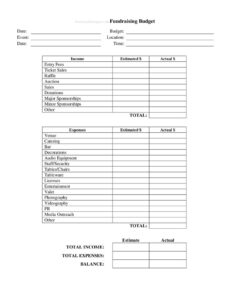
Fundraising Budget
Plan campaign income and expenses with our free Fundraising Budget template, available as a free download in PDF and DOCX for nonprofits and committees.
PDF
DOCX
2 downloads
0
likes
Download Files
- DOCX
A Fundraising Budget is a planning document that lays out the projected income and expenses for a fundraising effort, helping you set realistic goals before a single dollar is raised. Campaign teams, nonprofits, and political committees use it most often to estimate net proceeds from an event or appeal and to keep spending in check. You can download this Fundraising Budget template for free in both PDF and DOCX formats, with no signup required.
What Is a Fundraising Budget?
A Fundraising Budget is a financial roadmap that compares the money you expect to raise against the money you expect to spend on a campaign, gala, online appeal, or grassroots drive. It is typically prepared by a campaign treasurer, development director, event chair, or finance committee at the start of planning. The document records anticipated revenue sources, itemized costs, and the resulting net figure that will actually support your cause or candidate. Because political and nonprofit fundraising is often subject to reporting requirements, a written budget also creates an early paper trail that supports later disclosure and reconciliation. In short, it turns a vague goal into a concrete, trackable plan.
When Do You Need a Fundraising Budget?
Almost any organized fundraising activity benefits from a written budget. Common situations include:
- Planning a campaign event such as a gala, dinner, auction, or rally where ticket sales must outpace venue and catering costs.
- Launching an online or direct-mail appeal where you need to weigh postage, platform fees, and design costs against expected donations.
- Setting a quarterly or election-cycle target for a political committee so the finance team knows how much net cash will be available for ads or operations.
- Seeking board or committee approval before committing the organization to deposits, contracts, or staffing.
- Comparing several fundraising options to decide which event or channel yields the best return on effort and money.
- Reviewing results afterward by placing actual figures next to your projections to learn what worked.
Types of Fundraising Budgets
Not every budget looks the same. An event budget focuses on a single occasion and tallies venue, food, entertainment, and ticket revenue. A campaign-period budget spans a quarter, a year, or an election cycle and aggregates many activities. A program or appeal budget isolates one channel, such as a year-end email drive or a peer-to-peer campaign. Choosing the right scope keeps the numbers meaningful and the comparisons fair.
What a Fundraising Budget Should Have
A complete Fundraising Budget should identify the organization or committee and the specific campaign or event it covers, along with the budget period and the person responsible. The body should separate projected income by source — ticket sales, individual donations, sponsorships, grants, and merchandise — from projected expenses by category, such as venue, printing, postage, platform and processing fees, staffing, and promotion. Each line should show an estimated amount, and the document should calculate total revenue, total costs, and the resulting net amount available for the cause. A notes column for assumptions and a space for approval signatures round out a useful, defensible plan.
How to Fill Out a Fundraising Budget
- Add the header details. Enter the organization, committee, or candidate name, the title of the event or campaign, and the budget period or event date.
- Name the preparer. Record who created the budget and who must approve it, so accountability is clear.
- List income sources. Create a line for each revenue stream — ticket sales, sponsorships, individual gifts, grants, and merchandise — and enter the estimated amount for each.
- Total projected income. Add the income lines to produce your gross revenue goal.
- List expense categories. Itemize every anticipated cost: venue, catering, printing, postage, design, software, payment-processing fees, staffing, and promotion.
- Total projected expenses. Sum the cost lines to see your full investment.
- Calculate the net. Subtract total expenses from total income to find the net proceeds that will actually fund your cause.
- Document assumptions. Use the notes column to explain attendance estimates, average gift size, or vendor quotes.
- Obtain approval. Sign and date the budget, and have the responsible officer or committee sign off before spending begins.
Tracking Actuals and Compliance Notes
A budget is most valuable when you revisit it. As money comes in and bills are paid, record the actual figures beside your projections to spot variances early — for example, lower-than-expected ticket sales or a venue invoice that exceeded the quote. This running comparison helps you adjust marketing or trim costs mid-campaign. For political committees and registered nonprofits, accurate income and expense records also feed into disclosure filings and tax documentation. Keep receipts, contracts, and donor records organized alongside the budget. Note that reporting thresholds, contribution limits, and filing rules vary by jurisdiction and by the type of organization, so confirm the requirements that apply to your committee before relying on this document for compliance.
Common Mistakes to Avoid
- Overestimating income. Optimistic attendance or donation projections lead to overspending; use conservative, evidence-based numbers.
- Forgetting hidden fees. Payment-processing charges, taxes, gratuities, and platform commissions can quietly erode net proceeds.
- Omitting in-kind values. Donated venues or services should be noted so the real economics of the event are clear.
- Skipping a contingency line. Unexpected costs are common; reserve a small buffer rather than budgeting to zero.
- Never comparing actuals to projections. A budget that is filed and forgotten teaches you nothing for next time.
- Ignoring approval and recordkeeping. Spending without sign-off or supporting documents creates governance and compliance risk.
Frequently Asked Questions
What is a Fundraising Budget used for? It is used to plan and control the money tied to a fundraising effort, projecting how much you will raise and spend so you know the realistic net result. Teams use it to win approval, guide spending decisions, and later measure performance against the plan.
Who should prepare the budget? Typically a campaign treasurer, finance committee, development director, or event chair prepares it, often with input from anyone responsible for major costs. Having one accountable preparer and a designated approver keeps the document accurate and authoritative.
Is a Fundraising Budget legally binding? No, a budget itself is an internal planning tool, not a contract, so it does not create legal obligations on its own. However, the records it supports may feed into financial disclosures or tax filings that do carry legal weight, so accuracy matters.
How detailed should the budget be? It should be detailed enough that every significant income source and cost has its own line, but not so granular that it becomes unmanageable. Grouping small, related costs under sensible categories with notes usually strikes the right balance.
How much does this template cost? Nothing — this Fundraising Budget template is completely free to download in PDF and DOCX, with no account or signup required. You can edit the DOCX version to match your organization’s specific revenue sources and expense categories.
Can I use this for a political committee? Yes, the template works well for political fundraising as well as nonprofit and community events. Just remember that contribution limits, reporting deadlines, and disclosure rules differ by jurisdiction, so verify the requirements that govern your committee.
This Fundraising Budget template is provided as a general example for informational purposes only and does not constitute legal, financial, tax, or campaign-finance advice. Reporting and compliance requirements vary by jurisdiction and organization type; consult a qualified professional before relying on this document.
Related Forms
- Fundraising Budget Spreadsheet
- Contribution Tracker
- Campaign Funding Violation Complaint Letter
- Voting Demographics By Age
- Voting Demographics By Gender
- Opinion Poll
Browse more in Political.