
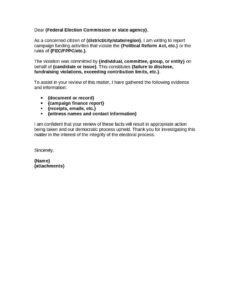
Campaign Funding Violation Complaint Letter
Use this free Campaign Funding Violation Complaint Letter template to report suspected campaign finance violations clearly and formally—free download in PDF and DOCX.
DOCX
3 downloads
0
likes
Download Files
- DOCX
A Campaign Funding Violation Complaint Letter is a formal written notice used to report a suspected breach of campaign finance laws to the appropriate election authority or oversight body. People most often use it to flag undisclosed contributions, illegal donations, or spending irregularities by a candidate or political committee. You can download this template free in both PDF and DOCX formats—no signup required.
What Is a Campaign Funding Violation Complaint Letter?
A Campaign Funding Violation Complaint Letter is a document submitted by a concerned citizen, watchdog group, opposing campaign, or election official to formally allege that a candidate, political action committee, or party organization has violated campaign finance rules. It identifies the party accused of wrongdoing, describes the specific conduct in question, and requests that the receiving agency investigate. The letter serves as an official record, often triggering a review or audit. Because election agencies typically require complaints in writing, this letter is the standard first step. It does not decide guilt—it simply puts a factual allegation on the record so that the proper authority can evaluate whether the law was broken and what enforcement action, if any, is warranted.
When Do You Need a Campaign Funding Violation Complaint Letter?
This letter is appropriate whenever you have a good-faith belief that campaign finance rules have been broken and want an authority to look into it. Common situations include:
- A candidate appears to have accepted donations exceeding the legal contribution limit from a single donor or entity.
- A campaign failed to disclose contributions or expenditures in required public reports.
- You suspect funds were funneled through straw donors or undisclosed sources to hide their origin.
- A committee used campaign funds for clearly personal expenses unrelated to the campaign.
- Foreign nationals or prohibited corporate sources appear to have contributed money.
- Coordination between a candidate and a supposedly independent group seems to have occurred in violation of the rules.
What a Campaign Funding Violation Complaint Letter Should Have
To be taken seriously and acted upon, the letter should contain several core elements. First, your full name and contact information as the complainant, so the agency can follow up. Second, the date and the name and address of the agency or office receiving the complaint. Third, the identity of the candidate, committee, or individual you believe violated the rules. Fourth, a clear, factual description of the alleged conduct, including dates, amounts, and how you became aware of it. Fifth, references to the specific rule or reporting requirement you believe was breached, if known. Finally, a signature and, where required, a sworn or notarized statement attesting that the allegations are true to the best of your knowledge. Supporting documents or evidence should be attached and referenced.
How to Fill Out a Campaign Funding Violation Complaint Letter
Since this template is provided as a flexible framework, complete it step by step using your own facts:
- Enter the current date at the top, then add your full name, mailing address, phone number, and email as the complainant.
- Address the letter to the correct election or campaign finance authority, including the office name and full mailing address.
- Write a subject line identifying the matter, such as the candidate or committee name and the words “Campaign Finance Complaint.”
- Open with a sentence stating that you are filing a formal complaint and naming the party you believe committed the violation.
- Describe the alleged conduct in plain, factual language—what happened, when, how much money was involved, and how you learned of it.
- Cite the specific reporting requirement, contribution limit, or rule you believe was broken, if you know it.
- List any evidence you are attaching, such as copies of disclosure reports, screenshots, or news articles, and reference each item.
- Close with a clear request that the agency investigate the matter, then sign and date the letter. Include a notarized attestation if the agency requires one.
Stick to Verifiable Facts
The strength of a complaint rests on documented facts, not opinion or speculation. Describe only what you can support—amounts, dates, names, and the source of your information—and avoid characterizing motives or making accusations you cannot back up. If a piece of information is an inference rather than a fact, say so plainly. Election agencies generally dismiss vague or unsupported complaints, while specific, evidence-backed allegations are far more likely to prompt a review. Where possible, attach copies of public disclosure filings, official reports, or other records that the agency can independently verify. A focused, well-documented letter is more persuasive than a broad one full of allegations.
Filing and Confidentiality Notes
Procedures for filing differ by jurisdiction and by the level of the election—local, state, or federal. Some agencies require the complaint to be sworn or notarized; others accept a signed letter or an online submission. Many agencies make complaints part of the public record, so assume your name and the contents may become accessible. Knowingly filing a false complaint can carry penalties, so file only when you have a genuine, good-faith basis. Before sending, confirm the correct authority, the required format, and whether copies must go to multiple offices. Keep a dated copy of everything you submit for your own records.
Common Mistakes to Avoid
- Sending the letter to the wrong agency—confirm whether your concern falls under local, state, or federal jurisdiction.
- Making accusations without attaching or referencing supporting evidence.
- Using emotional or inflammatory language instead of a calm, factual tone.
- Leaving out key details like dates, dollar amounts, or the exact party involved.
- Forgetting to sign or to include a required notarized attestation.
- Failing to keep a copy of the complaint and its attachments for your records.
Frequently Asked Questions
What is a Campaign Funding Violation Complaint Letter? It is a formal written notice alleging that a candidate, committee, or individual has violated campaign finance rules. It is sent to an election authority and asks that agency to investigate the matter. The letter creates an official record of the allegation.
Who can file this complaint? In most jurisdictions, any person who believes campaign finance laws were broken may file, including voters, watchdog organizations, journalists, and opposing campaigns. You generally do not need to be directly harmed to file. Check your agency’s rules, as some have specific eligibility or residency requirements.
Does the letter need to be notarized? It depends on the agency. Some election authorities require complaints to be signed under oath or notarized to confirm the allegations are made in good faith, while others accept a signed letter or online form. Verify the requirement with the office receiving your complaint before submitting.
Is filing this complaint free? Most election agencies do not charge a fee to accept a campaign finance complaint, and this template is completely free to download in PDF and DOCX. You may incur small costs only for things like notarization or certified mailing, depending on the filing method.
What evidence should I include? Attach anything that supports your allegation, such as copies of public disclosure filings, bank or expenditure records you can lawfully access, screenshots, or news reports. Reference each attachment in the body of the letter so the reviewer can connect your statements to the evidence. Specific, verifiable documents make a complaint much stronger.
What happens after I file the complaint? The agency typically reviews the letter to decide whether it states a possible violation and whether it has jurisdiction. If so, it may open an investigation, request a response from the accused party, or dismiss the matter if the claim is unsupported. Timelines and procedures vary widely by agency.
This template is provided as a general example for informational purposes only and is not legal advice. Campaign finance rules, filing procedures, and complaint requirements vary by jurisdiction and by the level of election involved. Consult the relevant election authority or a qualified attorney before filing.
Related Forms
- Support Outreach Hours
- Candidate Favorability
- Endorsements Tracker
- Contributor Mailing List
- Opinion Poll
- Voting Demographics By Income
Browse more in Political.