
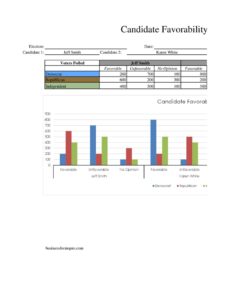
Candidate Favorability
Download a free Candidate Favorability form to survey voter opinion and approval ratings for political candidates in PDF or DOCX format with no signup.
PDF
XLSX
2 downloads
0
likes
Download Files
- XLSX
A Candidate Favorability form is a structured survey used to measure how voters or constituents feel about a specific political candidate, capturing whether they view that person favorably, unfavorably, or neutrally. Campaigns, pollsters, advocacy groups, and student organizations use it to gauge public sentiment before an election, debate, or messaging push. You can download it free in both PDF and DOCX formats with no signup required.
What Is a Candidate Favorability Form?
A Candidate Favorability form is a polling instrument designed to collect a respondent’s overall impression of a candidate and the reasons behind that impression. It is typically issued by a campaign team, a polling firm, a political science class, or a nonprofit conducting research. The form documents the respondent’s level of approval, name recognition, party preference, and sometimes the issues that shape their opinion. Unlike a simple ballot, it does not ask who someone will vote for outright; instead it isolates the emotional and reputational standing of an individual candidate. The aggregated results help campaigns understand their standing, identify weaknesses, and decide where to focus outreach, advertising, and resources before voting begins.
When Do You Need a Candidate Favorability Form?
This form is useful any time you need a quick, repeatable way to capture voter sentiment about a candidate. Common situations include:
- Pre-election polling — measuring a candidate’s standing weeks or months before voting day to set a baseline.
- Tracking polls — running the same questions repeatedly to see whether favorability rises or falls after debates, ads, or news events.
- Primary positioning — comparing how members of the same party view several candidates competing for a nomination.
- Message testing — checking whether a new campaign theme or response to an attack improves perception.
- Academic or classroom research — political science students studying public opinion and survey methodology.
- Local and student government races — small organizations gauging campus or community sentiment without hiring a professional firm.
What a Candidate Favorability Form Should Have
A complete favorability form balances clarity with enough detail to be useful. At minimum it should capture the candidate’s name, the respondent’s overall favorability rating on a clear scale, and a measure of name recognition (whether the respondent has even heard of the candidate). Strong forms also record the respondent’s party affiliation, district or location, and one or two open or multiple-choice items explaining the rating. A date and survey identifier help you compare results over time, and a brief introduction reassuring respondents that answers are anonymous improves honesty and response rates. Keep wording neutral so the question itself does not push respondents toward a particular answer.
How to Fill Out a Candidate Favorability Form
Whether you are the surveyor entering responses or a respondent completing it directly, work through the form in order:
- Enter the survey date and identifier so the response can be grouped with the correct polling wave.
- Record the candidate’s full name and the office being sought, since favorability is always tied to one specific person.
- Mark name recognition — indicate whether the respondent recognizes the candidate before asking for an opinion; unrecognized names skew the rest.
- Select the favorability rating on the provided scale, such as very favorable, somewhat favorable, neutral, somewhat unfavorable, or very unfavorable.
- Note the respondent’s party preference and any demographic or district fields included.
- Capture the reason in the comment or issue field, recording what drives the impression.
- Review for completeness before submitting, confirming no rating was skipped.
Reading and Using the Results
Once you have collected responses, the value comes from comparison rather than a single number. Calculate a net favorability score by subtracting the percentage of unfavorable ratings from the percentage of favorable ones; a positive net suggests a candidate is generally well regarded. Break the data down by party, district, and the reasons respondents gave to find where opinion is soft and where it is solid. If you are running tracking polls, plot the net score over time so you can connect changes to specific campaign events. Always note your sample size and how respondents were selected, because a small or self-selected group cannot represent an entire electorate and should be presented honestly.
Keeping the Survey Fair and Neutral
The credibility of a favorability survey depends on neutral design. Avoid leading language, loaded adjectives, or questions that praise or criticize the candidate before asking for an opinion. Present the rating scale in a consistent order and offer a genuine neutral or “don’t know” option so undecided respondents are not forced to pick a side. If you survey people about more than one candidate, rotate the order to reduce bias. Be transparent about who is conducting the survey and how the data will be used; respondents who trust the process give more honest answers, and ethical practice protects your organization’s reputation.
Common Mistakes to Avoid
- Skipping name recognition — recording favorability for a candidate the respondent has never heard of produces meaningless data.
- Using a biased scale — offering more favorable options than unfavorable ones quietly inflates results.
- Leading wording — phrasing that compliments or attacks the candidate first contaminates the response.
- Ignoring sample size — drawing conclusions from a handful of responses or a non-random group.
- Forgetting the date — without it you cannot compare waves or tie shifts to events.
- Leaving out the reason field — a number alone tells you the standing but not how to improve it.
Frequently Asked Questions
What is a Candidate Favorability form used for? It is used to measure how voters or constituents perceive a specific political candidate, separating approval from voting intention. Campaigns, pollsters, and researchers use the results to understand a candidate’s reputation and decide where to focus outreach. It is a sentiment tool, not a ballot.
How do I fill out a Candidate Favorability form? Start by entering the date and the candidate’s name, then mark whether the respondent recognizes that candidate. Select the favorability rating on the provided scale, record party preference and location, and note the reason for the rating. Review the form for any skipped fields before submitting.
What is the difference between favorability and approval? Favorability measures an overall personal impression of a candidate, while approval usually refers to satisfaction with a specific job or performance once someone holds office. They often move together but can diverge — a voter might find a candidate likeable yet disapprove of a particular decision. This form focuses on the broader favorable-or-unfavorable impression.
Does a Candidate Favorability form need to be anonymous? Anonymity is strongly recommended because respondents answer more honestly when their identity is not attached to their opinions. The template can be completed without personal identifiers if you choose. Always tell respondents up front how their answers will be used.
Is this form a substitute for professional polling? It is a useful, low-cost tool for small campaigns, classrooms, and informal research, but it is not a replacement for scientifically sampled professional polling. Results from a small or self-selected group should not be presented as representative of an entire electorate. Treat the data as directional unless you follow rigorous sampling methods.
Is the Candidate Favorability form free to download? Yes. You can download this template completely free in both PDF and DOCX formats with no signup or account required. Edit the candidate names, scale, and questions to fit your race or research before distributing it.
This template is a general example provided for informational purposes only and does not constitute legal, campaign-finance, or polling-methodology advice. Survey and election-related requirements vary by jurisdiction and organization, so consult a qualified professional before using this form in a regulated context.
Related Forms
- Campaign Endorsement Request Letter
- Contributor Mailing List
- Electorate Information
- Candidate Information Form
- Fundraising Budget
- Voting Demographics By Age
Browse more in Political.