
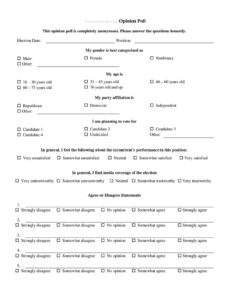
Opinion Poll
Use this free Opinion Poll template to gather clear, unbiased responses from voters, members, or the public — free download in PDF and DOCX.
PDF
DOCX
2 downloads
0
likes
Download Files
- DOCX
An Opinion Poll is a structured questionnaire used to measure what a group of people thinks about a candidate, issue, policy, or proposal. The most common reason people use one is to gather quick, comparable feedback from voters, members, or the general public before making a decision or shaping a message. This template is free to download in both PDF and DOCX, with no signup required.
What Is an Opinion Poll?
An Opinion Poll is a survey instrument that collects the views, preferences, or attitudes of a defined group on one or more topics. It is typically issued by campaigns, political parties, advocacy groups, community organizations, student bodies, or researchers, and completed by respondents either on paper or electronically. The poll documents how people lean on specific questions, often using rating scales, yes/no choices, or multiple-choice options. Its purpose is to turn scattered, individual opinions into measurable data that can guide strategy, messaging, or policy. A well-built opinion poll keeps questions neutral, captures basic context about who is responding, and makes the results easy to tally and compare across a population.
When Do You Need an Opinion Poll?
Opinion polls are useful any time you need to understand how a group feels before you act. Common scenarios include:
- Election campaigns: measuring support for a candidate, name recognition, or which issues matter most to likely voters.
- Ballot measures and referendums: gauging whether residents favor or oppose a proposed tax, bond, or policy change.
- Community decisions: a neighborhood association polling members on a new rule, fee, or shared project.
- Message testing: finding out which arguments or slogans resonate before launching a public campaign.
- Organizational governance: unions, clubs, or boards sampling members before a formal vote.
- Issue advocacy: nonprofits documenting public sentiment to support a position with policymakers or the press.
Types of Opinion Poll Questions
Most polls combine a few question formats, and choosing the right mix improves the quality of your data. Closed-ended questions — yes/no, multiple choice, or rating scales such as 1 to 5 — produce clean numbers that are easy to chart. Open-ended questions invite respondents to explain their reasoning in their own words, which adds depth but takes longer to analyze. Demographic questions capture age range, district, or membership status so you can break results down by group. A balanced opinion poll usually leads with the topic questions, places demographics near the end, and keeps the total length short enough that people finish.
What an Opinion Poll Should Have
A complete opinion poll is clear, neutral, and easy to tally. The strongest versions include the following elements:
- A title and short introduction explaining the poll’s purpose and how responses will be used.
- An estimated completion time and a note on whether responses are anonymous.
- A clear set of questions written in plain, unbiased language.
- Consistent answer formats so results are comparable.
- Optional demographic fields for segmenting the data.
- Space for the date, location or district, and any reference to the issue or election being studied.
- Instructions for returning the completed poll.
How to Fill Out an Opinion Poll
Whether you are designing the poll or completing one, work through it in order:
- Add a title and introduction: name the poll and state its purpose in one or two sentences so respondents know what they are weighing in on.
- Enter the date and location: record when and where the poll is administered, plus the relevant district or organization.
- Note anonymity and instructions: tell respondents whether answers are anonymous and how to submit the completed form.
- Write the main questions: list each topic question with its answer options — yes/no, a rating scale, or multiple choice.
- Answer each item: as a respondent, mark the single option that best reflects your view, choosing one per question unless told otherwise.
- Complete open responses: add brief written comments where the poll invites explanation.
- Fill in demographics: provide optional details such as age range, district, or membership status if requested.
- Review and submit: check that every required question is answered, then return the poll by the stated method.
Writing Neutral, Reliable Questions
The credibility of an opinion poll depends almost entirely on how its questions are worded. Avoid leading phrasing that nudges respondents toward an answer, such as starting with “Don’t you agree that…” Keep each question focused on a single idea — a “double-barreled” question that asks about two things at once produces muddy results. Offer balanced answer choices so neither side is favored, and use the same scale throughout for consistency. Randomizing the order of candidates or options, when possible, reduces bias toward whatever appears first. Finally, keep the poll short; long questionnaires lower completion rates and skew your sample toward only the most motivated respondents.
Interpreting and Reporting Results
Once responses are collected, tally each question and calculate the share choosing each option. Be transparent about your sample: note how many people responded, how they were selected, and the dates the poll ran. Remember that a poll reflects only the people who answered — it is a snapshot, not a guarantee of future outcomes. When sharing results publicly, present the actual question wording alongside the numbers so readers can judge for themselves, and avoid overstating small differences that fall within normal variation.
Common Mistakes to Avoid
- Leading questions: wording that pushes respondents toward a preferred answer undermines the whole poll.
- Too many questions: long forms cause drop-off and unreliable data.
- Unbalanced answer choices: offering more positive than negative options skews results.
- Skipping context fields: omitting date, district, or sample details makes results hard to interpret later.
- Double-barreled questions: asking about two issues in one item confuses respondents.
- Ignoring anonymity: people answer more honestly when they know their responses are confidential.
Frequently Asked Questions
What is an opinion poll used for? An opinion poll is used to measure how a group of people feels about a candidate, issue, or proposal. Campaigns, organizations, and researchers use the results to guide strategy, test messages, and understand public sentiment before making decisions.
How do I fill out an opinion poll? Read each question carefully and select the answer that best reflects your view, choosing one option per question unless the form says otherwise. Add any written comments where requested, complete optional demographic fields, then return the poll by the method given in the instructions.
Are opinion poll responses anonymous? They can be, and many polls are designed to keep responses confidential to encourage honest answers. The form should state clearly whether your responses are anonymous; if it does not, ask the person administering the poll before completing it.
How many people should I poll? There is no single right number — it depends on the size of the group you want to represent and the precision you need. Larger, more randomly selected samples generally produce more reliable results, while small or self-selected samples should be treated as informal feedback only.
Is an opinion poll legally binding? No. An opinion poll measures sentiment and is not a formal vote or contract, so it does not create binding obligations. Official elections and member votes follow separate procedures defined by the relevant rules or bylaws.
How much does this opinion poll template cost? Nothing — this template is completely free to download in PDF and DOCX with no signup required. You can edit the questions, answer options, and instructions to fit your specific issue, election, or organization.
This Opinion Poll template is a general example provided for informational purposes only and does not constitute legal, electoral, or professional advice. Polling rules and disclosure requirements vary by jurisdiction and organization, so consult a qualified professional or your governing body before relying on poll results for official purposes.
Related Forms
- Media Contacts
- Support Outreach Hours
- Election Contributions Form
- Campaign Donation Request Letter
- Campaign Endorsement Request Letter
- Opponent Information Form
Browse more in Political.