
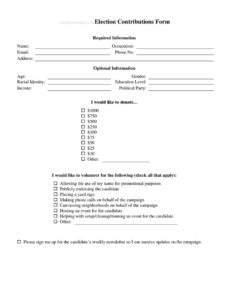
Election Contributions Form
Use our free Election Contributions Form template to record campaign donations accurately and stay compliant — free download in PDF and DOCX.
PDF
DOCX
6 downloads
0
likes
Download Files
- DOCX
An Election Contributions Form is a document used to record the details of a donation made to a political campaign, candidate, party, or committee. The most common reason people use it is to capture the required donor information for accurate campaign finance records and disclosure reporting. You can download this template free in both PDF and DOCX formats, with no signup required.
What Is an Election Contributions Form?
An Election Contributions Form is a record-keeping document issued by a campaign committee, political party, fundraising organization, or candidate to document a financial or in-kind contribution from a supporter. It is typically completed by the donor and retained by the campaign’s treasurer or finance staff. The form documents who gave, how much, when, and in what form, along with the certifications a contributor must affirm under applicable campaign finance rules. These records form the backbone of the periodic disclosure reports that many candidates and committees are required to file with election authorities, so accuracy and completeness are essential from the very first contribution received.
When Do You Need an Election Contributions Form?
Campaigns and committees rely on this form any time money or value changes hands. Common scenarios include:
- A donor writes a check or gives cash to a candidate’s campaign and the treasurer needs a complete record of the gift.
- An organization holds a fundraising event and collects multiple contributions that must each be individually documented.
- A supporter makes an in-kind contribution, such as donating printing services, venue space, or supplies, and its fair-market value must be recorded.
- A committee approaches or exceeds a reporting threshold and must produce itemized donor records for a disclosure filing.
- A recurring or pledged donor commits to giving over time and the campaign needs a baseline record of the arrangement.
- An auditor, compliance officer, or election authority requests documentation supporting the figures on a filed report.
Types of Contributions This Form Can Capture
A single template can document several kinds of support. Monetary contributions are direct gifts of cash, check, or electronic payment. In-kind contributions are goods or services provided at no charge or below market value, recorded at fair-market value. Pledges are promises to give in the future. Capturing the type accurately matters because different categories may be treated differently for reporting and limit purposes.
What an Election Contributions Form Should Have
A complete form leaves no ambiguity about the gift or the giver. At a minimum it should include the full legal name and contact details of the contributor, the recipient campaign or committee, the date and amount of the contribution, and the method of payment. Many jurisdictions also require occupation and employer information once a donor reaches a certain cumulative total, so a good form prompts for those fields. Finally, it should contain certification language by which the contributor affirms the gift is lawful — for example, that it is made from personal funds, not in another’s name, and within applicable limits — followed by a signature and date.
How to Fill Out an Election Contributions Form
Complete each field carefully, since these entries may feed directly into a public disclosure report:
- Recipient information: Enter the exact name of the campaign, candidate, party, or committee receiving the contribution, along with any committee identification number if one applies.
- Contributor name: Write the donor’s full legal name as it appears on official records, not a nickname or business shorthand.
- Contact details: Provide the contributor’s mailing address, phone number, and email so the campaign can confirm and report the gift.
- Occupation and employer: Record the donor’s occupation and the name of their employer, as many rules require this for itemized contributions.
- Contribution amount: Enter the exact dollar value. For in-kind gifts, state the fair-market value and describe the goods or services.
- Contribution type and method: Indicate whether the gift is monetary or in-kind, and the payment method — cash, check, credit card, or electronic transfer.
- Date received: Note the date the contribution was actually received by the campaign.
- Certification and signature: Have the contributor read the certification statements, then sign and date the form to affirm the gift is lawful.
Recordkeeping and Disclosure
The form is only the first step. Campaign treasurers should file each completed form in an organized system, ideally matching it to the corresponding bank deposit or in-kind valuation worksheet. Because many jurisdictions require periodic itemized reporting of contributions above a threshold, keeping clean, dated, signed records makes filing far easier and protects the campaign during any audit or inquiry. Retain these forms for the full period your election authority requires, which often extends beyond the election itself.
How It Differs From a Donation Receipt
An Election Contributions Form and a charitable donation receipt may look similar, but they serve different purposes. A charitable receipt primarily helps a donor substantiate a tax deduction. A political contributions form, by contrast, exists chiefly for campaign finance compliance — political contributions are generally not tax-deductible, and the emphasis is on disclosure, source verification, and contribution limits rather than tax treatment. Treating the two as interchangeable is a frequent and avoidable error.
Common Mistakes to Avoid
- Leaving occupation or employer blank when the contribution amount triggers a requirement to collect that information.
- Accepting and recording a cash gift above the limit your jurisdiction allows for cash contributions.
- Failing to record in-kind gifts, or guessing at their value instead of using fair-market value.
- Omitting the contributor’s signature on the certification, which is what affirms the gift is lawful.
- Recording the deposit date instead of the date the campaign actually received the contribution.
- Storing forms loosely so they cannot be matched to bank records when a report is due.
Frequently Asked Questions
What is an Election Contributions Form used for? It is used to document the details of a donation to a political campaign, candidate, party, or committee. The recorded information — donor name, amount, date, and certification — supports the campaign’s internal records and any required public disclosure reports.
How do I fill out an Election Contributions Form? Enter the recipient committee, the contributor’s full legal name and contact details, occupation and employer where required, the amount and type of contribution, the method of payment, and the date received. The contributor then reads the certification statements and signs and dates the form.
Are political contributions tax-deductible? Generally no — contributions to political campaigns and committees are typically not tax-deductible as charitable donations. The purpose of this form is campaign finance compliance and disclosure, not to substantiate a tax deduction, so do not treat it like a charitable receipt.
Does this form need to be notarized or witnessed? Notarization is usually not required for a contribution record. The contributor’s signature on the certification is generally what gives the form its weight, though specific requirements vary by jurisdiction and by the type of committee involved.
Is there a limit to how much someone can contribute? Contribution limits exist in many jurisdictions and can differ by office, donor type, and election cycle. Always confirm the current limits that apply to your campaign before accepting a gift, and use the form to document the source so you can verify compliance.
How much does this Election Contributions Form template cost? It is completely free to download here in both PDF and DOCX formats, with no signup or payment required. You can edit the DOCX version to add your committee’s name and any jurisdiction-specific certification language before distributing it to donors.
This Election Contributions Form template is provided as a general example for informational purposes only and is not legal, financial, or tax advice. Campaign finance rules, contribution limits, and disclosure requirements vary by jurisdiction and change over time — consult a qualified attorney or compliance professional and your governing election authority before relying on this document.
Related Forms
- Voting Demographics By Education
- Sponsorships Tracker
- Candidates Comparison Chart
- Fundraising Budget
- Opponent Information Form
- Voting Demographics By Gender
Browse more in Political.