
Voting Demographics By Education
Download a free Voting Demographics By Education template to record and analyze voter turnout by education level in PDF or DOCX format.
PDF
XLSX
4 downloads
0
likes
Download Files
- XLSX
A Voting Demographics By Education form is a structured worksheet used to record, organize, and analyze how voters break down by their level of educational attainment. Campaigns, researchers, civic organizations, and pollsters most often use it to understand which education segments turned out, supported a candidate, or responded to outreach. It is free to download here in both PDF and DOCX formats with no signup required.
What Is a Voting Demographics By Education Form?
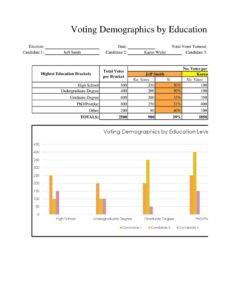
A Voting Demographics By Education form is a data-collection and reporting template that captures voter participation figures grouped by educational background — for example, no high school diploma, high school graduate, some college, associate degree, bachelor’s degree, and graduate or professional degree. It is typically issued by a campaign analytics team, a political science researcher, a nonprofit get-out-the-vote (GOTV) coordinator, or a polling firm. The form documents how many voters fall into each education tier, what share of the total they represent, and how their turnout or preferences compare. Its purpose is to turn raw voter or survey records into a clear, comparable snapshot that supports outreach planning, message targeting, and academic or journalistic analysis.
When Do You Need a Voting Demographics By Education Form?
This form is useful any time education level is a meaningful variable in understanding an electorate. Common scenarios include:
- Campaign strategy: A field director wants to know which education segments are under-engaged so canvassing resources can be redirected.
- Post-election analysis: A team reviews precinct or county results to see how turnout differed between college-educated and non-college voters.
- Academic research: A political science student or professor studies the relationship between educational attainment and voter participation.
- Polling and survey work: A research firm weights or segments respondents by education to ensure a sample reflects the broader population.
- Nonprofit voter education: A civic group measures whether its registration drives reached voters across all education levels equally.
- Grant reporting: An organization documents the demographic reach of a funded outreach program for a foundation or board.
Types of Education Categories to Track
Most education-based voter analyses rely on a standard set of attainment tiers so the data stays comparable across sources. A typical breakdown includes voters with less than a high school diploma, high school graduates (including equivalency), those with some college or vocational training, holders of an associate degree, bachelor’s degree holders, and those with a graduate or professional degree. Choosing categories that match official statistics — such as those used by the U.S. Census Bureau — makes it far easier to benchmark your numbers against regional or national figures. Keep your categories consistent across reporting periods so trends remain meaningful.
What a Voting Demographics By Education Form Should Have
A complete and useful version of this form should include several core elements. First, a clear title and the reporting period or election date so the data is anchored in time. Second, a defined geographic scope — a precinct, ward, district, county, or state. Third, the education categories listed in a logical order from least to most attainment. Fourth, columns for the count of voters in each category, the percentage of the total, and where relevant the turnout rate. Fifth, a totals row that confirms the segments add up correctly. Finally, a notes or source field that records where the figures came from and any assumptions made.
How to Fill Out a Voting Demographics By Education Form
Because this is a flexible analytical template, fill it out methodically so the numbers stay accurate and easy to audit:
- Add the title and date range. Identify the election, survey, or reporting window the data covers.
- Define the geographic scope. Note the precinct, district, county, or other boundary so readers know what population the figures describe.
- List the education categories. Enter each attainment tier as its own row, ordered consistently.
- Enter the raw counts. For each education level, record the number of voters, respondents, or registered individuals.
- Calculate percentages. Divide each count by the total and record the share for that segment.
- Add turnout or preference data. If available, include columns for turnout rate or candidate support by category.
- Total every column. Sum the counts and confirm percentages reach 100.
- Record the source and notes. Cite where the data came from and flag any estimates or rounding.
Tips for Accurate and Ethical Reporting
Demographic data carries weight, so accuracy and transparency matter. Always cite your data source — whether it is the voter file, an exit poll, or census-based estimates — and distinguish clearly between hard counts and projections. Use the same education definitions across every report so comparisons hold up. Be cautious about drawing conclusions from small sample sizes, since a handful of voters in one category can swing a percentage dramatically. When sharing the form publicly, aggregate the data so no individual voter can be identified, and follow any applicable privacy rules governing voter records in your jurisdiction.
Common Mistakes to Avoid
- Inconsistent categories: Mixing different education groupings across reports makes the data impossible to compare.
- Percentages that don’t total 100: A rounding or entry error here undermines the credibility of the whole sheet.
- Omitting the data source: Without a citation, readers cannot judge how reliable the figures are.
- Confusing counts with rates: A large raw count is not the same as a high turnout rate; label each column clearly.
- Ignoring sample size: Treating a tiny sample as representative leads to misleading conclusions.
- Forgetting the time and place: Data without a date and geographic scope loses most of its analytical value.
Frequently Asked Questions
What is a Voting Demographics By Education form used for? It is used to organize and analyze how voters or survey respondents break down by educational attainment. Campaigns use it to target outreach, while researchers and journalists use it to study patterns in participation and preferences. The form turns scattered records into a clear, comparable summary.
How do I fill out the education categories? List each attainment tier — such as high school graduate, some college, bachelor’s degree, and graduate degree — as its own row in a consistent order. Enter the raw count for each, calculate its percentage of the total, and add a totals row. Matching official statistical categories makes benchmarking much easier.
Where does the data come from? Sources vary by purpose and may include public voter files, exit polls, official census estimates, or your own survey responses. Always record the source in the notes field so the figures can be verified. Avoid mixing data from sources with different definitions.
Is this form legally binding? No. It is an internal analytical and reporting worksheet, not a contract or government filing. Its value lies in clarity and accuracy rather than any legal status.
How much does this template cost? Nothing. You can download the Voting Demographics By Education template for free here in both PDF and DOCX formats, with no account or signup required. Edit it freely to match your own categories and reporting needs.
Does using this form raise privacy concerns? It can if individual records are exposed. Always aggregate data so no single voter is identifiable, and follow any rules in your jurisdiction governing access to and use of voter information. Reporting only summary counts and percentages keeps the analysis both useful and respectful of privacy.
This template is a general example provided for informational purposes only. It is not legal, statistical, or compliance advice, and rules governing voter data and demographic reporting vary by jurisdiction. Consult a qualified professional before relying on this form for official or published analysis.
Related Forms
- Voting Demographics By Affiliation
- Contribution Tracker
- Sponsorships Tracker
- Voting Demographics By Gender
- Opinion Poll
- Exit Poll
Browse more in Political.