
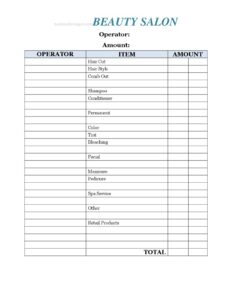
Salon Receipt
Download a free Salon Receipt template to bill clients for hair, nail, and spa services with itemized totals, tax, and tip — free download in PDF or DOCX.
PDF
DOCX
7 downloads
0
likes
Download Files
- DOCX
A Salon Receipt is a written record a salon or stylist gives a client after providing hair, nail, skin, or spa services and collecting payment. The most common reason people use one is to give clients clear proof of what they paid for — itemized services, products, tax, and tip — while keeping a tidy record for the business. You can download this Salon Receipt free in PDF or DOCX, with no signup required.
What Is a Salon Receipt?
A Salon Receipt is a transaction document issued by a beauty business — a hair salon, barbershop, nail salon, spa, or independent stylist — confirming that a client paid for services or retail products. It documents who provided the service, what was performed, the price of each item, any applicable sales tax, gratuity, and the total amount collected. Salons use it to confirm payment, support bookkeeping, and give clients something to keep for personal budgeting or expense claims. Because beauty services often mix labor (a haircut or manicure) with retail products (shampoo, polish, styling tools), a good salon receipt separates the two so both the client and the business can see exactly how the final total was built.
When Do You Need a Salon Receipt?
A salon receipt is useful any time money changes hands for a beauty service or product. Common situations include:
- After a standard appointment — a cut, color, blowout, manicure, pedicure, facial, or waxing session that the client pays for at checkout.
- Retail product sales — when a client buys shampoo, conditioner, styling products, or nail polish to take home.
- Package or membership purchases — prepaid bundles of services such as a series of facials or color appointments.
- Gift card sales — recording the amount loaded and the payment method used.
- Tip and tax tracking — clients who want documentation of gratuity, and salons that must report sales tax collected.
- Business expense reimbursement — clients (for example, models, performers, or wedding parties) who need an itemized receipt to claim styling costs.
What a Salon Receipt Should Have
A complete salon receipt should clearly identify both parties and the transaction. Key elements include the salon’s name, address, and phone number; a unique receipt number and the date and time of service; the client’s name; the name of the stylist or technician who performed the work; an itemized list of each service and any retail product with individual prices; the subtotal; sales tax; gratuity (tip); the grand total; and the method of payment. A blank line for notes — about products used, color formulas, or rebooking — adds helpful context. These elements turn a simple price into a transparent, professional record that protects both the salon and the client.
How to Fill Out a Salon Receipt
- Add your salon details. Enter the business name, address, phone number, and email or website at the top so the client knows who issued the receipt.
- Assign a receipt number and date. Use a sequential number for easy bookkeeping, then record the date and time of the appointment.
- Enter the client’s name. Add the client and the stylist or technician who performed the services.
- List each service. Write a short description (e.g., “Women’s cut and style,” “Gel manicure”) and its price on its own line.
- Add retail products. List any take-home products with quantity and price.
- Calculate the subtotal. Add up all service and product lines.
- Apply sales tax. Add tax where required on products and, in some areas, services.
- Add the tip. Record any gratuity the client chose to add.
- Total and record payment. Sum everything for the grand total and note the payment method — cash, card, or gift card.
Itemizing Services Versus Products
One feature that makes a salon receipt genuinely useful is the way it separates labor from retail. Services like a balayage, a keratin treatment, or a spa pedicure are skilled labor, while shampoo, serums, and styling tools are tangible goods. Listing them apart matters for two reasons. First, sales tax rules often treat them differently — many jurisdictions tax retail products but not personal services, though this varies widely, so check your local rules. Second, clear separation helps clients understand value and helps the salon analyze what is driving revenue. A receipt that simply shows a lump sum invites questions; an itemized one builds trust and reduces disputes at the front desk.
Tips for Professional, Trustworthy Receipts
Small habits make a big difference. Number your receipts in sequence so nothing slips through the cracks at tax time. Keep a copy for your records — paper, PDF, or both — and hand or email the original to the client. Use the notes line to record color formulas, product lines used, or the recommended rebooking window, which doubles as a service history for repeat visits. If you offer loyalty discounts or promotions, show the discount as its own line so the client sees the savings clearly. Consistent, legible receipts signal a well-run business and make accounting at month-end far simpler.
Common Mistakes to Avoid
- Lumping everything into one total — clients and bookkeepers benefit from itemized lines for each service and product.
- Forgetting the date and receipt number — these are essential for warranty, returns, and tax records.
- Mixing up tax and tip — keep gratuity and sales tax on separate lines so the math is transparent.
- Leaving off the stylist’s name — it matters for commission tracking and follow-up questions.
- Not noting the payment method — cash, card, and gift card balances need to be reconciled at the end of the day.
- Failing to keep a copy — without your own record, refunds and bookkeeping become guesswork.
Frequently Asked Questions
What is a salon receipt used for? It confirms that a client paid for beauty services or products and provides an itemized record of what was charged, including tax and tip. Clients keep it as proof of payment, and salons use it for bookkeeping and sales tracking.
How do I fill out a salon receipt? Start with your salon’s contact details, a receipt number, and the date, then list each service and product with its price. Add the subtotal, sales tax, and tip, total everything, and record the payment method.
Does a salon receipt need to include sales tax? If your jurisdiction requires tax on the items you sell, it should appear as a separate line. Tax rules differ by location and by whether you are selling services or retail products, so check your local requirements.
Is a salon receipt a legally binding document? A receipt is primarily proof that a payment was made rather than a contract. It can support disputes, refunds, and tax records, but it does not create ongoing obligations the way a service agreement might.
How much does this salon receipt template cost? Nothing. You can download it free from Business Forms Pro in PDF or DOCX with no signup, then customize it with your salon’s branding and pricing.
Should I give a receipt for tips paid by card? Yes — listing gratuity as its own line shows the full amount charged and helps both you and the client reconcile what was paid. It also keeps your tip reporting accurate at the end of the day.
This Salon Receipt template is a general example provided for informational purposes only and is not legal, financial, or tax advice. Sales tax and recordkeeping requirements vary by jurisdiction — consult a qualified accountant or professional to confirm what applies to your business.
Official resource: for the rules that apply to your situation, see your state DMV.
Related Forms
- As-Is Bill Of Sale
- Dog Bill of Sale
- Receipt for Company Property
- Salvage Bill Of Sale
- Snowmobile Bill Of Sale
- Boat Bill of Sale
Browse more in Bills of Sale.