
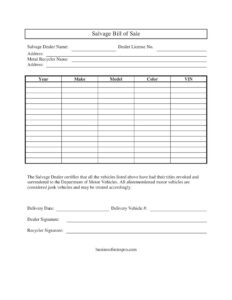
Salvage Bill Of Sale
Download a free Salvage Bill of Sale template to document the sale of junk vehicles from a salvage dealer to a metal recycler — free PDF and DOCX download.
PDF
DOCX
6 downloads
0
likes
Download Files
- DOCX
A Salvage Bill of Sale is a document that records the transfer of one or more junk or salvage vehicles from a licensed salvage dealer to a metal recycler. It is most often used to certify that the vehicles being sold have had their titles revoked and surrendered to the Department of Motor Vehicles before they are processed for scrap. You can download this template for free in both PDF and DOCX formats — no signup required.
What Is a Salvage Bill of Sale?
A Salvage Bill of Sale is a written record issued by a salvage dealer when selling one or more end-of-life vehicles to a metal recycler or scrap processor. Unlike a standard vehicle bill of sale, it does not transfer a roadworthy car with a clean title — instead, it documents that the listed vehicles are junk, that their titles have been revoked and surrendered to the DMV, and that they may be treated as scrap metal. The form names both parties, lists each vehicle by year, make, model, color, and VIN, and is signed by the dealer and the recycler to confirm the transaction and the condition of the vehicles being delivered.
When Do You Need a Salvage Bill of Sale?
Salvage dealers, auto recyclers, and scrap yards rely on this document any time junk vehicles change hands for recycling. Common situations include:
- A licensed salvage dealer selling a batch of crushed or stripped vehicles to a metal recycler for scrap value.
- Documenting that vehicle titles have been surrendered to the DMV so the vehicles can be legally treated as junk.
- Delivering multiple junk vehicles in a single load and needing a record that lists every VIN on the truck.
- Maintaining compliance records for state motor vehicle or environmental regulators who audit salvage operations.
- Providing the recycler with proof of lawful ownership transfer before the vehicles are shredded or melted down.
- Keeping an internal paper trail for tax, insurance, and accounting purposes when disposing of unsalvageable inventory.
What a Salvage Bill of Sale Should Have
A complete Salvage Bill of Sale should clearly identify both parties, each vehicle, and the certification that makes the sale lawful. Key elements include the salvage dealer’s business name and dealer license number, the dealer’s address, the metal recycler’s name and address, and a full list of vehicles with their year, make, model, color, and VIN. It should also contain the certification statement confirming that titles have been revoked and surrendered to the DMV, the delivery date, the delivery vehicle number, and signature lines for both the dealer and the recycler. Together these details establish who sold what, when, and on what legal basis.
How to Fill Out a Salvage Bill of Sale
- Salvage Dealer Name: Enter the legal business name of the salvage dealer making the sale.
- Dealer License No.: Write the dealer’s salvage or motor vehicle license number issued by your state.
- Address: Provide the dealer’s full business street address.
- Metal Recycler Name: Enter the name of the recycling business or scrap processor receiving the vehicles.
- Address: Record the recycler’s complete business address.
- Vehicle list: For each vehicle, fill in the Year, Make, Model, Color, and VIN. Use one row per vehicle and double-check each VIN for accuracy.
- Certification: Confirm the statement that all listed vehicles have had their titles revoked and surrendered to the DMV and are considered junk.
- Delivery Date: Enter the date the vehicles are delivered to the recycler.
- Delivery Vehicle #: Note the identifying number of the truck or transport used to deliver the load.
- Signatures: Have both the Dealer and the Recycler sign to confirm the transaction.
Why the Title Certification Matters
The certification statement is the heart of a Salvage Bill of Sale. By signing, the dealer affirms that the titles for every listed vehicle have already been revoked and surrendered to the Department of Motor Vehicles. This protects the recycler from receiving vehicles that still carry an active title, which could later create ownership disputes or regulatory problems. It also confirms that the vehicles qualify as junk and may be crushed, shredded, or melted down without further title processing. Because handling of revoked titles and salvage certificates varies by state, dealers should keep copies of the surrendered title documentation alongside this form.
Recordkeeping and Compliance Tips
Salvage and recycling operations are often subject to state inspection and environmental rules. Keep a signed copy of each Salvage Bill of Sale for your records, and give a copy to the recycler. Accurate VIN entries are essential because regulators and law enforcement use the VIN to confirm that a vehicle was lawfully processed and not stolen. Many dealers store these forms in date order alongside their title surrender receipts so a complete chain of custody can be produced quickly if requested.
Common Mistakes to Avoid
- Transposing or skipping digits in a VIN — every character must match the vehicle exactly.
- Leaving the dealer license number blank, which can call the legitimacy of the sale into question.
- Failing to confirm that titles were actually surrendered before signing the certification.
- Forgetting to fill in the delivery date or delivery vehicle number, leaving gaps in your records.
- Listing more vehicles than were actually delivered, or omitting a vehicle from the load.
- Not obtaining both signatures, which leaves the transfer unconfirmed by one party.
Frequently Asked Questions
What is a Salvage Bill of Sale used for? It documents the sale of junk or salvage vehicles from a licensed salvage dealer to a metal recycler. The form certifies that the vehicles’ titles have been revoked and surrendered to the DMV and that they may be treated as scrap. It serves as proof of the transaction for both parties.
How do I fill out a Salvage Bill of Sale? Enter the dealer’s name, license number, and address, then the recycler’s name and address. List each vehicle by year, make, model, color, and VIN, add the delivery date and delivery vehicle number, and have both the dealer and recycler sign. Verify every VIN before signing.
Does a Salvage Bill of Sale need to be notarized? Notarization is generally not required for a salvage sale between a dealer and a recycler, but requirements vary by state. Some jurisdictions may require additional paperwork or recordkeeping for salvage transactions. Check your state’s motor vehicle and salvage regulations to be sure.
Is a Salvage Bill of Sale legally binding? Once both parties sign, it serves as a record of the agreed transfer and the dealer’s certification about the vehicle titles. Its legal effect depends on state salvage and motor vehicle laws. Keeping it with your surrendered title documentation strengthens the chain of custody.
Can I list multiple vehicles on one form? Yes. This template is designed to list several vehicles, with a separate line for each one’s year, make, model, color, and VIN. This is useful when an entire load of junk vehicles is delivered to a recycler at the same time.
How much does this template cost? Nothing — it is completely free to download from Business Forms Pro in both PDF and DOCX formats, with no signup required. You can edit the DOCX version to match your business details or print the PDF and complete it by hand.
This Salvage Bill of Sale template is provided as a general example for informational purposes only and does not constitute legal, financial, or tax advice. Salvage, title surrender, and recycling requirements vary by jurisdiction. Consult a qualified professional or your state motor vehicle authority to ensure compliance with applicable laws.
Official resource: for the rules that apply to your situation, see your state DMV.
Related Forms
- Furniture Bill Of Sale
- Snowmobile Bill Of Sale
- Canoe Or Kayak Bill Of Sale
- Receipt for Company Property
- Antique Bill of Sale
- Rare Book Bill Of Sale
Browse more in Bills of Sale.