
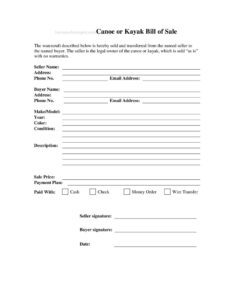
Canoe Or Kayak Bill Of Sale
Download a free canoe or kayak bill of sale template in PDF and DOCX to record the sale, transfer ownership, and protect both buyer and seller.
PDF
DOCX
4 downloads
0
likes
Download Files
- DOCX
A canoe or kayak bill of sale is a simple written record that documents the sale and transfer of a paddle craft from a seller to a buyer. People most often use it to prove ownership when selling a used canoe, kayak, or paddleboard privately, and it provides both parties a paper trail showing the agreed price and condition. You can download this template free in PDF and DOCX, with no signup required.
What Is a Canoe or Kayak Bill of Sale?
A canoe or kayak bill of sale is a short document that records the details of a paddle craft sale between two private parties. It identifies the buyer and seller, describes the vessel being sold, states the purchase price, and confirms that ownership has changed hands on a specific date. The seller typically issues it at the moment of sale, and both parties keep a signed copy. While a canoe or small kayak often doesn’t carry a title, the bill of sale serves as the primary proof of the transaction. It protects the seller by showing the craft was sold “as is,” and it protects the buyer by establishing a legitimate ownership trail in case registration or proof of purchase is later required.
When Do You Need a Canoe or Kayak Bill of Sale?
This form is useful any time a paddle craft changes hands outside of a retail store. Common situations include:
- Selling a used canoe, kayak, or paddleboard to a private buyer found through an online marketplace or classified ad.
- Buying a secondhand vessel and wanting written proof of the price and date for your records.
- Registering a motorized or larger kayak with your state when proof of ownership is required.
- Gifting a canoe or kayak to a family member or friend and documenting the transfer for clarity.
- Trading or selling a craft at a paddling club swap, garage sale, or community event.
- Donating a kayak to a nonprofit or camp and needing a record of the handover.
What a Canoe or Kayak Bill of Sale Should Have
A complete bill of sale leaves no ambiguity about what was sold, for how much, and to whom. The strongest versions include the full legal names and contact information of both the buyer and seller, a detailed description of the craft, the agreed purchase price, the date of sale, payment method, and signatures from both parties. The vessel description is the heart of the document: list the make or brand, model, length, color, material, and any hull identification number (HIN) or serial number stamped on the craft. A clear “as is” statement protects the seller from later disputes about condition, while space for any included accessories — paddles, life vests, roof racks — keeps the deal transparent.
How to Fill Out a Canoe or Kayak Bill of Sale
- Enter the date of sale at the top so the transfer is clearly time-stamped.
- Fill in the seller’s full name and address, followed by the buyer’s full name and address, so both parties are identified.
- Describe the vessel in the craft details section: brand or manufacturer, model, year, length, color, and material (such as polyethylene, fiberglass, or aluminum).
- Record the hull identification number (HIN) or serial number if the craft has one, which is essential for registration.
- List any included accessories, such as paddles, seats, life jackets, or a trailer.
- Write the agreed purchase price in both numbers and words, and note the payment method (cash, check, or transfer).
- Confirm the “as is” condition statement so the buyer accepts the craft in its current state.
- Have both the seller and buyer sign and date the form, and add a witness or notary if your state requires it.
Registration and Titling Notes
Whether a canoe or kayak must be registered varies widely by location. Many states do not require registration for human-powered paddle craft, but rules often change once a vessel has a motor mount, exceeds a certain length, or carries a trolling motor. If registration is required, the bill of sale is usually the document the boating or motor vehicle agency asks for as proof of ownership, along with the HIN. Keep the original signed copy in a safe place and store a photo or scan digitally. If you plan to launch on certain lakes or rivers, check whether a local launch permit or invasive-species sticker is also needed — these are separate from the bill of sale but worth confirming at the time of purchase.
Tips for a Smooth Paddle Craft Sale
Inspect the hull for cracks, soft spots, and UV damage before agreeing on a price, and test that any hatches or bulkheads seal properly. Take clear photos of the craft and its serial number at the time of sale, and attach copies to both parties’ bill of sale records. If accessories are part of the deal, list each one specifically rather than writing “extras included.” When meeting a private buyer, choose a public location and bring a second person if possible. Finally, complete two identical copies so the buyer and seller each walk away with a signed original.
Common Mistakes to Avoid
- Leaving out the hull identification number, which can stall registration later.
- Failing to write the purchase price in both words and numbers, leaving room for disputes.
- Forgetting to include the “as is” clause, which exposes the seller to condition complaints.
- Listing only a vague description like “green kayak” without brand, model, or length.
- Skipping signatures from one party or forgetting to date the document.
- Not making a copy for each side, so neither has independent proof of the sale.
Frequently Asked Questions
What is a canoe or kayak bill of sale? It is a written document that records the sale of a canoe, kayak, or similar paddle craft between a buyer and seller. It lists the parties, describes the vessel, states the price, and serves as proof that ownership transferred on a specific date.
How do I fill out a canoe or kayak bill of sale? Enter the date, the names and addresses of both parties, and a full description of the craft including make, model, length, and any serial or hull number. Then add the purchase price, payment method, an “as is” statement, and signatures from both the buyer and seller.
Does a canoe or kayak bill of sale need to be notarized? In most cases a notary is not required for a private paddle craft sale, but some states or registration offices may request notarized or witnessed signatures. Check your local boating or motor vehicle agency rules before completing the form.
Is a kayak bill of sale legally binding? Yes — once both parties sign it voluntarily and the details are accurate, it functions as a binding record of the transaction. It can be used as evidence of ownership and the agreed terms if a dispute arises.
Do I need to register my canoe or kayak? Requirements vary by state and depend on factors like whether the craft has a motor and its length. Human-powered canoes and kayaks are often exempt, but you should verify the rules where you live and use the bill of sale as proof of ownership if registration applies.
How much does this bill of sale cost? Nothing — this canoe or kayak bill of sale template is completely free to download in PDF and DOCX formats, with no signup or payment required. You can fill it in on your computer or print it and complete it by hand.
This template is a general example provided for informational purposes only and is not legal, financial, or tax advice. Registration and documentation requirements for canoes, kayaks, and other watercraft vary by jurisdiction — consult your local boating authority or a qualified professional before completing a sale.
Official resource: for the rules that apply to your situation, see your state DMV.
Related Forms
- Appliance Bill Of Sale
- As-Is Bill Of Sale
- Trailer Bill Of Sale
- Dog Bill of Sale
- Recreational Vehicle Bill Of Sale
- Bill of Sale With Lien
Browse more in Bills of Sale.