
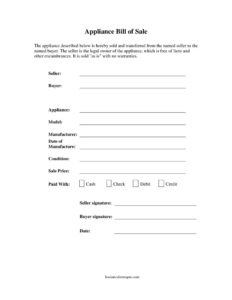
Appliance Bill Of Sale
Download a free Appliance Bill of Sale template in PDF or DOCX to record the sale and transfer of any household appliance — free download, no signup.
PDF
DOCX
16 downloads
0
likes
Download Files
- DOCX
An Appliance Bill of Sale is a simple document that records the sale and transfer of an appliance — such as a refrigerator, washer, dryer, oven, or dishwasher — from a seller to a buyer. People most often use it to create proof of ownership and the agreed price when selling a used appliance privately. You can download this Appliance Bill of Sale free in PDF or DOCX, with no signup required.
What Is an Appliance Bill of Sale?
An Appliance Bill of Sale is a written receipt and transfer-of-ownership record for a single appliance. The seller — usually a private individual, landlord, or small business — uses it to confirm they are the legal owner, that the appliance is free of liens, and that it is being sold “as is” with no warranties. The buyer receives documented proof of what they purchased, the price they paid, and when the transaction occurred. Unlike a vehicle title, appliances rarely have formal registration, so this document often serves as the only paper trail showing that money changed hands and that ownership shifted from one party to another on a specific date.
When Do You Need an Appliance Bill of Sale?
This form is useful any time an appliance changes hands for money and both parties want a clear record. Common situations include:
- Selling a used refrigerator, range, or freezer through an online marketplace or classified ad to a private buyer.
- Selling a washer and dryer set when moving or downsizing and you need a receipt for the buyer.
- A landlord transferring appliances to a tenant or new property owner as part of a separate transaction.
- Documenting an “as is” sale of an older or imperfect appliance so the buyer cannot later claim it was warranted.
- Providing proof of purchase for the buyer’s records, insurance, or potential resale down the road.
- Settling an estate or household where multiple appliances are sold individually to different buyers.
What an Appliance Bill of Sale Should Have
A complete Appliance Bill of Sale identifies both parties, describes the appliance in enough detail to distinguish it from any other, states the price and how it was paid, and is signed and dated by both sides. The description should include the manufacturer, model, and date of manufacture where available, along with the condition. An “as is” statement protects the seller, while the signatures and date make the document binding and give each party a copy that matches. The clearer the appliance description, the less room there is for a future dispute about exactly what was sold.
How to Fill Out an Appliance Bill of Sale
- Enter the Date of the sale at the top so the transaction is anchored in time.
- Fill in the Seller name (the current legal owner) and the Buyer name (the person receiving the appliance).
- Describe the Appliance — for example, “top-load washing machine” or “side-by-side refrigerator.”
- Record the Manufacturer (such as Whirlpool, GE, or LG), the Model number, and the Date of Manufacture if it appears on the appliance label.
- Note the Condition honestly — “used, fully working,” “sold for parts,” or any visible flaws.
- Enter the Sale Price agreed by both parties.
- Indicate Paid With by selecting the payment method: Cash, Check, Credit, or Debit.
- Have both parties sign: the Seller signature and the Buyer signature finalize the transfer.
Print or save two copies — one for the seller and one for the buyer — so each side keeps an identical, signed record.
Understanding the “As Is” Clause
This template states that the appliance is sold “as is” with no warranties. That means the buyer accepts the appliance in its current condition, with all faults known and unknown, and the seller is not promising it will continue to work for any period of time. For private sales of used appliances, this is standard and fair to both sides — it sets clear expectations and limits the seller’s exposure after the handoff. Buyers should test the appliance before signing if possible, since the document confirms they inspected and accepted it. Sellers should still describe the condition truthfully, because an “as is” clause does not protect against deliberate misrepresentation. Spelling out the actual condition in the form is the best protection for everyone.
After the Sale: Tips for Both Parties
Once both parties sign, the buyer becomes responsible for transport, installation, and any repairs. Sellers should hand over any original manuals, warranty cards, or installation hardware they still have, even if the sale is “as is.” Buyers should keep the signed bill of sale with their household records — it can help if they later resell the appliance, file an insurance claim after damage or theft, or need to prove the appliance is legitimately theirs. If the appliance still carries a transferable manufacturer warranty, note the original purchase date and keep any related documentation, though that protection is separate from this private sale.
Common Mistakes to Avoid
- Leaving the Model number or Manufacturer blank, which makes the appliance hard to identify later.
- Forgetting one of the signatures — an unsigned bill of sale offers little proof of the transaction.
- Describing the Condition vaguely or inaccurately, which can lead to disputes despite the “as is” clause.
- Not recording how payment was made in the Paid With section, leaving no link to a receipt or check number.
- Failing to date the document, which makes it unclear when ownership actually transferred.
- Only making one copy instead of giving each party a matching, signed version.
Frequently Asked Questions
What is an Appliance Bill of Sale used for? It documents the sale and transfer of an appliance from a seller to a buyer, recording the price, payment method, and condition. It serves as a receipt and as proof of ownership for the buyer. It is especially useful for private, used-appliance sales where no other paperwork exists.
Does an Appliance Bill of Sale need to be notarized? In most cases, no — a bill of sale for an appliance is valid once both the buyer and seller sign and date it. Notarization is generally not required for everyday household appliance sales. If you want added assurance or your local rules call for it, you can have signatures notarized, but it is usually optional.
Is an Appliance Bill of Sale legally binding? Yes, once both parties sign, it generally functions as a binding record of the transaction and the transfer of ownership. It shows the agreed price, the condition accepted, and the date of sale. Keeping a signed copy helps either party in the event of a future dispute.
What does “sold as is” mean on this form? It means the buyer accepts the appliance in its present condition with no warranties or guarantees from the seller. The seller is not promising the appliance will keep working or be free of defects. Buyers should inspect or test the appliance before signing whenever possible.
How much does this template cost? Nothing — this Appliance Bill of Sale is completely free to download in PDF or DOCX format. There is no signup, account, or payment required. You can fill it out by hand after printing or type directly into the editable version.
What information do I need before filling it out? You’ll want the names of the buyer and seller, the appliance’s manufacturer, model, and date of manufacture, its condition, the agreed sale price, and the payment method. Having the appliance’s label handy makes the model and manufacture date easy to record. Both parties should be present to sign and date the form.
This Appliance Bill of Sale template is provided as a general example for informational purposes only and is not legal, financial, or tax advice. Requirements for bills of sale vary by jurisdiction. For guidance on your specific situation, consult a qualified professional.
Official resource: for the rules that apply to your situation, see your state DMV.
Related Forms
- Golf Cart Bill Of Sale
- Antique Bill of Sale
- Collateral Receipt
- Musical Instrument Bill of Sale
- Snowmobile Bill Of Sale
- Canoe Or Kayak Bill Of Sale
Browse more in Bills of Sale.