
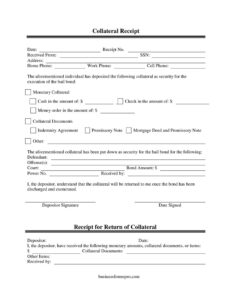
Collateral Receipt
Download a free Collateral Receipt template for bail bonds to document cash, checks, and collateral documents deposited as security — free PDF and DOCX download.
PDF
DOCX
3 downloads
0
likes
Download Files
- DOCX
A Collateral Receipt is a document that records the cash, checks, or property a person deposits as security for a bail bond. The most common reason people use one is to create a clear, signed paper trail proving exactly what collateral was handed over and the promise that it will be returned once the bond is discharged. You can download this Collateral Receipt template for free in both PDF and DOCX formats, with no signup required.
What Is a Collateral Receipt?
A Collateral Receipt is a written acknowledgment issued by a bail bond agent, bondsman, or surety company confirming that an individual (the depositor or indemnitor) has provided collateral to secure a defendant’s release on bail. It documents the type and amount of collateral — whether monetary, such as cash or a money order, or documentary, such as a promissory note or mortgage deed. The receipt also names the defendant, the offense, the court, and the bond amount. Crucially, it includes the bondsman’s commitment to return the collateral once the bond is exonerated. It protects both parties by establishing exactly what was deposited and under what conditions it will be released.
When Do You Need a Collateral Receipt?
This form comes into play any time a bail bond is secured with something of value. Common situations include:
- A family member or friend pledges cash to a bondsman to help a defendant make bail.
- A depositor signs over a promissory note or indemnity agreement as security rather than putting up cash.
- A property owner uses a mortgage deed on real estate to collateralize a high bond amount.
- A bondsman needs to issue proof of receipt the moment collateral changes hands, before posting the bond.
- The bond is discharged and exonerated, and the depositor needs documentation confirming the return of their cash or documents.
- A surety company maintains internal records linking each power number and bond to the collateral held against it.
Types of Collateral You Might Record
Collateral generally falls into two categories on this form. Monetary collateral includes cash, a personal or cashier’s check, or a money order, each entered as a dollar amount. Collateral documents are legal instruments that pledge value without an immediate cash transfer — these include an indemnity agreement, a promissory note, or a combined mortgage deed and promissory note secured by property. The form also leaves an “Other” line for items that do not fit neatly into these boxes, such as vehicle titles or other valuables. Recording the exact type matters because the return process and the documentation involved differ for cash versus a recorded deed.
What a Collateral Receipt Should Have
A complete Collateral Receipt should clearly identify the depositor, the defendant, and the bond it secures. It should specify the exact amount and form of collateral, the court and offense, the bond amount, and the power number assigned to the bond. It must include the depositor’s signature acknowledging the terms of return, the date, and the name of the person who received the collateral. A well-built receipt also contains a separate section for the eventual return of collateral, so both deposit and release can be tracked on a single document.
How to Fill Out a Collateral Receipt
- Enter the Collateral Receipt Date and a unique Receipt No. for your records.
- Complete the Received From line with the depositor’s full name, then add their SSN, Address, and Home, Work, and Cell Phone numbers.
- Under Monetary Collateral, fill in the dollar amount for any Cash, Check, or Money order deposited.
- Under Collateral Documents, check the items provided — Indemnity Agreement, Promissory Note, or Mortgage Deed and Promissory Note — or describe anything else on the Other line.
- Identify the bond by entering the Defendant, the Offense(s), the Court, the Bond Amount, and the Power No.
- The agent records their name on the Received by line.
- The depositor reviews the return statement, then signs the Depositor Signature line and adds the Date Signed.
- When the bond is exonerated, complete the Receipt for Return of Collateral section: the Depositor‘s name, the Date, the returned amounts, Collateral Documents, and Other Items, with a final Received by signature.
Return of Collateral and Next Steps
The lower portion of this form is designed to close the loop. Once the court discharges and exonerates the bond — meaning the defendant met all appearance obligations and the case is resolved — the bondsman returns the collateral. The depositor signs the return section acknowledging receipt of the exact cash, checks, documents, or other items handed back. Keep both halves of the completed receipt together. For collateral secured by real property, returning the documents may also involve releasing or reconveying a recorded deed, so coordinate with the bondsman or a title professional to ensure the lien is properly cleared.
Common Mistakes to Avoid
- Leaving the amount blank or vague — always write the exact dollar figure for cash, checks, or money orders.
- Not recording the Power No., which ties the collateral to the specific bond and prevents mix-ups.
- Forgetting the depositor’s signature and date, which is what makes the acknowledgment of return terms binding.
- Skipping the defendant and court details, leaving the receipt disconnected from the bond it secures.
- Failing to complete the return section when collateral is given back, which leaves no proof the depositor was made whole.
- Keeping no copy for the depositor — both parties should retain a signed version.
Frequently Asked Questions
What is a Collateral Receipt used for? It documents that a depositor has handed over cash, a check, a money order, or legal documents to a bail bondsman as security for a defendant’s bond. It serves as proof of what was deposited and confirms the bondsman’s obligation to return it once the bond is exonerated.
Who fills out a Collateral Receipt? The bail bond agent or surety company typically completes the receipt at the time collateral is deposited, recording the amounts and details. The depositor then signs to acknowledge the terms, and the same document is used again to confirm the return of collateral later.
Does a Collateral Receipt need to be notarized? A basic Collateral Receipt usually does not require notarization, but associated documents like a mortgage deed or some indemnity agreements may need to be notarized or recorded depending on local rules. Requirements vary by state, so check with your bondsman or local court.
Is a Collateral Receipt legally binding? When signed by both the depositor and the receiving agent, it serves as evidence of the transaction and the agreement to return collateral. Its enforceability depends on the underlying bail and indemnity agreements and applicable state law.
When will my collateral be returned? Collateral is returned after the bond is discharged and exonerated — that is, once the defendant has satisfied all court appearance requirements and the case is closed. The return section of this receipt should be completed and signed at that time.
How much does this Collateral Receipt template cost? Nothing — it is completely free to download from Business Forms Pro in both PDF and DOCX formats, with no signup required. You can edit it to match your agency’s needs and reuse it as often as you like.
This Collateral Receipt template is a general example provided for informational purposes only and does not constitute legal, financial, or tax advice. Bail bond and collateral requirements vary by jurisdiction. Consult a qualified attorney or licensed bail professional before relying on this document.
Official resource: for the rules that apply to your situation, see your state DMV.
Related Forms
- Salvage Bill Of Sale
- Musical Instrument Bill of Sale
- Large-Print Bill of Sale
- Snowmobile Bill Of Sale
- Horse Bill Of Sale
- Personal Watercraft Bill Of Sale
Browse more in Bills of Sale.