
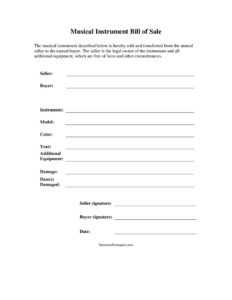
Musical Instrument Bill of Sale
Download a free Musical Instrument Bill of Sale template in PDF and DOCX to document the sale and transfer of any instrument with no signup required.
PDF
DOCX
20 downloads
0
likes
Download Files
- DOCX
A Musical Instrument Bill of Sale is a simple written record that documents the sale and transfer of an instrument from a seller to a buyer. People most often use it to create proof of ownership and price when buying or selling a guitar, violin, keyboard, or other instrument privately. You can download this template free in PDF and DOCX formats with no signup required.
What Is a Musical Instrument Bill of Sale?
A Musical Instrument Bill of Sale is a short legal document that records the details of a private instrument sale and confirms that ownership has passed from one party to another. It is typically created by the seller and signed by both the seller and the buyer at the time money changes hands. The form identifies the instrument by make, model, color, and year, lists any additional equipment included, notes existing damage, and confirms that the seller is the legal owner and that the item is free of liens. It serves as a receipt, a proof-of-ownership document, and a written acknowledgment of the condition the instrument was in on the day of the transaction.
When Do You Need a Musical Instrument Bill of Sale?
This document is useful any time an instrument changes hands and both parties want a clear record. Common situations include:
- Private sales: Selling a guitar, drum kit, or amplifier to another individual through a classifieds listing or local marketplace.
- Buying a used instrument: Getting written proof of ownership and condition before handing over cash for a violin, saxophone, or keyboard.
- Selling to or buying from a shop: Documenting a transaction with a music store or pawn dealer that wants a signed record.
- Gifting or transferring within a family: Recording the handover of a valued instrument, even at no or nominal cost.
- Insurance and appraisal records: Providing documentation of ownership and value for a homeowner’s or musician’s instrument policy.
- Resolving disputes: Establishing who owned the instrument and what condition it was in if a disagreement arises later.
What a Musical Instrument Bill of Sale Should Have
A complete bill of sale leaves no ambiguity about who, what, and when. The essentials include the full names of both the seller and the buyer, a precise description of the instrument (type, model, color, and year), a list of any additional equipment such as cases, pedals, straps, or amplifiers, and an honest note of any existing damage along with when that damage occurred. It should also include a statement that the seller is the rightful owner and that the instrument is free of liens or encumbrances, the date of sale, and the signatures of both parties. Together these elements turn a casual exchange into a documented transfer that protects everyone involved.
How to Fill Out a Musical Instrument Bill of Sale
- Seller: Enter the full legal name of the person or business selling the instrument.
- Buyer: Enter the full legal name of the person or business purchasing it.
- Instrument: Identify the type of instrument, for example “electric guitar,” “acoustic violin,” or “digital piano.”
- Model: Record the manufacturer and specific model name or number, such as “Fender Stratocaster” or “Yamaha P-125.”
- Color: Note the finish or color so the instrument is easy to identify.
- Year: Write the year of manufacture if known; estimate or write “unknown” if it cannot be verified.
- Additional Equipment: List everything included in the sale, such as a hard case, amplifier, cables, pedals, or stand.
- Damage: Describe any scratches, dents, cracks, or functional issues honestly and in detail.
- Date(s) Damaged: Record when the noted damage occurred, if known, to keep the condition history clear.
- Signatures and Date: Have both the seller and the buyer sign, and enter the date the sale is completed.
Recording the Instrument’s Condition
The damage and condition fields are one of the most valuable parts of this form. Because instruments are sensitive and often expensive, disagreements after a sale frequently center on whether a crack, fret buzz, or finish flaw was present before the handover. By describing each known issue and the date it occurred, you create a snapshot of the instrument’s condition at the moment of sale. Buyers should inspect the instrument carefully, ideally playing it before signing, and ask the seller to add anything they notice to the form. Sellers benefit equally: a documented description protects them from later claims that the instrument arrived in worse shape than agreed. Consider taking dated photographs and attaching or referencing them as well.
Bill of Sale vs. Receipt vs. Warranty
A bill of sale is broader than a basic receipt. A receipt simply confirms that money was paid, while a bill of sale also identifies the specific item, confirms the seller’s ownership, and documents the transfer and condition. It is not a warranty, however. Unless the seller separately promises future performance, most private instrument sales are made “as is,” meaning the buyer accepts the instrument in its current condition. If any guarantees about playability or repairs are part of the deal, note them in writing on the form or in an attached statement so both parties have the same understanding.
Common Mistakes to Avoid
- Leaving the description vague: “Guitar” is not enough — record the model, color, and year so the instrument is clearly identifiable.
- Skipping the additional equipment list: Failing to note the case, amp, or pedals can cause disputes about what was actually included.
- Hiding or omitting damage: Undisclosed cracks or repairs undermine the document and can lead to claims of misrepresentation.
- Forgetting both signatures and the date: An unsigned or undated form has little value as proof of the transaction.
- Not keeping copies: Both the buyer and seller should retain a signed copy for their records.
- Ignoring lien status: Confirm the seller truly owns the instrument outright and that it is not pledged as collateral.
Frequently Asked Questions
What is a Musical Instrument Bill of Sale? It is a written record that documents the sale and transfer of an instrument from a seller to a buyer. It identifies the instrument, lists included equipment, notes condition and damage, and is signed by both parties to confirm ownership has changed hands.
How do I fill out a Musical Instrument Bill of Sale? Enter the seller and buyer names, describe the instrument by type, model, color, and year, list any additional equipment, and honestly note any damage and when it occurred. Both parties then sign and date the form to complete it.
Does a Musical Instrument Bill of Sale need to be notarized? Notarization is usually not required for a private instrument sale, but some buyers or sellers request it for high-value items to add an extra layer of verification. Requirements vary by location, so check your local rules if you want notarized signatures.
Is a Musical Instrument Bill of Sale legally binding? Once both parties sign voluntarily and the details are accurate, it generally serves as a binding record of the transaction. Its enforceability and any specific formalities can vary by jurisdiction, so confirm what applies in your area.
How much does this template cost? Nothing — you can download this Musical Instrument Bill of Sale free of charge from Business Forms Pro in both PDF and DOCX formats, with no signup or account required.
Should I include the sale price? Yes, adding the agreed price is a good idea even if there is no dedicated field, since it strengthens the document as a receipt. You can write the amount and payment method near the description or in the additional equipment area for clarity.
This template is provided as a general example for informational purposes only and does not constitute legal, financial, or tax advice. Requirements for bills of sale and ownership transfers vary by jurisdiction. Consult a qualified professional to ensure your document meets the rules that apply to your situation.
Official resource: for the rules that apply to your situation, see your state DMV.
Related Forms
- Business Bill of Sale
- Salon Receipt
- Sports Memorabilia Bill Of Sale
- Artwork Bill Of Sale
- Bike Bill of Sale
- Dog Bill of Sale
Browse more in Bills of Sale.