
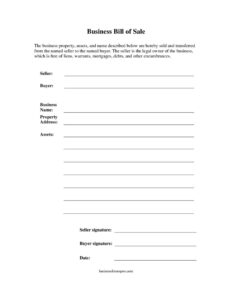
Business Bill of Sale
Download a free Business Bill of Sale template in PDF and DOCX to legally document the transfer of business assets, name, and property — free download, no signup.
PDF
DOCX
0
likes
Download Files
- DOCX
A Business Bill of Sale is a written document that records the sale and transfer of a business — including its assets, property, and name — from a seller to a buyer. It is most commonly used to create a clear paper trail at closing so both parties have proof of what changed hands and on what date. You can download it free here in both PDF and DOCX formats, with no signup required.
What Is a Business Bill of Sale?
A Business Bill of Sale is a legal document that confirms ownership of a business and its assets has passed from one party to another in exchange for payment. It is typically signed at the point of sale and identifies the seller, the buyer, the business being sold, and the assets included in the deal. The form also states that the seller is the lawful owner and that the business is free of liens, mortgages, debts, and other encumbrances. Small business owners, sole proprietors, partnerships, and buyers of established companies use it as a record of the transaction. While a comprehensive purchase agreement may govern the full terms, the bill of sale serves as the concise proof that the transfer actually occurred.
When Do You Need a Business Bill of Sale?
This document is useful any time business ownership or its assets are formally transferred. Common situations include:
- Selling a small business outright — transferring a shop, restaurant, salon, or service company to a new owner.
- Buying an existing business — the buyer wants documented proof of what assets and goodwill they acquired.
- Transferring a business name — when the trade name or brand is part of the deal and needs to be assigned.
- Selling business equipment and assets together — inventory, fixtures, machinery, and furnishings bundled into one transfer.
- Dissolving a partnership — one partner buys out another’s share of the business and its property.
- Estate or succession transfers — passing a family business to an heir or successor with a clear record of the handover.
What a Business Bill of Sale Should Have
A complete and credible Business Bill of Sale leaves no ambiguity about who sold what to whom. At minimum it should clearly identify both parties by full legal name, name the business being sold, and describe the property address and the assets included. It should contain a statement of warranty confirming the seller is the legal owner and that the business is free of liens, debts, and encumbrances. Finally, it needs the date of the sale and the signatures of both the seller and the buyer. A precise list of assets is especially important: vague descriptions invite disputes, while a detailed inventory protects both sides if questions arise later about exactly what was transferred.
How to Fill Out a Business Bill of Sale
Work through the template field by field, entering complete and accurate information:
- Seller: Enter the full legal name of the person or entity selling the business. If a company is the seller, include its registered name and the authorized signer.
- Buyer: Enter the full legal name of the person or entity acquiring the business.
- Business Name: Write the official name of the business being sold, including any registered trade name or DBA that transfers with the deal.
- Property Address: Record the physical address where the business operates or where its property is located.
- Assets: List everything included in the sale — equipment, inventory, fixtures, furniture, intellectual property, goodwill, and the business name. Be specific and itemize where possible.
- Seller signature: The seller signs to confirm the transfer and the warranty of clear ownership.
- Buyer signature: The buyer signs to acknowledge acceptance of the business and assets as described.
- Date: Enter the date the sale is finalized and the document is signed.
How It Differs From a Purchase Agreement
A Business Bill of Sale and a business purchase agreement are related but serve different roles. The purchase agreement is usually the longer, negotiated contract that sets out price, payment terms, contingencies, representations, and the closing timeline. The bill of sale is the shorter instrument signed at or after closing that actually transfers title to the assets and serves as the receipt of the completed sale. For larger or more complex transactions, you may use both: the agreement to govern the terms, and the bill of sale to document the final transfer. For a simple sale of a small business, the bill of sale may be sufficient on its own, though both parties should keep signed copies.
Notarization, Records, and Next Steps
Notarization is not always required for a Business Bill of Sale, but having both signatures notarized adds an extra layer of authenticity and can help if the transaction is ever questioned. Some assets included in a business sale — such as vehicles or real estate — may require separate transfer documents or title work, so check what each asset type demands. After signing, both parties should retain a copy, and the buyer should update relevant registrations, licenses, tax accounts, and bank arrangements. Keep the document with your business and tax records, as it may be needed to substantiate the transaction’s value and date.
Common Mistakes to Avoid
- Listing assets too vaguely — “all equipment” invites disputes; itemize what is and isn’t included.
- Leaving the date blank — the date establishes when ownership and risk transferred.
- Using nicknames instead of legal names — match names exactly to IDs or business registrations.
- Overlooking liens or debts — confirm the business is truly free of encumbrances before signing the warranty.
- Forgetting to assign the business name — if the trade name is part of the deal, name it explicitly.
- Skipping copies — both buyer and seller should keep an original signed version for their records.
Frequently Asked Questions
What is a Business Bill of Sale used for? It documents the sale and transfer of a business, its assets, and its name from a seller to a buyer. It serves as proof that the transaction occurred and identifies exactly what was transferred and when. Both parties use it as a record for legal, financial, and tax purposes.
Is a Business Bill of Sale legally binding? Once both the seller and the buyer sign it, it generally functions as a binding record of the transfer. Its enforceability depends on the accuracy of the information and compliance with local requirements. For complex deals, it is often paired with a more detailed purchase agreement.
Does a Business Bill of Sale need to be notarized? Notarization is not always legally required, but it is recommended because it verifies the identities of the signers and strengthens the document if it is ever challenged. Requirements vary by jurisdiction and by the type of assets involved. Check your local rules before finalizing.
What should I include in the assets section? List everything transferring in the sale, such as equipment, inventory, fixtures, furniture, intellectual property, goodwill, and the business name. Be specific and itemize wherever possible. A detailed list protects both parties from later disagreements about what was included.
How much does this template cost? This Business Bill of Sale template is completely free to download from Business Forms Pro. It is available in both PDF and DOCX formats, and no signup or payment is required. You can edit the DOCX version to fit your specific transaction.
Can I use this for selling just business equipment? Yes, you can adapt it to transfer business assets and equipment, though a dedicated equipment or general bill of sale may fit better for an assets-only sale. If the business name and goodwill are also transferring, this Business Bill of Sale is the more appropriate choice. Adjust the assets section to reflect exactly what is being sold.
This template is provided as a general example for informational purposes only and is not legal, financial, or tax advice. Business sale requirements vary by jurisdiction and by transaction type. Consult a qualified attorney or accountant before completing any business sale.
Official resource: for the rules that apply to your situation, see your state DMV.
Related Forms
- Musical Instrument Bill of Sale
- Bike Bill of Sale
- Domain Name Bill Of Sale
- Personal Watercraft Bill Of Sale
- Firearm Bill Of Sale
- Jewelry Bill of Sale
Browse more in Bills of Sale.