
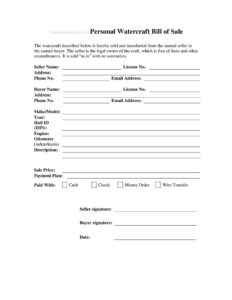
Personal Watercraft Bill Of Sale
Download a free Personal Watercraft Bill of Sale template in PDF and DOCX to document the legal sale of a jet ski or wave runner with no signup required.
PDF
DOCX
3 downloads
0
likes
Download Files
- DOCX
A Personal Watercraft Bill of Sale is a written record that documents the sale and transfer of ownership of a jet ski, wave runner, or similar personal watercraft (PWC) from a seller to a buyer. People most often use it to prove who legally owns the craft and to satisfy state titling or registration requirements after a private-party sale. You can download this template free in both PDF and DOCX formats, with no signup required.
What Is a Personal Watercraft Bill of Sale?
A Personal Watercraft Bill of Sale is a short legal document that records the details of a PWC transaction. It is typically created and signed by the seller and given to the buyer at the time of sale. The form identifies the watercraft, the parties involved, the purchase price, and the date ownership changes hands. It serves as proof of the transfer and protects both sides: the buyer gets evidence of legitimate ownership, and the seller gets a record that they no longer hold liability for the craft. Many state agencies request a bill of sale when titling or registering a personal watercraft purchased from a private individual.
When Do You Need a Personal Watercraft Bill of Sale?
This form comes into play any time a jet ski or similar craft changes hands outside of a dealership. Common situations include:
- Private party sales — buying or selling a used Sea-Doo, Yamaha WaveRunner, or Kawasaki Jet Ski directly between individuals.
- Registration and titling — when your state’s boating or motor vehicle agency requires proof of purchase to register the PWC.
- Trailer-included deals — documenting the watercraft along with a trailer sold as part of the same transaction.
- Gifts or family transfers — recording the handover even when little or no money changes hands.
- Estate or inheritance sales — transferring a watercraft from an estate to a new owner with a paper trail.
- Trade-ins between individuals — when two parties swap watercraft or other property and need to fix a value for each.
What a Personal Watercraft Bill of Sale Should Have
A complete bill of sale leaves no doubt about what was sold, by whom, and for how much. The key elements include the full legal names and addresses of both buyer and seller, a precise description of the personal watercraft, the agreed purchase price, the date of sale, the condition of the craft (often sold “as-is”), and the signatures of both parties. A strong watercraft description is essential and should capture the make, model, year, color, hull identification number (HIN), and engine or serial number. If a trailer or accessories are included, those should be listed separately. Some versions add an odometer or hour-meter reading and a space for a notary or witnesses.
How to Fill Out a Personal Watercraft Bill of Sale
- Enter the date of sale — write the calendar date the transaction is completed and ownership transfers.
- Identify the seller — provide the seller’s full legal name and current mailing address.
- Identify the buyer — provide the buyer’s full legal name and current mailing address.
- Describe the watercraft — record the make, model, year, color, and the hull identification number (HIN). Include the engine or motor serial number and the current hour-meter reading if available.
- List included items — note any trailer (with its VIN), life jackets, covers, or accessories included in the price.
- State the purchase price — write the total agreed amount in both numbers and words, and note the payment method and whether a deposit was paid.
- Specify the sale terms — confirm the watercraft is sold “as-is” unless a warranty is offered, and note any conditions.
- Sign and date — both seller and buyer sign and print their names; add notary or witness signatures if your state requires them.
Notarization, Witnesses, and Registration
Whether a Personal Watercraft Bill of Sale must be notarized depends entirely on where you live. Some states require notarization or a witness signature for the document to be accepted at the registration office, while others accept a simple signed form. Because a personal watercraft is usually titled and registered like a boat or vehicle, you will often need to submit the bill of sale alongside the title, an application, and applicable taxes or fees. It is wise to check with your state’s boating agency, department of motor vehicles, or natural resources department before finalizing the sale so you know exactly what they require. When in doubt, having the document notarized rarely hurts and can speed up the registration process.
As-Is Sales and Why They Matter
Most private PWC sales are “as-is,” meaning the buyer accepts the watercraft in its current condition with no guarantee of future performance. Spelling this out on the bill of sale protects the seller from later claims that the engine, hull, or pump failed after the handover. Buyers should inspect or test-ride the craft, verify the HIN matches the title, and confirm there are no liens before signing. If the seller does promise a warranty or that specific repairs were made, write those promises into the document so both parties have a clear record. A few extra lines of detail now can prevent a costly dispute later.
Common Mistakes to Avoid
- Omitting the HIN — without the hull identification number, the form may not identify the exact craft and could be rejected at registration.
- Leaving the price blank or vague — always state the full amount in numbers and words, and note any deposit.
- Forgetting to sign and date — an unsigned bill of sale has little legal weight.
- Skipping the trailer details — if a trailer is included, list its VIN separately so it can be registered too.
- Not keeping copies — both buyer and seller should retain a signed copy for their records.
- Ignoring lien checks — failing to confirm the craft is free of loans can leave the buyer responsible for someone else’s debt.
Frequently Asked Questions
What is a Personal Watercraft Bill of Sale used for? It documents the sale and transfer of ownership of a jet ski or similar PWC from one party to another. The buyer uses it as proof of purchase and ownership, while the seller keeps it as evidence that they have released the craft. It is also commonly required when registering or titling the watercraft with your state.
How do I fill out a Personal Watercraft Bill of Sale? Enter the date, the names and addresses of the buyer and seller, and a full description of the watercraft including make, model, year, and HIN. Add the purchase price in numbers and words, list any included trailer or accessories, and have both parties sign. Add notary or witness signatures if your state requires them.
Does a Personal Watercraft Bill of Sale need to be notarized? It depends on your state. Some states require notarization or witnesses for the document to be accepted at registration, while others accept a simple signed form. Check with your local boating agency or DMV, and consider notarizing it anyway for added protection.
Is a Personal Watercraft Bill of Sale legally binding? Yes — once both parties sign it voluntarily and it contains the essential details, it is generally a binding record of the transaction. It establishes the agreed terms and serves as evidence if a dispute arises. To strengthen it, make sure all fields are complete and accurate.
Do I need a bill of sale if the watercraft already has a title? Often yes. The title proves ownership, but many state agencies still require a bill of sale to show the purchase price, document the transfer, and calculate any taxes due. Having both documents makes registration smoother.
How much does this template cost? Nothing — this Personal Watercraft Bill of Sale template is completely free to download in PDF and DOCX, with no signup or account required. You can fill it out by hand after printing or edit the DOCX version on your computer before printing and signing.
This template is a general example provided for informational purposes only and is not legal, financial, or tax advice. Requirements for bills of sale, notarization, and watercraft registration vary by state and jurisdiction. Consult a qualified professional or your local registration authority to ensure your document meets all applicable requirements.
Official resource: for the rules that apply to your situation, see your state DMV.
Related Forms
- Conditional Bill Of Sale
- Dog Bill of Sale
- Airplane Bill Of Sale
- Receipt for Company Property
- Horse Bill Of Sale
- Antique Bill of Sale
Browse more in Bills of Sale.