
Firearm Bill Of Sale
Free firearm bill of sale template in PDF & DOCX. Learn what to include, whether it needs notarizing, and how to document a private gun sale — download today.
PDF
DOCX
1 downloads
0
likes
Download Files
- DOCX
A firearm bill of sale documents the private sale of a gun from a seller to a buyer, recording the firearm’s details, the price, and an “as-is” transfer of ownership. Download the free firearm bill of sale below in PDF or DOCX. No signup or email required.
What Is a Firearm Bill of Sale?
A firearm bill of sale is a written record that ownership of a gun has passed from a seller to a buyer. It identifies the specific firearm — by make, model, serial number, caliber, and action type — states the sale price and date, and confirms the seller is the legal owner selling it free of liens, usually “as is.” For both parties it’s an important paper trail: the seller has proof of when they transferred the firearm and to whom, and the buyer has documentation of how they acquired it. Because firearms are heavily regulated, this record can matter a great deal, and many private sellers use one specifically to show they sold the gun in good faith.
What a Firearm Bill of Sale Includes
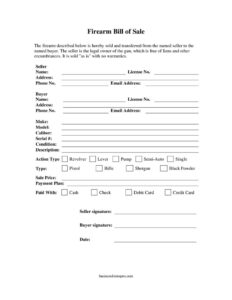
A thorough firearm bill of sale captures the gun precisely. The template above records the seller and buyer names, addresses, and signatures, along with the firearm’s make, model, serial number, caliber, action type, and condition, and whether it’s a black powder firearm. It also documents the sale price and payment method (cash or check), the date, and an “as-is” statement confirming the gun is sold free of liens with no warranty. The serial number is especially important, since it’s the unique identifier for that specific firearm.
When Do You Need a Firearm Bill of Sale?
- Documenting a private sale of a firearm between two individuals
- Keeping a personal record of when and to whom you transferred a gun
- Proving the details and good faith of a private transaction
- Recording the firearm’s serial number and condition at the time of sale
- Providing both parties with documentation of the transfer
Private Firearm Sales and the Law
This is the most important section, and it’s where you need to be careful. Firearm sales are regulated by a combination of federal, state, and local laws, and the rules for private sales vary widely from one state to another. Some states require a background check or that the sale go through a licensed dealer (an FFL), even between private parties; others have different requirements. It is generally illegal to knowingly sell a firearm to someone who is prohibited from owning one, or to sell across state lines other than through a licensed dealer. A bill of sale documents the transaction, but it does not replace any legally required background check, dealer transfer, or permit. Before completing any private firearm sale, confirm exactly what your federal, state, and local laws require — and when in doubt, use a licensed dealer to handle the transfer.
How to Fill Out a Firearm Bill of Sale
- Enter the seller’s and buyer’s names and addresses.
- Describe the firearm: make, model, serial number, caliber, action type, and condition, noting if it’s black powder.
- Record the sale price and the payment method (cash or check).
- Add the date of sale.
- Confirm the firearm is sold “as is” and free of liens (stated in the template body).
- Have both the seller and buyer sign and date, and add notarization if your state requires or you prefer it.
Notarization and Records
Whether a firearm bill of sale needs to be notarized depends on your state — some prefer or require it, many don’t. Even where it’s optional, notarizing adds independent proof that the signatures are genuine, which can be reassuring given how regulated firearms are. Keep a signed copy for your own records; a documented sale is exactly what protects a seller who later needs to show they transferred a firearm responsibly and in good faith.
Common Mistakes to Avoid
- Recording the serial number incorrectly — it must match the firearm exactly
- Assuming the bill of sale replaces a required background check or dealer transfer
- Selling to someone you know or suspect is prohibited from owning a firearm
- Leaving out the date, signatures, or “as-is” statement
- Skipping the legal check — private-sale rules vary significantly by state
Keep a Record After the Sale
Once the sale is complete, keeping your signed copy is the whole point of the document. A recorded transfer — with the firearm’s serial number, the date, and the buyer’s details — is exactly what protects a seller who later needs to show they no longer own a particular firearm and that they sold it responsibly and in good faith. Store the bill of sale somewhere safe with your other important records, treat the buyer’s information with appropriate privacy, and hold on to it indefinitely, since there’s no telling when proof of a past transfer might be needed.
Frequently Asked Questions
What is a firearm bill of sale? It’s a written record of a private gun sale, documenting the firearm’s make, model, serial number, the price, the date, and the transfer of ownership from seller to buyer.
Does a firearm bill of sale need to be notarized? It depends on your state — some prefer or require it and many don’t. Notarizing is optional in many places but adds extra proof the signatures are genuine.
How do I write a bill of sale for a firearm? Record the seller and buyer details, the firearm’s make, model, serial number, caliber, and condition, the price and date, and an “as-is” line, then both parties sign. The template above includes each field.
Does a bill of sale make a private gun sale legal? No. It documents the sale but doesn’t satisfy any legally required background check, permit, or dealer transfer. You must follow the federal, state, and local laws that apply to your sale.
Do I need a background check for a private sale? It depends entirely on your state — some require one (often through a licensed dealer) and some don’t. Always confirm your local and state requirements first.
How much does this template cost? It’s free to download in PDF and DOCX.
Related Forms
Bill of Sale · Car Bill of Sale · Boat Bill of Sale · Firearm Inventory · Personal Property Bill of Sale
This template is provided for general informational purposes only and is not legal advice. Firearm sales are regulated by federal, state, and local law and rules vary significantly — confirm and follow all applicable laws, and use a licensed dealer when required, before completing any sale.
Official resource: for the rules that apply to your situation, see your state DMV.
Related Forms
- Jewelry Bill of Sale
- Dry Cleaning Ticket
- Conditional Bill Of Sale
- Domain Name Bill Of Sale
- Bill of Sale Vehicle Parts
- Canoe Or Kayak Bill Of Sale
Browse more in Bills of Sale.