
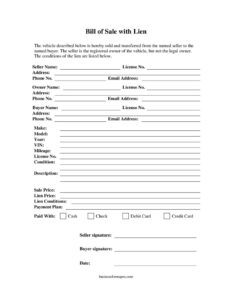
Bill of Sale With Lien
Download a free Bill of Sale With Lien template in PDF and DOCX to transfer a vehicle while documenting an outstanding lien — free download, no signup.
PDF
DOCX
8 downloads
0
likes
Download Files
- DOCX
A Bill of Sale With Lien is a document used to sell and transfer a vehicle that still has an outstanding loan or other financial claim against it, recording both the sale terms and the conditions of the lien. People most often use it when a seller is the registered owner but not yet the legal owner because a lender holds title until the debt is paid. You can download this Bill of Sale With Lien free in PDF and DOCX formats — no signup required.
What Is a Bill of Sale With Lien?
A Bill of Sale With Lien is a written record that documents the transfer of a vehicle from a seller to a buyer while acknowledging that a lien — typically a financing balance owed to a bank, credit union, or other lender — remains attached to that vehicle. Unlike a standard bill of sale, it spells out that the seller is the registered owner but not the full legal owner, and it lists the specific conditions of the lien. It is usually completed by the seller and signed by both parties. The form protects everyone by making the encumbrance visible, clarifying who is responsible for satisfying the debt, and reducing the chance of later disputes about clear title.
When Do You Need a Bill of Sale With Lien?
This form fits situations where a vehicle changes hands before the loan against it is fully repaid. Common scenarios include:
- Selling a financed car, truck, or motorcycle while monthly payments are still owed to a lender.
- Transferring a vehicle between private parties where the buyer agrees to assume or pay off the existing lien.
- Documenting a private sale in which the seller will use the buyer’s payment to satisfy the lender and release the title.
- Setting up a payment plan between buyer and seller so the buyer pays the lien balance over time.
- Selling a vehicle to a family member or friend who understands and accepts the outstanding obligation.
- Creating a paper trail for a dealer-to-buyer or buyer-to-buyer transaction involving a lienholder.
What a Bill of Sale With Lien Should Have
To be complete and useful, this form should clearly identify the parties, the vehicle, the financial terms, and the lien itself. That means full names and contact details for both the buyer and the seller, a precise description of the vehicle including VIN and mileage, the agreed sale price, and how the buyer is paying. Crucially, it must spell out the lien conditions: what is owed, who holds the lien, the lien price, and how and when it will be satisfied. Dated signatures from both parties turn the document from a draft into a binding record of the agreement.
How to Fill Out a Bill of Sale With Lien
- Enter the Date of the transaction at the top of the form.
- Fill in the Seller Name and the Buyer Name, then add the buyer’s Address, Phone No., and Email Address for contact and follow-up.
- Record the Owner Name — the registered owner — if it differs from the seller.
- Describe the vehicle: Year, Make, Model, VIN, License No., Mileage, and a short Description and Condition noting any known issues.
- State the Sale Price the buyer agrees to pay for the vehicle.
- Indicate how the buyer is paying under Paid With, selecting Cash, Check, Credit Card, Debit Card, or a Payment Plan.
- Complete the lien section: enter the Lien Price (the amount still owed) and write out the Lien Conditions, naming the lienholder and how the balance will be satisfied.
- Have both parties review everything, then sign and date the Seller Signature and Buyer Signature lines.
Understanding the Lien Conditions
The lien conditions are the heart of this document and deserve careful attention. Because the seller is the registered owner but not the legal owner, the lender ultimately controls when clear title is released. Spell out exactly who the lienholder is, the remaining balance, and the agreed mechanism for paying it off — for example, whether the buyer’s payment first goes to the lender, whether the seller will use proceeds to clear the loan, or whether the buyer is assuming a payment plan. Stating these terms in writing prevents misunderstandings about who is responsible for the debt and when the buyer can expect a free-and-clear title transferred into their name.
After You Complete the Form
A signed Bill of Sale With Lien is only one step in a financed sale. The buyer typically cannot register the vehicle in their own name until the lien is satisfied and the lender releases the title. Keep copies for both parties, retain proof of any payments made toward the lien price, and confirm with the lienholder exactly what documentation they require to release the title. Many buyers verify the payoff amount directly with the lender before handing over money. Once the lien is cleared, follow your local motor vehicle agency’s process to complete the title transfer and registration.
Common Mistakes to Avoid
- Leaving the lien conditions vague or blank instead of naming the lienholder and the payoff terms.
- Recording an incorrect or incomplete VIN, which can derail registration and title transfer.
- Forgetting to verify the actual payoff amount with the lender before agreeing on the lien price.
- Failing to note the true Mileage and Condition, which can lead to later disputes.
- Not collecting both the Buyer Signature and Seller Signature with the date.
- Assuming the buyer can register the vehicle immediately when the lender still holds the title.
Frequently Asked Questions
What is a Bill of Sale With Lien used for? It documents the sale of a vehicle that still has an outstanding loan or financial claim attached to it. The form records the sale terms while making clear that a lienholder retains an interest until the debt is paid. This protects both buyer and seller by putting the encumbrance and payoff plan in writing.
How is it different from a regular bill of sale? A standard bill of sale assumes the seller can transfer clear title, while a Bill of Sale With Lien explicitly states the seller is the registered owner but not the legal owner. It adds dedicated fields for the lien price and lien conditions. This makes it the right choice when a loan balance still exists.
Does this form need to be notarized? Notarization is not always required, but some states and many lenders prefer or require notarized signatures for vehicle transactions involving a lien. Check your local motor vehicle agency’s rules and ask your lienholder what they need. Notarizing can add an extra layer of protection even when it is optional.
Can the buyer register the vehicle right away? Usually not until the lien is satisfied and the lender releases the title. Most jurisdictions will not issue a clear title in the buyer’s name while a lien remains active. Confirm the payoff and title-release process with the lender before assuming registration can happen.
Is this Bill of Sale With Lien legally binding? When both parties sign and date the form and the terms are accurately stated, it serves as a binding record of the agreement between buyer and seller. However, it does not override the lender’s rights to the vehicle. Requirements vary by state, so confirm what your jurisdiction recognizes.
How much does this template cost? This Bill of Sale With Lien template is completely free to download in PDF and DOCX formats with no signup required. You can fill it out on your computer or print it and complete it by hand. Edit the fields as needed to match your specific transaction.
This template is a general example provided for informational purposes only and is not legal, financial, or tax advice. Lien, title, and vehicle transfer requirements vary by jurisdiction and lender. Consult a qualified professional or your local motor vehicle agency before relying on this document.
Official resource: for the rules that apply to your situation, see your state DMV.
Related Forms
- Bill of Sale Vehicle Parts
- Farm Animal Bill Of Sale
- Salvage Bill Of Sale
- Boat Bill of Sale
- Domain Name Bill Of Sale
- Rare Book Bill Of Sale
Browse more in Bills of Sale.