
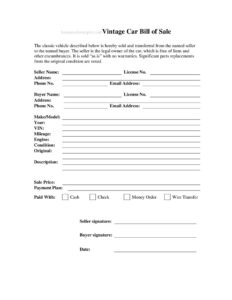
Vintage Car Bill Of Sale
Download a free Vintage Car Bill of Sale template to document the sale of a classic or antique vehicle — free PDF and DOCX download, no signup.
PDF
DOCX
22 downloads
1
likes
Download Files
- DOCX
A Vintage Car Bill of Sale is a written record that documents the sale and transfer of a classic, antique, or collector vehicle from a seller to a buyer. People most commonly use it to prove ownership changed hands, lock in the agreed price, and protect both parties when a prized car finds a new home. You can download this Vintage Car Bill of Sale free in both PDF and DOCX formats, with no signup required.
What Is a Vintage Car Bill of Sale?
A Vintage Car Bill of Sale is a legal document that records the details of a transaction involving an older or collectible automobile — typically a vehicle decades old, restored, or prized for its rarity. It is issued by the seller and signed by both parties to confirm who sold the car, who bought it, what was paid, and the exact vehicle involved. Unlike a standard car bill of sale, a vintage version often notes condition, restoration history, and whether the sale is “as-is.” It serves as proof of purchase for registration, titling, insurance, and tax purposes, and creates a paper trail that protects buyer and seller if a dispute arises later.
When Do You Need a Vintage Car Bill of Sale?
This form is useful any time ownership of a collector vehicle moves from one person or entity to another. Common situations include:
- Selling a restored classic car to a private buyer who found it through a listing or club.
- Buying an antique automobile at a swap meet, estate sale, or auction where the seller has no dealer paperwork.
- Transferring a vintage vehicle between family members or as part of an inheritance or gift.
- Documenting an “as-is” sale of a project car or barn find that needs significant work.
- Providing your state’s DMV with proof of purchase to register and title the car in the new owner’s name.
- Establishing the purchase price for sales tax calculation or for an insurance agreed-value policy.
What a Vintage Car Bill of Sale Should Have
To be complete and useful, the document should clearly identify both parties, the vehicle, the price, and the terms of the sale. Key elements include the full legal names and addresses of the buyer and seller, a detailed vehicle description with year, make, model, and Vehicle Identification Number (VIN), the odometer reading, the sale price and payment method, and the date of sale. It should also state whether the vehicle is sold “as-is” or with any warranty, disclose known defects, and include signatures from both parties. For high-value collector cars, a notary acknowledgment and witness signatures add extra protection and may be required by your state.
How to Fill Out a Vintage Car Bill of Sale
- Enter the date of sale. Write the calendar date the transaction takes place at the top of the form.
- Identify the seller. Add the seller’s full legal name and current mailing address.
- Identify the buyer. Add the buyer’s full legal name and current mailing address.
- Describe the vehicle. Record the year, make, model, body style, and color, plus the VIN, license plate number, and current odometer reading.
- Note the condition. Describe restoration work, original versus replacement parts, and any known defects so expectations are clear.
- State the sale price. Write the agreed amount in both numbers and words, and indicate the payment method (cash, certified check, wire transfer).
- Specify the terms. Mark whether the sale is “as-is” with no warranty, and note any trade-in or deposit details.
- Sign and date. Both buyer and seller sign and date the form; add witness or notary blocks if your state requires them.
As-Is Sales and Disclosure for Collector Cars
Most private vintage car sales are completed on an “as-is” basis, meaning the buyer accepts the vehicle in its current condition with no implied warranty from the seller. Stating this clearly on the bill of sale protects the seller from later claims about mechanical issues or hidden flaws. That said, sellers should still honestly disclose known problems — a cracked frame, flood damage, or a non-matching engine — because deliberate concealment can expose a seller to liability regardless of an as-is clause. For collector vehicles, buyers often want documentation of restoration history, provenance, and matching numbers; attaching photos, receipts, and prior titles strengthens the record and supports the car’s value.
Titling, Registration, and Notarization
A bill of sale usually works alongside the vehicle title, not instead of it. To register a vintage car in the new owner’s name, most states require the signed title plus the bill of sale as proof of purchase and price. Some states require the odometer disclosure and a notarized signature, while others accept a simple signed form. Older vehicles may qualify for antique or historic vehicle registration, which can have special plate and inspection rules. Because requirements vary widely, check your state’s motor vehicle agency before completing the sale to confirm exactly which documents and signatures you need.
Common Mistakes to Avoid
- Leaving the VIN blank or copying it incorrectly — always verify it against the dash and door jamb.
- Failing to record the odometer reading, which many states require for legal transfer.
- Forgetting to mark the sale “as-is,” leaving the seller open to later warranty claims.
- Writing the price only in numbers, which is easier to alter than spelled-out words.
- Skipping signatures, dates, or required notarization, which can invalidate the document at the DMV.
- Not keeping copies — both buyer and seller should retain a signed original.
Frequently Asked Questions
What is a Vintage Car Bill of Sale used for? It documents the sale of a classic or antique vehicle, recording the buyer, seller, price, and vehicle details. Buyers use it to register and title the car, prove ownership, and calculate sales tax, while sellers use it as evidence they transferred the vehicle on a specific date.
Does a Vintage Car Bill of Sale need to be notarized? It depends on your state. Some states require a notarized signature or witnesses for a vehicle transfer, while others accept a plain signed form. For high-value collector cars, notarizing the document adds an extra layer of protection even when it is not legally required.
Is a bill of sale enough to transfer ownership? Usually not on its own. In most states the signed vehicle title is the primary ownership document, and the bill of sale supports it as proof of purchase and price. You typically submit both to your motor vehicle agency to complete the transfer.
What does “as-is” mean on the form? An “as-is” sale means the buyer accepts the vehicle in its present condition with no warranty from the seller. This is common for vintage and project cars, but the seller should still disclose any known defects honestly to avoid disputes.
How much does this template cost? Nothing — this Vintage Car Bill of Sale is completely free to download in both PDF and DOCX formats, with no signup or account required. You can fill it out by hand after printing or type directly into the editable document.
What information do I need before filling it out? Gather the full names and addresses of both parties, the vehicle’s year, make, model, VIN, and odometer reading, the agreed sale price, and the payment method. Having restoration receipts and the existing title on hand also helps you complete the form accurately.
This template is a general example provided for informational purposes only and is not legal, financial, or tax advice. Vehicle sale, titling, and registration requirements vary by state and jurisdiction. Consult a qualified professional or your local motor vehicle agency to confirm the rules that apply to your transaction.
Official resource: for the rules that apply to your situation, see your state DMV.
Related Forms
- Antique Bill of Sale
- Artwork Bill Of Sale
- Bill of Sale for Parts Only
- Dock Receipt
- Bill of Sale Vehicle Parts
- Trailer Bill Of Sale
Browse more in Bills of Sale.