
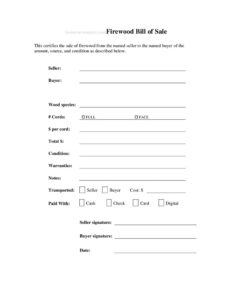
Firewood Bill Of Sale
Download a free Firewood Bill of Sale template in PDF and DOCX to document the sale of cordwood, log loads, or seasoned firewood with no signup required.
PDF
DOCX
4 downloads
0
likes
Download Files
- DOCX
A Firewood Bill of Sale is a simple written record that documents the sale of firewood from a seller to a buyer, including how much wood changed hands, the price paid, and the date of the transaction. People most often use it to confirm payment for a cord or truckload of firewood and to prove the wood was sold as-is. You can download this Firewood Bill of Sale for free in both PDF and DOCX formats, with no signup required.
What Is a Firewood Bill of Sale?
A Firewood Bill of Sale is a short document that records the transfer of firewood ownership from one party to another in exchange for payment. It is typically created by the seller — a firewood supplier, tree service, farmer, or private individual clearing land — and signed by both the seller and the buyer. The form documents the type and quantity of wood, the agreed price, and the condition of the wood at the time of sale. Because firewood is sold by volume rather than by serial number, this receipt helps both sides agree on exactly what was delivered. It serves as proof of purchase, a delivery confirmation, and a record for tax or bookkeeping purposes.
When Do You Need a Firewood Bill of Sale?
This form is useful any time firewood is exchanged for money and either party wants written proof. Common situations include:
- A firewood dealer selling cords of seasoned hardwood to a homeowner for the winter heating season.
- A tree-removal company selling the leftover logs from a job rather than hauling them to a dump.
- A farmer or rural landowner selling stacked cordwood from their woodlot to neighbors.
- A buyer purchasing a bulk truckload of green or unsplit wood to season themselves.
- A casual seller listing surplus firewood online and wanting a record of who bought it and for how much.
- A business needing a paper receipt to track firewood sales for income reporting or sales tax.
What a Firewood Bill of Sale Should Have
To be clear and useful, a complete Firewood Bill of Sale should identify both parties and describe the wood precisely. Key elements include the full names and contact details of the seller and buyer, the date of sale, and a detailed description of the firewood — species (oak, maple, pine, mixed hardwood), whether it is seasoned or green, split or in rounds, and the quantity stated in recognized units such as full cords, face cords, or cubic feet. It should also state the total price, the payment method, any delivery or stacking arrangements, and an “as-is” clause noting the wood is sold in its current condition. Signature lines for both parties finish the document.
How to Fill Out a Firewood Bill of Sale
- Enter the date of the transaction at the top of the form.
- Add the seller’s information: full name, address, and phone number or email.
- Add the buyer’s information: full name, address, and contact details.
- Describe the firewood: note the wood species or that it is mixed, and whether it is seasoned, green, split, or in unsplit rounds.
- State the quantity using a clear unit — for example, two full cords, four face cords, or a measured truckload — so there is no dispute over volume.
- Record the price: enter the price per unit and the total amount paid.
- Note the payment method (cash, check, electronic transfer) and whether payment was made in full or in part.
- Specify delivery terms: whether the buyer is picking up, delivery is included, and whether stacking is provided.
- Include an as-is statement confirming the wood is sold in its present condition.
- Sign and date: both seller and buyer sign to finalize the sale and each keeps a copy.
Understanding Firewood Quantities
The single biggest source of firewood disputes is volume, so a good bill of sale spells it out precisely. A full cord is a stacked pile measuring 4 feet high by 4 feet wide by 8 feet long, totaling 128 cubic feet. A face cord (sometimes called a rick) is also 4 feet high by 8 feet long but only as deep as the log length — often 16 inches — so it contains far less wood than a full cord. Terms like “truckload” or “pile” are ambiguous and should be tied to an estimated cubic-foot figure on the form. When you write the quantity, use the standard unit and, if helpful, the stack dimensions. This protects the buyer from coming up short and protects the seller from unfounded complaints later.
Seasoned Versus Green Firewood
Note the wood’s condition clearly on the form because it affects value and usability. Seasoned wood has dried for months to a year and burns efficiently with low moisture; green wood is freshly cut, heavier, and needs time to dry before burning well. Recording this on the bill of sale sets expectations and reduces disagreements, especially when a buyer expects ready-to-burn wood but receives unseasoned logs.
Common Mistakes to Avoid
- Using vague quantities like “a load” instead of cords, face cords, or measured cubic feet.
- Failing to state whether the wood is seasoned or green, which is the most common buyer complaint.
- Leaving out delivery and stacking terms, then disputing who was responsible for the labor.
- Forgetting to record the payment method or whether the balance was paid in full.
- Omitting the as-is clause, leaving the seller exposed to later quality claims.
- Not having both parties sign, or failing to give the buyer a copy of the completed form.
Frequently Asked Questions
What is a Firewood Bill of Sale? It is a written receipt that documents the sale of firewood, including the quantity, type, price, and date. It proves payment was made and records what condition the wood was in at the time of sale, protecting both the buyer and seller.
How do I fill out a Firewood Bill of Sale? Enter the date, the seller’s and buyer’s contact details, a description of the wood, the quantity in cords or face cords, the price and payment method, any delivery terms, and an as-is statement. Both parties then sign and keep a copy.
Does a Firewood Bill of Sale need to be notarized? Notarization is generally not required for a routine firewood sale, since it is a low-value goods transaction. A signed copy held by each party is usually sufficient, though requirements can vary by location.
Is a Firewood Bill of Sale legally binding? Once both the buyer and seller sign, it serves as a binding record of the agreed transaction. It documents the price, quantity, and condition of the wood and can be referenced if a dispute arises later.
How much does this Firewood Bill of Sale cost? The template is completely free to download from Business Forms Pro in PDF and DOCX formats. There is no signup or fee required to use it for personal or business firewood sales.
Why should I specify the quantity in cords? Because firewood is sold by volume, stating the exact unit — full cords, face cords, or cubic feet — prevents disputes about whether the buyer received the amount they paid for. Vague terms like “truckload” leave both parties open to disagreement.
This Firewood Bill of Sale template is a general example provided for informational purposes only and is not legal, financial, or tax advice. Sales and consumer-protection requirements vary by jurisdiction, so consult a qualified professional to confirm what applies to your situation.
Official resource: for the rules that apply to your situation, see your state DMV.
Related Forms
- ATV Bill Of Sale
- Boat Bill of Sale
- Large-Print Bill of Sale
- Artwork Bill Of Sale
- Rare Book Bill Of Sale
- Farm Animal Bill Of Sale
Browse more in Bills of Sale.