
Limited Power of Attorney
Download a free Limited Power of Attorney template in PDF and DOCX to authorize someone to act on your behalf for specific tasks — free download, no signup.
PDF
DOCX
2 downloads
0
likes
Download Files
- DOCX
A Limited Power of Attorney is a legal document that lets you (the principal) authorize another person (the agent or attorney-in-fact) to handle specific tasks on your behalf, while keeping all other decisions in your own hands. People most often use one to delegate a single, defined responsibility — such as signing a contract, managing one bank account, or handling a property closing — without granting broad control over their affairs. This template is free to download in both PDF and DOCX, with no signup required.
What Is a Limited Power of Attorney?
A Limited Power of Attorney is a written authorization in which one person grants another the legal authority to act for them within clearly stated boundaries. Unlike a general power of attorney, which transfers wide-ranging authority, a limited version restricts the agent to the specific purposes you spell out in the document. The principal is the person granting authority; the agent is the person receiving it. The form documents who is involved, where the agent is located, when the authority takes effect, and exactly what the agent is and is not allowed to do. It is commonly used in business, real estate, banking, and personal situations where someone cannot be present to act on their own behalf.
When Do You Need a Limited Power of Attorney?
This document is useful any time you need someone to act for you on a narrow, defined matter. Common scenarios include:
- Real estate closings — authorizing someone to sign deeds or closing documents when you cannot attend in person.
- Banking tasks — letting a trusted person deposit checks, manage a single account, or handle a one-time transaction.
- Business operations — empowering a manager or partner to sign a specific contract or represent the company in one negotiation.
- Vehicle transactions — allowing a dealer or family member to register, sell, or transfer a vehicle on your behalf.
- Travel or deployment — covering specific obligations while you are overseas, deployed, or otherwise unavailable.
- Tax or filing matters — authorizing a representative to submit or collect documents for a particular agency.
What a Limited Power of Attorney Should Have
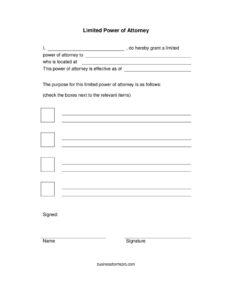
A complete and credible Limited Power of Attorney includes the full legal name of the principal, the full name and address of the agent, the effective date, and a precise description of the powers being granted. The defining feature is the list of permitted purposes — typically presented as checkboxes — so there is no ambiguity about the scope of authority. The document should also include the principal’s printed name and signature. Depending on where you live and how the document will be used, it may also need to be dated, witnessed, or notarized to be accepted by banks, recorders, and other third parties.
How to Fill Out a Limited Power of Attorney
- Principal’s name: In the opening line (“I, {Name}”), enter your own full legal name as the person granting the authority.
- Agent’s name: In the second name field, write the full legal name of the person you are authorizing to act for you.
- Agent’s address: Complete the location field ({address}) with the agent’s full mailing address, including street, city, state, and ZIP code.
- Effective date: Enter the date this power of attorney becomes effective. This is the day the agent’s authority begins.
- Purpose checkboxes: Review the list of purposes and check the box next to each task you are authorizing. Be specific and check only what applies — leave the rest blank to keep the authority limited.
- Signature block: Print your name on the “Name” line and sign on the “Signature” line. Sign in the manner required by your jurisdiction — often in front of a notary or witnesses.
Notarization, Witnesses, and Acceptance
Whether your Limited Power of Attorney needs to be notarized or witnessed depends on your jurisdiction and on the institution that will rely on it. Many banks, title companies, and government offices will only accept a power of attorney that has been notarized, and some states require witnesses in addition to a notary. Before you sign, it is wise to ask the third party that will receive the document — the bank, recorder, or agency — what they require. Signing before a notary even when it is not strictly mandatory can prevent the document from being rejected later. Keep the original in a safe place and give the agent a clear copy, since they may need to present it each time they act.
Limiting and Ending the Authority
The strength of this document lies in how narrowly you define it. Only check the purposes you genuinely want the agent to handle, and consider adding an expiration date or a triggering event if your template allows. A Limited Power of Attorney generally ends when the stated task is complete, on a date you specify, when you revoke it in writing, or upon the death of the principal. To revoke it, notify the agent in writing and inform any institutions that received a copy, so they stop honoring the old authority.
Common Mistakes to Avoid
- Leaving the purpose vague — failing to check or clearly describe the specific powers can lead third parties to reject the document or the agent to overstep.
- Checking too many boxes — authorizing more than you intend defeats the purpose of a limited power of attorney.
- Omitting the agent’s address — institutions often need this to verify identity and contact the agent.
- Skipping notarization — many banks and recorders will not accept an un-notarized document.
- Naming an unreliable agent — choose someone trustworthy, since they act in your name within the granted scope.
- Forgetting to date or sign — an undated or unsigned form is generally not enforceable.
Frequently Asked Questions
What is a Limited Power of Attorney used for? It is used to authorize someone to handle one or more specific tasks on your behalf, such as signing a particular contract, managing a single bank account, or closing on a property. The authority is restricted to the purposes you list, so the agent cannot act outside that scope.
How is it different from a general power of attorney? A general power of attorney grants broad authority over many or all of your affairs, while a Limited Power of Attorney is restricted to the specific tasks you check or describe. The limited version is ideal when you want help with one matter but not control over everything.
Does a Limited Power of Attorney need to be notarized? It depends on your jurisdiction and on the institution relying on the document. Many banks, title companies, and government offices require notarization, and some states also require witnesses, so confirm the requirements before signing.
Is this template legally binding? When properly completed, signed, and executed according to your local rules, a Limited Power of Attorney can be legally binding. Requirements such as notarization or witnesses vary, so follow the rules in your jurisdiction to ensure it is enforceable.
Can I cancel a Limited Power of Attorney? Yes. You can generally revoke it at any time while you are mentally competent by providing written notice to the agent and to any institutions that received a copy. It also typically ends once the stated task is finished or on any expiration date you include.
How much does this form cost? Nothing — you can download this Limited Power of Attorney template free in PDF and DOCX formats, with no signup required. You only incur a cost if you choose to have it notarized or seek professional advice.
This Limited Power of Attorney template is provided as a general example for informational purposes only and does not constitute legal advice. Laws and execution requirements vary by jurisdiction, and the document’s validity may depend on notarization or witnesses. Consult a qualified attorney to ensure your power of attorney meets your needs and local requirements.
Related Forms
- Request To Terminate Unauthorized Service
- Household Items Release Form
- Payroll Deduction Authorization
- Request For Bank Credit Reference
- Request to be Removed From Mailing List
- Request For Birth Certificate
Browse more in Request and Authorization.