
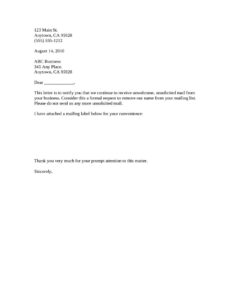
Request to be Removed From Mailing List
Stop unwanted junk mail with a Request to be Removed From Mailing List template — clear, formal, and ready for free download in PDF or DOCX.
DOCX
12 downloads
1
likes
Download Files
- DOCX
A Request to be Removed From Mailing List is a short formal letter that asks a company to stop sending you unsolicited mail and to delete your name and address from its mailing database. People most often use it to put an end to a steady stream of catalogs, flyers, and promotional mailings they never asked for. You can download this template free in PDF or DOCX, with no signup required.
What Is a Request to be Removed From Mailing List?
A Request to be Removed From Mailing List is a written notice sent by a recipient of unwanted mail to the business or organization generating it. The letter documents that you no longer wish to receive marketing material and formally instructs the sender to remove your name and address from its distribution list. Anyone can issue one — an individual, a household, or a business that is being flooded with unsolicited solicitations. Because it is written and dated, it also creates a record that you made the request, which is useful if the unwanted mail continues. The tone is polite but firm, and it usually includes a mailing label so the company can quickly locate and delete your exact entry.
When Do You Need a Request to be Removed From Mailing List?
This letter is helpful any time mail you did not ask for keeps arriving. Common situations include:
- You keep receiving catalogs or sales flyers from a retailer you bought from once or never bought from at all.
- A charity or nonprofit mails you repeated donation appeals after a single contribution.
- Your business mailbox fills with vendor solicitations, samples, and promotional packets.
- You moved and a company keeps sending mail to a previous occupant or an outdated version of your name.
- A subscription or membership ended, but renewal and upsell mailings continue.
- You want to reduce paper clutter and limit how much personal information a company keeps on file.
What a Request to be Removed From Mailing List Should Have
To be effective, the letter needs a few clear elements. First, your full name and return address so the company can match you to the right record. Second, the name and address of the business you are contacting. Third, a dated statement that you are receiving unsolicited mail and a direct, unambiguous request to be removed from the mailing list. Fourth, the attached mailing label or a copy of the exact address block printed on the unwanted mail — this is the fastest way for the sender to find your entry. Finally, a courteous closing and your signature. Keeping the message brief and specific makes it more likely the request is honored promptly.
How to Fill Out a Request to be Removed From Mailing List
- Add your return address. Replace the sample line (123 Main St., Anytown, CA 95928) with your own street, city, state, and ZIP, plus a phone number where you can be reached.
- Date the letter. Enter the current date in place of the placeholder so there is a clear record of when you sent the request.
- Enter the recipient. Replace “ABC Business” and “345 Any Place” with the company’s name and full mailing address, ideally a customer service or privacy department.
- Fill in the salutation. Complete the “Dear ____” line with a contact name if you have one, or use a general greeting such as “Dear Customer Service.”
- Keep the body statement. The letter already states that you receive unwelcome, unsolicited mail and formally requests removal — leave this intact or adjust the wording to match your situation.
- Attach a mailing label. Below the body, affix or paste the exact address label from a recent piece of unwanted mail so the company can locate your record precisely.
- Sign and send. Print your name, sign above “Sincerely,” and mail the letter, keeping a copy for your files.
Tips for Getting Your Request Honored
Including the original mailing label is the single most useful step, because large mailers store records by an exact address format. If your name appears with a slight variation — a middle initial, an abbreviation, or a misspelling — sending the precise label helps them find and delete the right entry. Sending the letter to a privacy, data, or customer service department rather than a general sales address often speeds things up. For persistent senders, consider mailing your request with proof of delivery so you have evidence the company received it. If you want to cut down on mail from many companies at once, you can also look into national mail preference and opt-out services, though those operate separately from a direct letter like this one.
How This Differs From a General Opt-Out
This template targets a single, specific sender. A broad opt-out program — such as a national mail preference service or a credit-offer opt-out line — reduces mail across many companies but may not stop a particular business you have an existing relationship with. The direct letter is more precise: it names one company, references the exact mail you received, and asks that one organization to act. Many people use both approaches together, sending direct letters to the worst repeat offenders while registering with broader opt-out services for everything else.
Common Mistakes to Avoid
- Forgetting to attach the mailing label, which makes it harder for the company to find your record.
- Leaving the sample text (Anytown, ABC Business) in the final letter instead of your real information.
- Sending the letter to a generic sales address rather than a customer service or privacy contact.
- Writing a long, emotional complaint instead of a clear, polite removal request.
- Not dating the letter or keeping a copy, which leaves you without a record if mail continues.
- Expecting instant results — mailings already in production may arrive for several more weeks.
Frequently Asked Questions
What is a Request to be Removed From Mailing List? It is a brief formal letter asking a specific company to stop sending you unsolicited mail and to delete your name and address from its mailing database. It documents your request in writing and includes a mailing label so the sender can identify your exact record. It works best when directed at a single, identifiable mailer.
How do I fill it out? Replace the sample return address, date, recipient name and address, and salutation with your own details, keep the removal request in the body, and attach the address label from a piece of unwanted mail. Then sign above the closing and send it, keeping a copy for your records.
Do I need to attach the mailing label? It is strongly recommended. Large mailers organize records by exact address format, so the original label lets them locate and delete your entry quickly and accurately, reducing the chance the unwanted mail continues.
Is this letter legally binding? The letter itself is a formal request rather than a binding contract, but it creates a documented record of your wishes. Some types of mail are governed by specific laws and opt-out rules that vary by location, so this template is best treated as a clear, good-faith notice to the sender.
How long until the mail stops? Allow a few weeks, since mailings already printed and scheduled may continue to arrive after the company processes your request. If mail keeps coming after a reasonable period, send a follow-up letter and consider using proof of delivery.
How much does this template cost? Nothing — it is completely free to download here in PDF or DOCX, with no signup or account required. You can customize it as many times as you need for different senders.
This template is a general example provided for informational purposes only and is not legal advice. Mail and privacy rules vary by jurisdiction, so consult a qualified professional if you have questions about your specific situation.
Related Forms
- Suede Leather Items Release Form
- Request A Raise
- Service Call Book
- Bank Account Closure Authorization
- Reservation Request Letter
- Additional Work Authorization Form
Browse more in Request and Authorization.