
Request A Raise
Use this free Request a Raise letter template to professionally ask your employer for a salary increase, with a clear PDF and DOCX free download.
PDF
DOCX
3 downloads
0
likes
Download Files
- DOCX
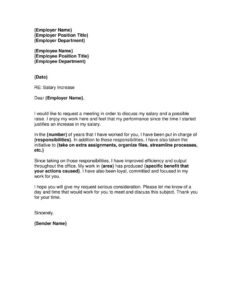
A Request a Raise letter is a short, professional document an employee uses to formally ask their employer for a salary increase and to propose a meeting to discuss it. People most often reach for this letter when they have taken on new responsibilities or delivered measurable results and want a structured way to make the case. It is free to download here in both PDF and DOCX formats, with no signup required.
What Is a Request a Raise Letter?
A Request a Raise letter is a written communication from an employee to a manager, supervisor, or company owner that asks for a salary review and a higher rate of pay. It documents who is making the request, who it is addressed to, and the reasons the raise is justified. Rather than springing the topic in a hallway conversation, the letter gives the employer a clear summary of your contributions and a polite invitation to meet. It serves as both a paper trail and a conversation starter, and it signals that you have thought carefully about your value to the organization before asking.
When Do You Need a Request a Raise Letter?
This letter is useful whenever you want to open a compensation discussion in a respectful, well-prepared way. Common situations include:
- You have taken on additional duties or a larger workload without a corresponding pay adjustment.
- You recently completed a major project, improved a process, or produced results you can point to.
- Your annual review is approaching and you want to set the stage for a salary conversation.
- You have been with the company for a significant length of time without a raise.
- You have researched market rates and believe your pay has fallen below comparable roles.
- You earned a new certification, degree, or skill that increases your value to the team.
What a Request a Raise Letter Should Have
A strong raise request is concise, factual, and confident without being demanding. It should clearly identify both parties, state the purpose up front, and back the request with specifics rather than feelings alone. The most persuasive versions include the length of your tenure, the responsibilities you hold, examples of extra initiative, and a concrete benefit your work created for the business. It should close with a courteous request for a meeting at the employer’s convenience and a professional sign-off. Keeping the tone positive and appreciative — while still being direct about the ask — helps the reader stay receptive.
How to Fill Out a Request a Raise Letter
- Enter your Employer Name, Employer Position Title, and Employer Department at the top so the letter is correctly addressed to your manager or decision-maker.
- Add your own details in the Employee Name, Employee Position Title, and Employee Department fields to identify yourself clearly.
- Fill in the Date the letter is written.
- Confirm the subject line reads RE: Salary Increase and open with Dear {Employer Name}.
- In the number field, state how many years you have worked for the company.
- List your core responsibilities so the employer sees the scope of your role.
- Describe the extra initiative you have taken — for example taking on extra assignments, organizing files, or streamlining processes.
- Name the area where you made an impact and the specific benefit your actions produced, such as faster turnaround or cost savings.
- Keep the closing request for a meeting, then sign with your Sender Name.
How to Make Your Case Stronger
Numbers are far more persuasive than adjectives. Where the template asks for a specific benefit, try to quantify it: a percentage increase in output, hours saved each week, a reduction in errors, or revenue you helped generate. If you cannot attach a hard figure, describe the outcome in concrete terms a manager would recognize. It also helps to do light market research before you send the letter so you know what comparable roles pay in your region and industry. While the template does not ask you to name a figure, going into the meeting with a realistic target range prepares you to negotiate calmly. Timing matters too — sending the letter after a clear win, or just before a scheduled review cycle, increases your odds of a favorable response.
Letter vs. In-Person Conversation
Some employees prefer to ask for a raise verbally, and there is nothing wrong with that. However, a written request creates a record, gives your manager time to consider the facts before responding, and lets them route the request to whoever controls the budget. Many people use the letter as a bridge: it formally raises the topic and requests a meeting, and then the actual negotiation happens face to face. Because this template ends by asking the employer to propose a day and time to meet, it is designed to complement an in-person discussion rather than replace it.
Common Mistakes to Avoid
- Relying only on loyalty or seniority instead of pointing to specific accomplishments and results.
- Leaving the responsibilities or specific benefit fields vague when concrete detail would be far more convincing.
- Using an aggressive or entitled tone that puts the employer on the defensive.
- Comparing your salary to a specific coworker’s pay, which can sound unprofessional.
- Sending the letter at a poor time, such as during a company downturn or right after a missed deadline.
- Forgetting to proofread — typos or the wrong manager’s name undercut your credibility.
Frequently Asked Questions
What is a Request a Raise letter? It is a brief professional letter in which an employee formally asks their employer for a salary increase and requests a meeting to discuss it. It summarizes your tenure, responsibilities, and the value you have added so your manager can review the request thoughtfully before responding.
How do I fill out this template? Add the employer’s and your own name, title, and department, insert the date, then complete the blanks describing your years of service, responsibilities, extra initiative, and the specific benefit your work produced. Finish by keeping the meeting request and signing your name at the bottom.
Should I name a specific salary figure in the letter? This template does not include a dollar amount, and many people prefer to leave the exact number for the meeting itself. It is still wise to research market rates beforehand so you can discuss a realistic target confidently once your employer agrees to meet.
Does a raise request letter need to be notarized or witnessed? No. A Request a Raise letter is an internal workplace communication, not a legal contract, so it does not require notarization, witnesses, or any official filing. A clear signature and accurate details are all that is needed.
Is this letter legally binding? No. The letter is a request, not an agreement, and it does not obligate your employer to grant a raise. Any actual change to your pay would be confirmed separately through your employer’s standard compensation or HR process.
How much does this template cost? Nothing. You can download the Request a Raise letter for free in both PDF and DOCX formats with no account or signup required, then edit it to match your situation.
This template is a general example provided for informational purposes only and is not legal, financial, or employment advice. Company policies and applicable rules vary by jurisdiction and employer — consult your HR department or a qualified professional for guidance specific to your situation.
Related Forms
- Request For Birth Certificate
- Shareholder Ballot
- Request For Bank Statement
- Drug and Alcohol Testing Individual
- Work Order
- Request To Terminate Unauthorized Service
Browse more in Request and Authorization.