
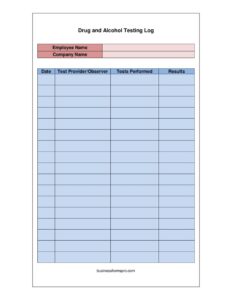
Drug and Alcohol Testing Individual
Download a free Drug and Alcohol Testing Individual form to document employee test results, provider, and date — free PDF and DOCX template, no signup.
PDF
DOCX
6 downloads
0
likes
Download Files
- DOCX
A Drug and Alcohol Testing Individual form is a simple record that documents the results of a single employee’s drug or alcohol screening, including who administered the test and when. Employers most often use it to keep a clear, signed record of workplace testing for safety and compliance purposes. You can download it free below in both PDF and DOCX formats — no signup required.
What Is a Drug and Alcohol Testing Individual Form?
A Drug and Alcohol Testing Individual form is a one-person testing record used by employers, HR departments, occupational health clinics, and third-party testing providers to capture the details of a screening event. It identifies the employee tested, the company requesting the test, the date, the provider or observer who oversaw the process, the specific tests performed, and the results. Unlike a broad testing policy document, this form focuses on a single individual and a single testing occasion, creating a clean paper trail. It is typically filed in the employee’s confidential records and may be referenced for pre-employment clearance, post-incident review, or routine compliance audits.
When Do You Need a Drug and Alcohol Testing Individual Form?
This form is useful any time an employer conducts or commissions a screening for one person. Common scenarios include:
- Pre-employment screening — documenting that a new hire passed a required drug or alcohol test before a start date.
- Post-incident testing — recording a test conducted after a workplace accident or near-miss to determine whether impairment was a factor.
- Reasonable-suspicion testing — capturing the result when a supervisor observes signs that warrant testing.
- Random testing programs — logging an individual’s result when they are selected from a random pool in safety-sensitive roles.
- Return-to-duty or follow-up testing — documenting that an employee returning from a violation or leave has cleared a required screening.
- Periodic compliance checks — keeping records for industries such as transportation, construction, or healthcare where testing is regulated.
Types of Tests This Form Can Document
The same form can record a range of screening methods because it leaves space to write in the tests performed. Employers commonly note urine drug screens, oral fluid (saliva) tests, hair follicle analysis, blood tests, and breath alcohol tests. Some organizations run a single panel; others combine multiple methods on the same day. Whatever combination you use, list each test clearly so the record reflects exactly what was checked and what was returned.
What a Drug and Alcohol Testing Form Should Have
A complete and useful record needs a few core elements. The employee’s full legal name ties the result to the correct person. The company name shows who requested or authorized the test. The date establishes when the screening occurred, which matters for time-sensitive post-incident or follow-up testing. The test provider or observer identifies who administered or witnessed the collection — important for chain-of-custody integrity. The tests performed describe the scope of screening, and the results section records the outcome. Together these fields create a concise, defensible snapshot of one testing event.
How to Fill Out a Drug and Alcohol Testing Individual Form
- Employee name: Enter the full legal name of the person being tested, matching the name on file in your HR system to avoid mismatched records.
- Company name: Write the name of the employer or organization requesting the test. If a staffing agency or client company is involved, use the entity that authorized the screening.
- Date: Record the calendar date the test was collected. For post-incident testing, accuracy here can be critical, so confirm the date before signing.
- Test provider/observer: Note the name (and where relevant the title or facility) of the collector, clinic, or supervisor who administered or witnessed the test. This supports chain-of-custody.
- Tests performed: List each screening method or panel conducted — for example, a urine drug panel and a breath alcohol test — so the record is unambiguous.
- Results: Enter the outcome for each test, such as negative, positive, or pending confirmation. If a laboratory will issue a separate confirmatory report, note that the result is preliminary.
Once complete, store the form securely with restricted access, since testing information is sensitive and often legally protected.
Confidentiality and Recordkeeping
Drug and alcohol test results are among the most sensitive employee records you will handle. Keep completed forms in a confidential file separate from general personnel folders, and limit access to staff who genuinely need it. Many jurisdictions and regulated industries set retention periods for testing documentation, so confirm how long your organization must keep the record. When in doubt, retain it for the duration of employment plus any required statutory window. Avoid emailing unencrypted results or discussing outcomes in shared spaces.
Consent and Authorization
Testing programs generally rely on the employee’s prior consent, usually obtained through an employment agreement or a separate authorization form at the time of collection. This individual results form documents the outcome rather than the consent itself, so pair it with your signed testing policy acknowledgment or collection consent. Keeping both on file strengthens your record and shows that the test was conducted under an agreed-upon program. Always follow your written policy consistently for every employee to support fair treatment.
Common Mistakes to Avoid
- Using a nickname or incomplete name — always use the employee’s full legal name to prevent record mix-ups.
- Leaving the date blank — an undated result is hard to defend in a dispute or audit.
- Vague test descriptions — writing only “drug test” instead of naming the panel or method reduces the record’s value.
- Omitting the provider or observer — without this, chain-of-custody and credibility suffer.
- Recording a preliminary result as final — note when a positive screen still requires laboratory confirmation.
- Storing the form with general personnel files — sensitive results should stay in a confidential, access-restricted location.
Frequently Asked Questions
What is a Drug and Alcohol Testing Individual form used for? It is used to document the results of a single employee’s drug or alcohol screening, including the date, the provider who administered the test, the tests performed, and the outcome. Employers use it for pre-employment, post-incident, random, and return-to-duty testing records.
How do I fill out this form? Enter the employee’s full name, the company requesting the test, the date of collection, the provider or observer, the specific tests performed, and the results. Keep entries precise and store the completed form in a confidential file.
Does this form need to be notarized? No, notarization is not typically required for an internal testing record. What matters more is that the test provider or observer and the relevant parties accurately complete and, where appropriate, sign the document. Follow your organization’s policy and any applicable regulations.
Is this form legally binding? The form itself is a record rather than a contract, so it documents an event instead of creating obligations. Its value comes from accuracy and proper handling, and it can be used as supporting documentation in employment or compliance matters when completed correctly.
How much does this template cost? It is completely free to download here in PDF and DOCX formats, with no signup or payment required. You can use it as-is or edit the DOCX version to fit your testing program.
Can I customize the tests and results fields? Yes. Download the DOCX version to add your logo, list specific test panels, or include extra fields such as collection time or a confirmation status. Make sure any changes still align with your written testing policy and applicable rules.
This template is provided as a general example for informational purposes only and is not legal, medical, or compliance advice. Drug and alcohol testing requirements, consent rules, and recordkeeping obligations vary by jurisdiction and industry — consult a qualified professional before relying on this form.
Related Forms
- Request For Bank Statement
- Polygraph Consent
- Reservation Request Letter
- Repair Request
- Repair Under Warranty Request
- Requisition Form
Browse more in Request and Authorization.