
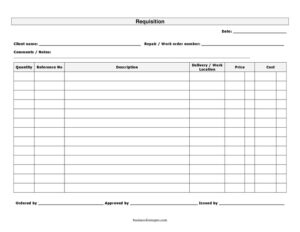
Requisition Form
Free requisition form template in PDF & DOCX. Learn what a requisition form is, how it differs from a purchase order, and how to fill one out today.
PDF
DOCX
5 downloads
0
likes
Download Files
- DOCX
A requisition form is an internal request to buy goods or services, used to get approval before an order is placed. It’s the first step in a controlled purchasing process. Download the free requisition form template below in PDF or DOCX. No signup or email required.
What Is a Requisition Form?
A requisition form is the document an employee or department uses to formally request a purchase from within their own organization. Rather than letting anyone order whatever they need directly, the requisition routes the request to whoever controls the budget for review and sign-off. If it’s approved, the purchasing team turns it into an actual order to a supplier. In other words, a requisition is an *internal* “please buy this” request, while the order that follows is the *external* commitment to the vendor. This simple step gives a business control over spending, a record of who asked for what, and a chance to catch duplicate or unnecessary purchases before any money is committed.
Requisition Form vs. Purchase Order
These two are closely linked but distinct, and understanding the difference makes both easier to use. A requisition is internal: it’s a request for permission to buy, circulated within the company. A purchase order (PO) is external: it’s the approved order sent to a supplier authorizing the purchase. The requisition comes first and triggers the approval; the PO comes after approval and commits the company to the vendor. Many organizations require a requisition before a PO can be raised, so the two together form a clean trail: request, approval, order. On smaller teams, a single requisition form may double as the order record.
When Do You Use a Requisition Form?
- Requesting supplies, materials, parts, or equipment from your purchasing team
- Getting budget approval before an order is placed with a supplier
- Ordering items tied to a specific job, repair, or work order
- Creating an audit trail of who requested a purchase and who approved it
- Preventing duplicate or unauthorized spending across departments
What a Requisition Form Includes
A complete requisition captures who is asking, what they need, and who signs off. The template above records the client or department name, a related repair or work-order number, and comments or notes explaining the request. Each line item lists the quantity, a reference number, and a description, along with the delivery or work location, the price, and the total cost. Finally, it documents the people involved — ordered by, approved by, and issued by — so accountability is clear at every step.
How to Fill Out a Requisition Form
- Enter the client or department name and any related repair or work-order number.
- Add comments or notes explaining why the items are needed.
- For each item, list the quantity, a reference number, and a clear description.
- Specify the delivery or work location where the items should go.
- Enter the price per item and the total cost so the approver can weigh the spend.
- Record who the request was ordered by, then route it for approval and note who issued it once it’s actioned.
Why Requisitions Matter for Spending Control
The requisition step exists to put a deliberate pause between “we need something” and “money has been spent.” That pause is where a business adds value: a manager can confirm the purchase fits the budget, catch a request that duplicates something already ordered, or question an item that isn’t really needed. It also creates accountability — every purchase can be traced back to the person who requested it and the person who approved it. For growing organizations, this control is what keeps spending from sprawling, and it’s why finance teams insist on a requisition before any significant order goes out.
Common Mistakes to Avoid
- Vague descriptions that lead to the wrong item being ordered
- Skipping the approval step, which defeats the purpose of the form
- Leaving out the price or cost, so the approver can’t judge the spend
- Not referencing the related job or work order, breaking the paper trail
- Treating a requisition as the final order rather than an internal request
Types of Requisitions
The same basic form appears under a few names depending on what’s being requested. A purchase requisition asks to buy goods or services from an outside supplier. A stock or material requisition requests items already held in a company’s own inventory or storeroom rather than buying new. A travel requisition seeks approval for trip costs before they’re incurred. And in fields like healthcare or laboratories, a requisition often means a request for specific tests or services. Whatever the label, the purpose is the same: a documented, approved request that controls spending and creates an audit trail before anything is ordered, issued, or carried out.
Frequently Asked Questions
What is a requisition form? It’s an internal request to buy goods or services, submitted for approval before an order is placed with a supplier.
What’s the difference between a requisition and a purchase order? A requisition is an internal request for permission to buy; a purchase order is the approved, external order sent to the supplier. The requisition comes first.
What is a purchase requisition form? It’s the same idea — an internal form requesting that a specific purchase be approved and ordered. “Purchase requisition” simply emphasizes that it’s for buying goods or services.
How do I fill out a requisition form? Enter the requesting department, describe the items with quantity and price, add the location and any work-order reference, then route it for approval. The template above includes each field.
What does a requisition form look like? A short internal form listing the requested items with quantities, descriptions, prices, and signature lines for who ordered, approved, and issued it — like the template above.
Who approves a requisition form? Usually a manager or budget owner reviews and signs off on the requisition before it becomes a purchase order. Larger purchases may require a second approval, depending on your company’s spending limits and policies.
How much does this template cost? It’s free to download in PDF and DOCX.
Related Forms
Purchase Order · Order Form · Stock Requisition Form · Supplies Requisition Form · Work Order
This template is provided for general informational purposes only and is not financial advice. Adapt it to your organization’s own purchasing and approval policies.
Related Forms
- Request A Raise
- Garage Repair Order
- Certified Copy of Resolution
- Specialty Item Form
- Request For Bank Statement
- Request To Terminate Unauthorized Service
Browse more in Request and Authorization.