
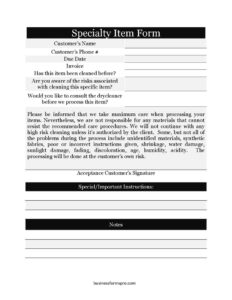
Specialty Item Form
Download a free Specialty Item Form template for dry cleaners to document customer consent and risk acknowledgment before processing delicate items.
PDF
DOCX
0
likes
Download Files
- DOCX
A Specialty Item Form is a short authorization document dry cleaners and garment-care businesses use to record a customer’s consent before cleaning a delicate, valuable, or high-risk item. People most often reach for it when an item could be damaged during cleaning and the business wants written acknowledgment of that risk. You can download this Specialty Item Form free in both PDF and DOCX formats, with no signup required.
What Is a Specialty Item Form?
A Specialty Item Form is a risk-acknowledgment and authorization sheet issued by a dry cleaner, laundry, or specialty garment-care provider to a customer dropping off a delicate or unusual item. It documents who the customer is, what is being cleaned, and—crucially—that the customer understands and accepts the possibility of damage to materials that may not survive the recommended care process. The form captures the customer’s answers to a few key questions, any special instructions, and a signature confirming acceptance. Its purpose is twofold: it informs the customer of genuine cleaning risks, and it creates a written record that the work was authorized despite those risks. It protects both parties by setting clear expectations before any processing begins.
When Do You Need a Specialty Item Form?
This form is most useful any time an item falls outside ordinary, routine cleaning. Common scenarios include:
- Vintage or heirloom garments where age, fabric weakness, or prior treatments make outcomes unpredictable.
- Items with unknown or unlabeled materials, where the care instructions are missing, faded, or appear incorrect.
- Wedding gowns, costumes, or formalwear with beading, sequins, or embellishments that may not withstand standard processing.
- Leather, suede, fur, or specialty fabrics that carry inherent risks of shrinkage, fading, or texture change.
- Items showing existing damage—stains, discoloration, or weakened fibers—that cleaning could worsen.
- High-value pieces where the customer wants to consult the cleaner first before authorizing any high-risk procedure.
In each case, the form converts a verbal conversation into a signed, dated record so there is no confusion later about what was discussed and agreed.
What a Specialty Item Form Should Have
A complete Specialty Item Form should clearly identify the customer and the transaction, present the relevant cleaning risks in plain language, and capture explicit consent. Essential elements include the customer’s name and phone number, a due date, and an invoice reference so the form ties to a specific order. It should include the key risk questions—whether the item has been cleaned before, whether the customer understands the risks, and whether they want to consult the cleaner first. A clear risk disclosure paragraph, a space for special instructions, a notes area, and a signature line for acceptance round out a valid, useful form. Together these make the authorization unambiguous.
How to Fill Out a Specialty Item Form
- Customer’s Name: Write the full name of the person dropping off the item, as it should appear on the order.
- Customer’s Phone #: Record a reachable number so the cleaner can call with questions or to confirm authorization.
- Due Date: Enter the agreed date the item is expected to be ready for pickup.
- Invoice: Add the invoice or order number so this form links directly to the transaction record.
- Has this item been cleaned before? Answer yes or no; prior cleaning history helps assess how the materials may react.
- Are you aware of the risks associated with cleaning this specific item? Confirm the customer has read or been told the risks before signing.
- Would you like to consult the drycleaner before we process this item? Indicate whether the customer wants a discussion before any high-risk step.
- Special/Important Instructions: Note any specific handling requests, spots to target, or areas to avoid.
- Notes: Use this space for observations such as existing stains or pre-existing damage.
- Customer’s Signature: Have the customer sign under Acceptance to authorize processing at their own risk.
Understanding the Risk Disclosure
The heart of this form is the disclosure stating that the business takes maximum care but is not responsible for materials that cannot resist the recommended care procedures. The form lists common problems that can arise during processing: unidentified materials, synthetic fabrics, poor or incorrect care instructions, shrinkage, water damage, sunlight damage, fading, discoloration, and effects of age, humidity, or acidity. By signing, the customer acknowledges that processing proceeds at their own risk. Importantly, the form also commits the cleaner to not continue with any high-risk cleaning unless the client authorizes it. This combination—full disclosure plus a consult option—keeps the customer in control of the decision and gives the business a clear paper trail.
Tips for Using This Form Effectively
Walk the customer through the disclosure verbally rather than letting them skim it. Point out the specific risks that apply to their item—for example, noting that a beaded gown may shed embellishments, or that an unlabeled jacket has unknown fibers. Photograph the item at intake and attach the photos to the form so the original condition is documented. If the customer chooses to consult before processing, log the outcome of that conversation in the Notes section. Keep the signed form with the order until the item is picked up and the transaction is fully closed.
Common Mistakes to Avoid
- Skipping the signature—without it under Acceptance, the authorization is incomplete and offers little protection.
- Leaving the invoice or due date blank, which makes it hard to tie the form to a specific order later.
- Not explaining the risks aloud and assuming the customer read the fine print.
- Ignoring the consult question—if the customer wants to be consulted, processing should pause until they respond.
- Failing to note existing damage in the Notes area, leading to disputes about whether cleaning caused it.
- Using vague special instructions instead of specific, actionable handling notes.
Frequently Asked Questions
What is a Specialty Item Form used for? It is used by dry cleaners and garment-care providers to document a customer’s consent before cleaning a delicate, valuable, or high-risk item. It records the customer’s details, the risks involved, and a signature confirming the work is authorized at the customer’s own risk.
How do I fill out a Specialty Item Form? Enter the customer’s name, phone number, due date, and invoice number, then answer the risk questions about prior cleaning, risk awareness, and whether a consultation is wanted. Add any special instructions and notes about the item’s condition, and have the customer sign under the Acceptance section.
Does this form need to be notarized or witnessed? No. A Specialty Item Form is a business intake and authorization document, not a legal instrument requiring notarization. A clear customer signature confirming acceptance is generally sufficient for this purpose.
Is a Specialty Item Form legally binding? A signed acknowledgment can serve as evidence that the customer was informed of the risks and authorized the work, but enforceability and the limits of liability waivers vary by location. For specific protection in your area, it is wise to confirm your terms with a qualified professional.
How much does this form cost? Nothing—this Specialty Item Form template is completely free to download here in PDF and DOCX formats, with no signup or payment required. You can edit the DOCX version to add your business name and logo.
What happens if the customer wants to consult before processing? If the customer marks that they want to consult the dry cleaner, you should pause and discuss the recommended approach and risks before doing any high-risk cleaning. Record the outcome of that conversation in the Notes section and proceed only once the customer authorizes it.
This Specialty Item Form template is provided as a general example for informational purposes only and is not legal advice. Liability disclosures and consumer-protection requirements vary by jurisdiction. Consult a qualified professional to ensure your forms meet the rules that apply to your business.
Related Forms
- Request For Birth Certificate
- FOIA Request
- Requisition Form
- Day Off Request Form
- Credit Card Authorization Form
- FOIA Request Appeal
Browse more in Request and Authorization.