
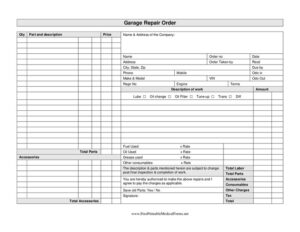
Garage Repair Order
Download a free Garage Repair Order form template in PDF and DOCX to document vehicle repairs, parts, labor, and customer authorization—free download.
PDF
DOCX
4 downloads
0
likes
Download Files
- DOCX
A Garage Repair Order is the document an auto repair shop uses to record the work requested on a vehicle, list the parts and labor involved, and capture the customer’s written authorization to proceed. It is most commonly used when a customer drops off a car for diagnosis or repair and the shop needs a signed agreement before starting billable work. You can download this Garage Repair Order template for free in both PDF and DOCX formats, with no signup required.
What Is a Garage Repair Order?
A Garage Repair Order is a combined work order and authorization form issued by an automotive garage, mechanic, or service center. It identifies the customer and vehicle, describes the work to be performed, itemizes the parts and labor that will be charged, and records the customer’s signature granting permission to carry out the repairs. Because it doubles as both a service record and an invoice framework, it protects the shop and the customer alike: the garage has documented consent to bill, and the customer has a clear, written summary of what was authorized, what parts were used, and what the total cost should be when the job is finished.
When Do You Need a Garage Repair Order?
Garages and independent mechanics rely on this form any time a vehicle enters the shop for billable service. Typical situations include:
- A customer brings in a car for a scheduled service such as an oil change, tune-up, or transmission flush and needs a written estimate.
- A vehicle arrives for diagnosis and the shop must list parts and labor before beginning repairs.
- A fleet or company vehicle requires documented authorization tied to a purchase or order number.
- A mechanic needs to record odometer readings in and out to verify mileage at the time of service.
- A customer asks whether old parts should be returned, requiring a clear yes/no record.
- The shop needs an itemized breakdown of labor, parts, consumables, and tax for the final bill.
What a Garage Repair Order Should Have
A complete repair order ties together three things: who the customer is, what vehicle is being worked on, and exactly what is being charged. That means full company or customer name and address, contact phone and mobile numbers, an order number, and a due-by date. It must also describe the vehicle in detail—make and model, VIN, registration number, and engine—and include odometer readings in and out. The cost section should separate the description of work, parts and their quantities and prices, labor at a stated rate, consumables such as oil and grease, accessories, other charges, tax, and a grand total. Finally, it must carry the authorization statement and the customer’s signature.
How to Fill Out a Garage Repair Order
- Enter the name & address of the company or customer, along with phone and mobile numbers, and assign an order no.
- Record the due by date so the customer knows when to expect the vehicle.
- Fill in the vehicle details: make & model, VIN, regn no, and engine.
- Note odo in when the car arrives and odo out when it leaves.
- Write the description of work and any agreed terms.
- List each part by qty, part and description, and price.
- Check off services performed—lube, oil change, oil filter, tune-up, trans, diff—and record their amount.
- Enter fuel used, oil used, grease used, and other consumables.
- Apply the labor x Rate and total it as total labor, then sum total parts, accessories, consumables, and other charges.
- Add tax to reach the total, mark Save old Parts: Yes/No, and have the customer sign.
Understanding the Authorization Statement
The line on this form reading “You are hereby authorized to make the above repairs and I agree to pay the charges as applicable” is the legal heart of the document. By signing beneath it, the customer acknowledges that they have reviewed the listed work and accept responsibility for the resulting charges. The accompanying note that the “description & parts mentioned herein are subject to change post final inspection & completion of work” tells the customer that the figures shown are an estimate and may be adjusted once the technician opens up the vehicle and discovers the true scope of the job. Many shops treat the initial signature as authorization for the estimated work and obtain a second approval—by phone, text, or signature—if the cost rises significantly beyond what was first quoted. Keeping a clean record of both the original estimate and any approved changes prevents billing disputes later.
Tips for Itemizing Parts, Labor, and Consumables
Accuracy in the cost breakdown is what makes a repair order trustworthy. Always log parts with quantity and unit price so a customer can verify each line, and separate the labor calculation (hours multiplied by the hourly rate) from parts so it is clear what is being charged for time versus materials. Consumables—oil, grease, fuel, shop supplies—are easy to overlook but add up; tracking them under their own headings keeps the math transparent. Recording odometer readings in and out also helps document the vehicle’s condition at service and is useful for warranty or maintenance history. The “Save old Parts” choice matters more than it seems: some customers want replaced parts returned for inspection, and recording their preference avoids misunderstandings at pickup.
Common Mistakes to Avoid
- Starting repairs before the customer signs the authorization line—doing so can make charges difficult to collect.
- Leaving the VIN, registration, or odometer fields blank, which weakens the record for warranty and history purposes.
- Bundling parts and labor into a single figure instead of itemizing each line.
- Forgetting to update the estimate or get fresh approval when the actual cost exceeds the quoted amount.
- Omitting consumables, accessories, or tax so the total fails to match the final invoice.
- Not recording the customer’s “Save old Parts” choice, leading to disputes when replaced parts are discarded.
Frequently Asked Questions
What is a Garage Repair Order used for? It is used to document the repairs a customer authorizes on their vehicle, itemize the parts, labor, and consumables involved, and record the customer’s signed consent to pay. It serves as both a work order for the shop and a written agreement for the customer, and it forms the basis of the final invoice.
How do I fill out a Garage Repair Order? Start with the customer and vehicle details, including name, address, phone, VIN, make and model, and odometer in. Then list the description of work, each part with quantity and price, the labor rate, consumables, and any other charges before adding tax to reach the total. Finally, mark the “Save old Parts” choice and have the customer sign the authorization line.
Does a repair order need to be signed? Yes—the customer’s signature beneath the authorization statement is what gives the shop permission to perform the listed work and bill for it. Without a signature, collecting payment can become difficult and the order may simply read as an unauthorized estimate. It is best practice to obtain the signature before any billable work begins.
Is a Garage Repair Order legally binding? Once signed, it generally functions as a binding agreement in which the customer accepts responsibility for the authorized charges. Its enforceability depends on local consumer-protection rules, which often require shops to provide written estimates and to obtain approval for charges above the quote. Requirements vary by jurisdiction, so check the rules that apply to your area.
What does “subject to change post final inspection” mean? It means the parts and prices on the order are an estimate based on the initial assessment and may be adjusted once the technician fully inspects or disassembles the vehicle. If the actual work or cost differs significantly, most shops contact the customer for additional approval before continuing. This clause protects both parties from disputes over unexpected charges.
Is this Garage Repair Order template free to download? Yes. You can download this Garage Repair Order template for free in both PDF and DOCX formats with no signup required. The DOCX version is fully editable so you can add your shop’s logo, adjust labor rates, and customize the cost categories to match your business.
This Garage Repair Order template is a general example provided for informational purposes only and does not constitute legal, financial, or tax advice. Automotive repair and consumer-protection requirements vary by jurisdiction, so consult a qualified professional to ensure your forms and practices comply with the rules that apply to your business.
Related Forms
- Appointment of Proxy
- Revocation of Power of Attorney
- Repair Under Warranty Request
- Estimate Of Auto Repairs
- FOIA Request
- Work Order
Browse more in Request and Authorization.