
Revocation of Power of Attorney
Cancel a power of attorney with this free Revocation of Power of Attorney template, available as a free download in PDF and DOCX with notary line.
PDF
DOCX
4 downloads
0
likes
Download Files
- DOCX
A Revocation of Power of Attorney is a written document used to cancel a power of attorney you previously granted, formally ending an agent’s authority to act on your behalf. People most often use it when they no longer trust the agent, no longer need the arrangement, or want to name someone new. You can download this template for free in PDF and DOCX, with no signup required.
What Is a Revocation of Power of Attorney?
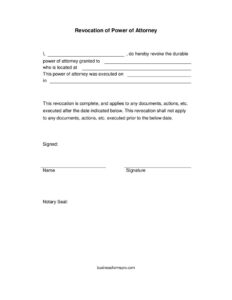
A Revocation of Power of Attorney is a statement signed by the original grantor (the “principal”) that withdraws the authority once given to an agent (the “attorney-in-fact”). The earlier power of attorney let someone make financial, legal, medical, or business decisions for you; this document formally takes that authority back. Once properly executed and delivered, the agent can no longer act in your name. This particular template makes the cancellation complete, applying to any documents or actions executed after the date indicated, while leaving valid anything the agent did beforehand. It provides signature lines and a notary seal section so the revocation can be witnessed and authenticated.
When Do You Need a Revocation of Power of Attorney?
There are many situations where ending a previously granted power of attorney becomes necessary. Common scenarios include:
- You no longer trust the agent to handle your finances, property, or affairs responsibly.
- The reason for the power of attorney has ended — for example, you recovered from an illness or returned from overseas.
- You want to appoint a different person and need to cancel the old authorization first to avoid two active agents.
- A relationship has changed, such as a divorce, business split, or estrangement, and the agent should no longer act for you.
- The agent has moved away, become unavailable, passed away, or is no longer capable of serving.
- You simply prefer to manage your own affairs again and want the existing arrangement on record as cancelled.
What a Revocation of Power of Attorney Should Have
To be effective, a revocation should clearly identify the principal who is cancelling the authority and reference the original power of attorney being revoked. It should state plainly that the prior authority is withdrawn and specify the effective date so there is no confusion about timing. This template states that the revocation is complete and applies to documents and actions executed after the indicated date, while preserving the validity of anything done before that date. Finally, it should be signed by the principal and, where required or advisable, notarized — which is why the form includes a notary seal section to authenticate the signature.
How to Fill Out a Revocation of Power of Attorney
- Read the opening statement confirming the revocation is complete and applies to documents and actions executed after the date below — and not to anything done before that date.
- Identify, in your records and ideally in writing, the original power of attorney you are revoking, including the agent’s name and the date it was signed.
- Enter the effective date of the revocation in the space indicated, since the document distinguishes actions before and after this date.
- Sign on the first signature line as the principal. The second signature line can be used by a witness or a second signer if your situation requires one.
- Sign in front of a notary public so the notary can complete the Notary Seal section, verifying your identity and signature.
- Keep the original and distribute copies to the former agent and any institutions that relied on the old power of attorney.
Notarization and Delivering Notice
Notarization matters because the original power of attorney was often notarized, and banks, title companies, and other institutions usually expect a revocation to carry the same level of formality. The notary seal section on this template gives space for that authentication. Beyond signing, the revocation only works in practice when the right people know about it. Deliver a copy to the former agent so they understand their authority has ended, and notify every bank, brokerage, insurer, government office, or business that may have a copy of the original power of attorney on file. Until those parties receive notice, they may continue honoring the old document in good faith.
How It Differs From Letting a Power of Attorney Expire
Some powers of attorney end on their own — for example, when a stated expiration date passes, when a specific task is finished, or in some cases upon the principal’s death. A revocation is different: it actively cancels authority before any natural endpoint and creates a dated written record of that cancellation. This is important when there is no built-in expiration, when the agent might otherwise keep acting, or when you simply want documented proof of the date you withdrew the authority. The revocation does not undo valid actions the agent already took; it stops future actions from the effective date forward.
Common Mistakes to Avoid
- Failing to notify the former agent, leaving them unaware their authority has ended.
- Forgetting to inform banks, title companies, and other institutions that hold the original power of attorney.
- Leaving the effective date blank, which creates confusion about which actions are covered.
- Not notarizing the revocation when the original document was notarized or when an institution requires it.
- Assuming a verbal statement is enough — a written, signed, dated document is far more reliable.
- Discarding the original power of attorney without keeping a copy of both it and the revocation for your records.
Frequently Asked Questions
What is a Revocation of Power of Attorney? It is a signed document in which the principal cancels a power of attorney they previously granted, ending the agent’s authority to act on their behalf. This template makes the revocation complete for any documents or actions executed after the stated date.
Does a Revocation of Power of Attorney need to be notarized? Requirements vary by jurisdiction, but notarization is strongly recommended — especially if the original power of attorney was notarized. This template includes a notary seal section so the document can be authenticated, which most banks and institutions prefer.
How do I make the revocation effective? Sign and date the document, have it notarized if required, and then deliver copies to the former agent and to any institution that may rely on the original power of attorney. The cancellation only takes practical effect once those parties have notice of it.
Does revoking cancel actions the agent already took? No. This template specifically states that the revocation applies only to documents and actions executed after the indicated date and does not affect anything the agent validly did before that date.
Is this Revocation of Power of Attorney legally binding? When properly completed, signed, dated, notarized where required, and delivered to the relevant parties, a revocation is generally effective. Because rules differ by state and situation, confirm the specific requirements that apply to you.
How much does this template cost? Nothing — this Revocation of Power of Attorney template is completely free to download in PDF and DOCX, with no signup required, so you can complete it and have it notarized at your convenience.
This template is a general example provided for informational purposes only and is not legal advice. Laws and requirements for revoking a power of attorney vary by jurisdiction, and individual circumstances differ. Consult a qualified attorney to confirm your revocation is valid and properly delivered.
Related Forms
- Product Replacement Request
- Grant Request
- Request For Bank Statement
- Garage Repair Order
- Appointment of Proxy
- Damage Claim
Browse more in Request and Authorization.