
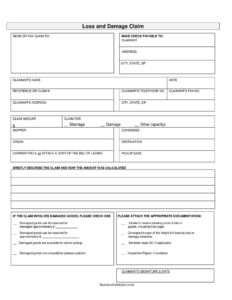
Damage Claim
Use our free Damage Claim form template to file a loss or damage claim with a carrier for shorted, damaged, or missing freight. Free PDF & DOCX download.
PDF
DOCX
6 downloads
0
likes
Download Files
- DOCX
A Damage Claim form is the document you submit to a freight carrier to recover the value of goods that were lost, shorted, or damaged during shipment. It is the standard tool businesses and individuals use to formally request reimbursement after a delivery arrives broken, incomplete, or not at all. You can download this Damage Claim template free in PDF and DOCX formats, with no signup required.
What Is a Damage Claim Form?
A Damage Claim form is a written request submitted by a claimant (usually the shipper or consignee) to the carrier responsible for transporting goods. It documents what was lost or damaged, the dollar value being claimed, and the shipment details that tie the claim to a specific delivery. Carriers, freight brokers, and logistics departments use the form to open and evaluate a claim file. Because the document names the parties, references the shipment by carrier pro number, and itemizes the amount requested, it serves as the official record that triggers the carrier’s investigation and, ultimately, a payment decision or denial.
When Do You Need a Damage Claim Form?
You’ll reach for this form any time freight does not arrive in the condition and quantity it left in. Common situations include:
- A pallet arrives crushed, water-stained, or with visibly broken product inside the cartons.
- The consignee counts fewer pieces than the bill of lading lists — a shortage claim.
- Goods are completely missing and never delivered, even though the carrier shows them as picked up.
- Sensitive equipment or electronics show concealed damage discovered only after unpacking.
- A temperature-controlled or fragile load is compromised and must be repaired or replaced.
- Any “other” loss situation, such as a load delivered to the wrong destination and returned damaged.
In each case, filing promptly with proper documentation gives you the best chance of recovering the claim amount from the carrier.
What a Damage Claim Form Should Have
A complete Damage Claim includes the parties and the money: where to send or fax the claim, who the check should be made payable to, and the full claimant name and address. It must reference the shipment with a reference or claim number, the carrier pro number, the pickup date, the shipper and origin, and the consignee and destination. It states the claim amount and the reason — shortage, damage, or other. A strong claim also includes a clear narrative explaining how the amount was calculated, the disposition of any damaged goods, and supporting documentation such as the vendor’s invoice, the freight bill, repair bills, and any inspection report.
How to Fill Out a Damage Claim Form
- Enter the carrier address where the claim should be sent or faxed, and the name to make the check payable to.
- Fill in the claimant name and full address — street, city, state, and zip.
- Add your reference or claim number so both parties can track the file.
- State the claim amount in dollars, then check the reason: shortage, damage, or other.
- Identify the shipment: shipper and origin, consignee and destination, the carrier pro number, and the pickup date.
- In the description box, briefly explain what happened and exactly how you calculated the amount.
- If goods are damaged, check one option: replaceable for approximately a stated amount, repairable for a stated amount, available for carrier pickup, or unavailable (and explain why).
- Attach the appropriate documentation — vendor’s invoice, freight bill with notations, itemized repair bill, and inspection report.
- Sign and date the form as claimant to certify the claim.
Understanding the Three Claim Types
This form lets you classify the loss as a shortage, damage, or other, and the distinction matters for how the carrier investigates. A shortage means fewer pieces arrived than were tendered — the carrier compares your piece count against the freight bill. Damage means the goods arrived but are no longer in sellable or usable condition; this is where the replace, repair, pickup, or unavailable checkboxes come into play. “Other” covers everything else, such as spoilage, delay-related loss, or misdelivery. Choosing the correct category and matching it to your supporting documents helps the adjuster route and resolve your claim faster.
Documentation That Strengthens Your Claim
Carriers rarely pay a claim on the narrative alone. The vendor’s invoice proves the actual value of the lost or damaged goods, so include the final page that shows totals. The consignee’s copy of the freight bill should bear the loss or damage notation made at delivery — that contemporaneous note is powerful evidence the damage happened in transit. An itemized repair bill supports a repair-cost claim, and an inspection report from the carrier or a third party documents the extent of the damage. Photographs of the damaged packaging and product, while not a listed field, are almost always worth attaching as well.
Common Mistakes to Avoid
- Leaving the carrier pro number or pickup date blank, which makes it hard for the carrier to locate the shipment.
- Stating a claim amount without explaining how it was calculated in the description box.
- Failing to note damage on the delivery receipt at the time of delivery.
- Checking “damaged goods available for carrier pickup” and then disposing of the goods before inspection.
- Submitting the form without the vendor’s invoice or freight bill, leaving the value unsupported.
- Forgetting to sign and date the form, which can stall or void the claim.
Frequently Asked Questions
What is a Damage Claim form used for? It is used to formally request reimbursement from a freight carrier for goods that were lost, shorted, or damaged during transit. The form documents the shipment, the parties, the amount claimed, and the supporting evidence so the carrier can open and evaluate a claim file.
How do I calculate the claim amount? Base the amount on the actual value of the lost or damaged goods, typically supported by the vendor’s invoice. For damaged items, you may claim the replacement cost or the repair cost as indicated by the checkboxes, and you should explain the calculation in the description section.
What documents should I attach? Attach the vendor’s invoice showing the price of the goods (including the final page), the consignee’s freight bill copy bearing the loss or damage notation, an itemized repair bill if applicable, and an inspection report if one is available. Photos of the damage are also helpful.
Does a Damage Claim form need to be notarized? No, this form does not generally require notarization. It does require the claimant’s signature and date to certify the claim, and carriers may have their own filing requirements you should confirm before submitting.
Is there a deadline to file a damage claim? Yes — carriers and applicable shipping regulations typically impose time limits for filing freight claims, often counted from the delivery date. Check your carrier’s tariff, the bill of lading terms, and any governing rules, and file as soon as possible.
Is this Damage Claim template free to download? Yes. You can download this Damage Claim form free in both PDF and DOCX formats with no signup required, fill it in by hand or on your computer, and submit it to the responsible carrier.
This Damage Claim template is provided as a general example for informational purposes only and is not legal, financial, or tax advice. Freight claim rules, deadlines, and carrier requirements vary by jurisdiction and by carrier. Consult a qualified professional or review your carrier’s specific procedures before filing.
Related Forms
- Specialty Item Form
- Household Items Release Form
- Grant Request
- Limited Power of Attorney
- Request For Bank Credit Reference
- Requisition Form
Browse more in Request and Authorization.