
Grant Request
Download a free Grant Request letter template in PDF and DOCX to introduce your grant application and make a compelling case for funding, no signup required.
DOCX
5 downloads
0
likes
Download Files
- DOCX
A Grant Request is a short, persuasive cover letter that introduces your formal grant application to a foundation, agency, or funding program. People most often use it to put a human face on the paperwork and briefly explain why their project deserves support. You can download this Grant Request template free in both PDF and DOCX formats, with no signup required.
What Is a Grant Request?
A Grant Request is a written letter sent by an applicant—an individual, nonprofit, school, researcher, or community group—to a grant-making organization to ask for funding. It typically accompanies a more detailed grant application, summarizing the purpose of the request in a few clear paragraphs. Rather than restating every detail of the full proposal, the letter gives the reader a quick, compelling overview: who you are, what you need funding for, and why the project fits the funder’s mission. It serves as a courteous introduction, a roadmap to the attached materials, and an invitation to follow up with questions. A well-written request can determine whether a reviewer reads the full application with interest.
When Do You Need a Grant Request?
This letter is useful any time you are formally asking an organization to fund a project, program, or need. Common situations include:
- Nonprofit program funding — when a charity seeks money to launch or expand a community service, scholarship fund, or outreach effort.
- Research or academic grants — when a researcher or department requests support for a study, equipment, or fieldwork.
- Arts and cultural projects — when an artist, theater, or museum applies for funding from an arts council or private foundation.
- Small business or startup grants — when an entrepreneur pursues a grant program aimed at job creation, innovation, or underserved communities.
- Capital and equipment needs — when an organization requests funds for a building, renovation, vehicle, or major purchase.
- Educational and youth initiatives — when a school, club, or after-school program seeks money for supplies, trips, or programming.
What a Grant Request Should Have
An effective Grant Request stays brief while covering the essentials. It should clearly identify the sender and the funding organization, open with a direct statement of what you are requesting, and offer a short, specific explanation of the project and its impact. It should reference the attached full application, connect your need to the funder’s stated priorities, and close with a polite invitation to discuss the request further. Tone matters: the letter should be confident but respectful, free of jargon, and easy to skim. Accuracy in names, dates, and contact details signals professionalism. Above all, the letter should make the reader want to open the attached application.
How to Fill Out a Grant Request
Follow these steps to complete the template using the fields provided:
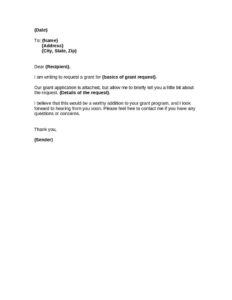
- Date: Enter the date you are sending the letter so the funder can track it against deadlines.
- To / Name: Write the name of the contact person or grant officer who reviews applications, if known.
- Address and City, State, Zip: Add the funding organization’s full mailing address for a complete, formal record.
- Dear {Recipient}: Open with a proper salutation, addressing the named contact or the appropriate department or committee.
- Basics of grant request: In one sentence, state plainly what you are asking for—for example, funding for a literacy program or a research project.
- Details of the request: Use this section to briefly describe your organization, the problem you address, the project’s goals, and why it fits the funder’s mission. Keep it concise and concrete.
- Closing and Sender: Reaffirm your interest, invite questions, and sign with your name. Add your title, organization, phone, and email below your signature.
Tips for Writing a Persuasive Request
Reviewers read many letters, so clarity and relevance win attention. Research the funder before you write and tailor your language to its published priorities—mirror the outcomes it cares about. Lead with the most compelling point rather than burying it, and use specific numbers where you can (people served, hours of programming, measurable results) without inventing figures. Keep the letter to a single page; the full application carries the detail. Proofread carefully, because a misspelled contact name or wrong organization title undermines credibility. Finally, make it easy for the funder to act by stating clearly what you are requesting and how to reach you.
How It Differs From the Full Application
It helps to understand where this letter ends and the application begins. The Grant Request is a cover letter—a short, human introduction. The full application is the detailed package containing budgets, timelines, organizational background, supporting documents, and required forms. Think of the letter as the handshake and the application as the substance behind it. Many funders specify exactly what the application must include, so always read the program guidelines and follow their formatting and submission instructions precisely. Your letter should point the reader toward those attached materials, not duplicate them.
Common Mistakes to Avoid
- Being too vague: Failing to state clearly and early exactly what you are requesting leaves reviewers guessing.
- Ignoring the funder’s priorities: Sending a generic letter that does not connect your project to the program’s mission weakens your case.
- Writing too much: Overloading the cover letter with detail that belongs in the application makes it hard to read.
- Incorrect recipient details: Misspelling the contact’s name or addressing the wrong organization signals carelessness.
- Forgetting the attachment reference: Not mentioning the enclosed application can leave the reader unsure where to find specifics.
- Missing contact information: Leaving out a phone number or email makes it harder for the funder to follow up.
Frequently Asked Questions
What is a Grant Request letter? It is a brief cover letter that introduces your grant application to a funding organization. It summarizes what you are asking for and why your project deserves support. It accompanies, rather than replaces, the detailed application.
How do I fill out a Grant Request? Start by adding the date and the funder’s name and address, then write a salutation to the contact person. State your request in one clear sentence, briefly describe the project and its impact, and close by inviting questions and signing your name. Reference your attached full application so the reader knows where to find details.
How long should the letter be? Keep it to a single page whenever possible. A few focused paragraphs are enough to introduce yourself, state the request, and point to the full application. Reviewers appreciate brevity and clarity.
Does a Grant Request need to be notarized or witnessed? No. A grant request is a business correspondence, not a legal contract, so it generally does not require notarization or witnesses. Always follow the specific submission instructions provided by the funding organization.
Is a Grant Request legally binding? By itself, the letter is simply a request and does not create a binding obligation. Any commitments take effect through a separate grant agreement or award letter issued by the funder. Review those documents carefully before accepting funds.
How much does this template cost? Nothing—this Grant Request template is completely free to download in PDF and DOCX formats, with no signup required. You can edit it freely to match your project, funder, and program guidelines.
This template is a general example provided for informational purposes only and is not legal, financial, or tax advice. Grant program requirements vary by funder and jurisdiction, so review the specific application guidelines and consult a qualified professional before submitting your request.
Related Forms
- Request For Bank Statement
- Company Request Rejection
- Bank Account Closure Authorization
- Credit Card Authorization Form
- Estimate Of Auto Repairs
- Service Call Book
Browse more in Request and Authorization.