
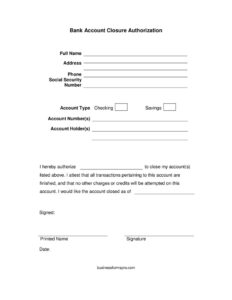
Bank Account Closure Authorization
Download a free Bank Account Closure Authorization template in PDF and DOCX to formally request your bank close an account quickly and clearly.
PDF
DOCX
4 downloads
0
likes
Download Files
- DOCX
A Bank Account Closure Authorization is a written request that instructs your bank to permanently close one or more accounts you hold. People most often use it to formally end a checking, savings, or money market account they no longer need while leaving a clear paper trail. You can download this template free in both PDF and DOCX formats — no signup or payment required.
What Is a Bank Account Closure Authorization?
A Bank Account Closure Authorization is a signed document submitted by an account holder directing a financial institution to close a specified account or accounts. It identifies the customer, lists the account number(s) and account type, and includes a statement authorizing the bank to proceed with closure on a chosen date. The form also confirms that the account holder has no outstanding transactions and that no further charges or credits should be attempted. Banks rely on this written instruction to verify your identity and intent before they shut down access, transfer remaining balances, and stop issuing statements. It serves as documented proof that you, and not someone else, requested the closure.
When Do You Need a Bank Account Closure Authorization?
This form is useful in many everyday banking situations where a verbal request is not enough or where you want documentation. Common scenarios include:
- You are switching banks and want to close an old checking or savings account after moving your direct deposits and automatic payments.
- You opened a secondary account for a specific purpose — a vacation fund, a project, or a short-term goal — and no longer need it.
- You are consolidating multiple accounts into one to simplify your finances and reduce monthly fees.
- A joint account holder relationship has ended and both parties agree to close the shared account.
- You are closing a business or hobby-related account and need a record for your bookkeeping.
- You are handling the affairs of a family member or estate and need to close accounts as part of settling matters.
What a Bank Account Closure Authorization Should Have
For a bank to act on your request, the document needs enough detail to confirm your identity and pinpoint the exact account. A complete authorization should include your full legal name as it appears on the account, your current address, and a phone number where the bank can reach you. It should list the account type, the specific account number or numbers to be closed, and the name(s) of all account holders. Critically, it must contain a clear authorization statement directing the named bank to close the account, an attestation that all transactions are finished, the requested closure date, and your signature with the date signed. Without a signature, most banks will not process the request.
How to Fill Out a Bank Account Closure Authorization
- Full name: Enter your name exactly as it appears on the bank’s records to avoid identity mismatches.
- Address: Provide your current mailing address so the bank can send a confirmation letter or any remaining balance by check.
- Phone: Add a daytime phone number in case the bank needs to verify the request.
- Social Security Number: Supply your SSN if the bank uses it to confirm identity; only include it on a form you are submitting securely.
- Account type: Specify whether the account is checking, savings, money market, or another type.
- Account number(s): Write the full account number, or list each number if you are closing more than one account.
- Account holder(s): List every person named on the account, since joint accounts may require all signatures.
- Bank name: Fill in the financial institution’s name in the authorization sentence.
- Closure date: Enter the date you want the account closed in the blank provided.
- Signature and date: Sign and date the form to make the authorization valid.
Before You Submit: Clear the Account First
The attestation line states that all transactions are finished and that no further charges or credits will be attempted, so it is worth confirming this is actually true before you sign. Move or withdraw any remaining balance, or ask the bank how it will return funds. Cancel or redirect any direct deposits — paychecks, benefits, refunds — and any automatic payments such as subscriptions, utilities, loan payments, and card autopays. Allow any pending or recently posted transactions to fully clear. Destroy unused checks and debit cards after closure is confirmed. Taking these steps prevents bounced payments, overdraft fees, and the awkward situation of a closed account being reopened to process a stray transaction.
How to Submit and What Happens Next
Banks accept closure requests in different ways: in person at a branch, by mail, through secure online messaging, or sometimes by fax. Ask your bank which method it prefers and whether it requires the original signed form or a scanned copy. Because this document contains sensitive information like your account number and Social Security Number, avoid sending it over unsecured email. After the bank processes your request, ask for written confirmation that the account is closed and request a final statement showing a zero balance. Keep a copy of the signed authorization and the confirmation for your records in case any disputes or stray transactions arise later.
Common Mistakes to Avoid
- Submitting the form while automatic payments or direct deposits are still routed to the account, which can cause failed transactions and fees.
- Leaving a balance in the account without telling the bank how you want the remaining funds returned.
- Forgetting to collect signatures from all named holders on a joint account.
- Writing an incomplete or incorrect account number, which delays processing.
- Not requesting written confirmation, so you have no proof the account was actually closed.
- Continuing to use the linked debit card or checks during the days before the closure date takes effect.
Frequently Asked Questions
What is a Bank Account Closure Authorization used for? It is a signed written instruction that tells your bank to permanently close one or more of your accounts. It documents your identity, the specific account numbers, and your intent so the bank can act with confidence. It also creates a record you can refer back to if questions arise later.
Do I need to notarize a bank account closure form? Most banks do not require notarization for a routine account closure; a signature that matches their records is usually enough. Some institutions may ask for in-branch identity verification instead. Check with your specific bank, since requirements vary between institutions.
Does a joint account need both holders to sign? Many banks require every account holder listed on a joint account to authorize the closure. That is why the form includes an account holder(s) field. Confirm your bank’s policy, because some accounts allow any single holder to close them while others require all signatures.
Is this closure authorization legally binding? When completed accurately and signed, the form serves as your formal authorization for the bank to act. The actual closure follows the bank’s own procedures and account agreement. It is binding as a request, but the bank still verifies the details before processing.
How much does this template cost? Nothing — this Bank Account Closure Authorization template is completely free to download in PDF and DOCX formats. There is no signup, subscription, or hidden fee. You can edit the DOCX version to match your bank’s specific requirements.
What should I do after the account is closed? Request written confirmation and a final statement showing a zero balance, then destroy any unused checks and debit cards tied to the account. Keep a copy of the signed authorization and confirmation in your records. Monitor for any stray transactions for a few weeks afterward.
This template is a general example provided for informational purposes only and is not legal, financial, or tax advice. Bank procedures and requirements vary by institution and jurisdiction. Consult your bank and a qualified professional for guidance specific to your situation.
Related Forms
- Shareholder Ballot
- Limited Power of Attorney
- Garage Repair Order
- Request to be Removed From Mailing List
- Request For Death Certificate
- Payroll Deduction Authorization
Browse more in Request and Authorization.