
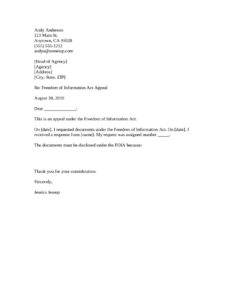
FOIA Request Appeal
Use this free FOIA Request Appeal letter template to challenge a denied Freedom of Information Act request, with a free download in PDF and DOCX.
DOCX
0
likes
Download Files
- DOCX
A FOIA Request Appeal is a formal letter you send to a federal agency to challenge a denial, partial release, or inadequate response to a Freedom of Information Act request. People most often use it after an agency withholds records, redacts too much, or claims no documents exist. This template is free to download in PDF and DOCX with no signup required.
What Is a FOIA Request Appeal?
A FOIA Request Appeal is a written objection submitted to a federal agency asking it to reconsider an unfavorable decision on a prior Freedom of Information Act request. It is typically addressed to the head of the agency or a designated appeals office and references the original request by tracking number, date, and the agency’s response. The letter explains why the requester believes the records should be released and asks the agency to overturn or modify its earlier decision. It is an administrative step that usually must be exhausted before a requester can take the matter to court, and most agencies set a deadline for filing it after the initial denial.
When Do You Need a FOIA Request Appeal?
- An agency denied your FOIA request in full and you believe the records are public.
- You received a partial release with heavy redactions you think are overbroad.
- The agency claimed it found no responsive records but you have reason to believe documents exist.
- Your fee waiver or expedited-processing request was rejected.
- The agency missed its statutory response deadline and effectively constructively denied your request.
- You want to preserve your right to pursue the matter in federal court later, which generally requires exhausting administrative appeals first.
What a FOIA Request Appeal Should Have
A complete appeal clearly identifies the original request and states a focused argument for disclosure. At minimum it should include your full contact information, the agency and recipient, the date of the original request, the date and author of the agency’s response, and the assigned request number so the agency can locate the file. The heart of the letter is your reasoning: a concise explanation of why the withheld documents must be disclosed under FOIA. Closing the letter with a polite thank-you and your signature keeps the tone professional and cooperative, which can help your case.
How to Fill Out a FOIA Request Appeal
- At the top, enter your name and full address (e.g., Andy Anderson, 123 Main St., Anytown, CA 95928), along with your phone number and email so the agency can reach you.
- Add the recipient block: the [Head of Agency] or appeals officer, the [Agency] name, and the complete [Address], [City, State, ZIP].
- Keep the Re: line as “Freedom of Information Act Appeal” and insert the current date.
- In the salutation (Dear ______________:), name the official or office handling appeals; if unknown, use a title.
- State that this is an appeal, then fill in the [date] you submitted your original request and the [date] and [name] of the person who responded.
- Enter your assigned request number on the blank provided.
- Complete the line “The documents must be disclosed under the FOIA because:” with your specific argument.
- Sign with your name and keep a dated copy for your records.
Writing a Persuasive Argument
The most important part of the appeal is the reasoning that follows “The documents must be disclosed under the FOIA because.” Be specific and factual rather than emotional. If the agency cited an exemption, explain why it does not apply to your records or why the public interest in disclosure outweighs the withholding. If the agency said no records exist, describe why you believe a reasonable search would locate them and ask the agency to broaden its search terms or locations. For overbroad redactions, request that the agency release all reasonably segregable portions of each document. Keep your points organized, reference the agency’s own language where helpful, and avoid speculation you cannot support.
Filing and Deadlines
Agencies generally set a window for filing an appeal after the date of the denial letter, so check the original response for the deadline and the correct mailing or email address for appeals. Send the appeal to the office the agency designates, not necessarily the same office that handled the request. Many requesters mark the envelope or subject line with “Freedom of Information Act Appeal” to ensure proper routing. Keep proof of the date you sent it, and retain copies of your original request, the agency’s response, and this appeal. If the appeal is denied or ignored, you may then have the option to seek review in federal court, which is why timely, well-documented filing matters.
Common Mistakes to Avoid
- Omitting the original request number or response date, which slows the agency’s ability to find your file.
- Missing the agency’s appeal deadline listed in the denial letter.
- Sending the appeal to the wrong office instead of the designated appeals authority.
- Writing a vague argument instead of explaining specifically why the records should be released.
- Forgetting to keep dated copies and proof of submission for your records.
- Using an aggressive or accusatory tone rather than a clear, professional explanation.
Frequently Asked Questions
What is a FOIA Request Appeal? It is a formal letter asking a federal agency to reconsider its denial, partial release, or other unfavorable decision on a Freedom of Information Act request. The appeal references your original request and explains why the records should be disclosed. It is typically an administrative step handled within the agency.
How do I fill out the FOIA Request Appeal template? Add your contact details at the top, the agency and recipient information, and the dates and request number from your original FOIA request and the agency’s response. Then write a focused explanation of why the documents must be disclosed under FOIA. Sign, date, and keep a copy before sending it to the agency’s appeals office.
Is there a deadline to file an appeal? Agencies generally specify a time limit for appeals in their denial letters, so check that letter carefully. Filing within the stated window helps preserve your rights, including any later option to seek review in federal court. Because the timeframe varies, confirm the exact deadline with the responding agency.
Does a FOIA Request Appeal need to be notarized? No, a FOIA appeal does not typically require notarization or witnesses. It is a written administrative request, so your signature and accurate identifying information are usually sufficient. Always follow any specific submission instructions the agency provides in its response.
Can I appeal if the agency says no records exist? Yes. You can appeal a “no records” determination by explaining why you believe responsive documents should exist and asking the agency to conduct a broader or more thorough search. Suggesting additional search terms, dates, or offices can support your request.
Is this FOIA Request Appeal template free? Yes, this template is completely free to download in PDF and DOCX with no signup required. You can edit it to match your situation, the agency involved, and the specific records you are seeking. Save a copy for your records each time you send an appeal.
This template is a general example provided for informational purposes only and is not legal advice. FOIA procedures, exemptions, and deadlines vary by agency and may change over time. Consult the relevant agency’s guidance or a qualified attorney for advice about your specific situation.
Related Forms
- Suede Leather Items Release Form
- Work Order
- FOIA Request
- Estimate Of Auto Repairs
- Reservation Request Letter
- Transcript Request
Browse more in Request and Authorization.